
Learn about AI for accountingJoin live workshops

Ask the support agent

Just ask a direct question or search related articles from the Knowledge Base.

Support Center / Workpaper Agent / Journal Entries

Prepare, review, and post journal entries to Sage Intacct

Prepare journal entries from your workpaper, review mappings and balances, and post to Sage Intacct. Follow Steps 1–5 for the main workflow; Steps 6–10 cover optional fixes, and Steps 11–12 are recommended checks.

Workflow

Step 1

Prepare your journal entries

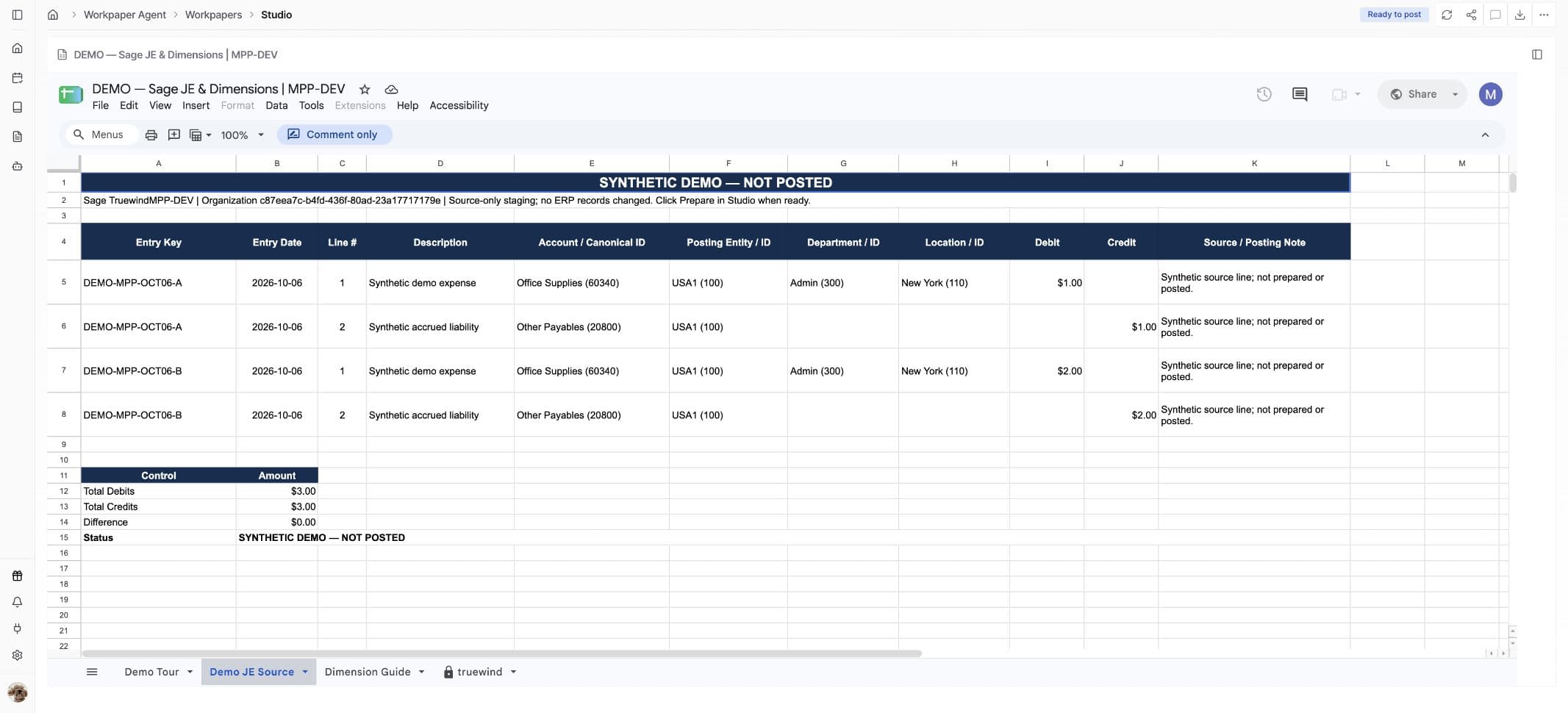
Open Workpaper Agent → Workpapers and choose your workpaper. Studio opens with the spreadsheet and Agent chat. Confirm the workpaper belongs to the intended Sage company and posting entity, and check the source entries and dates. Include the intended posting entity in your source or tell the Agent before preparing.

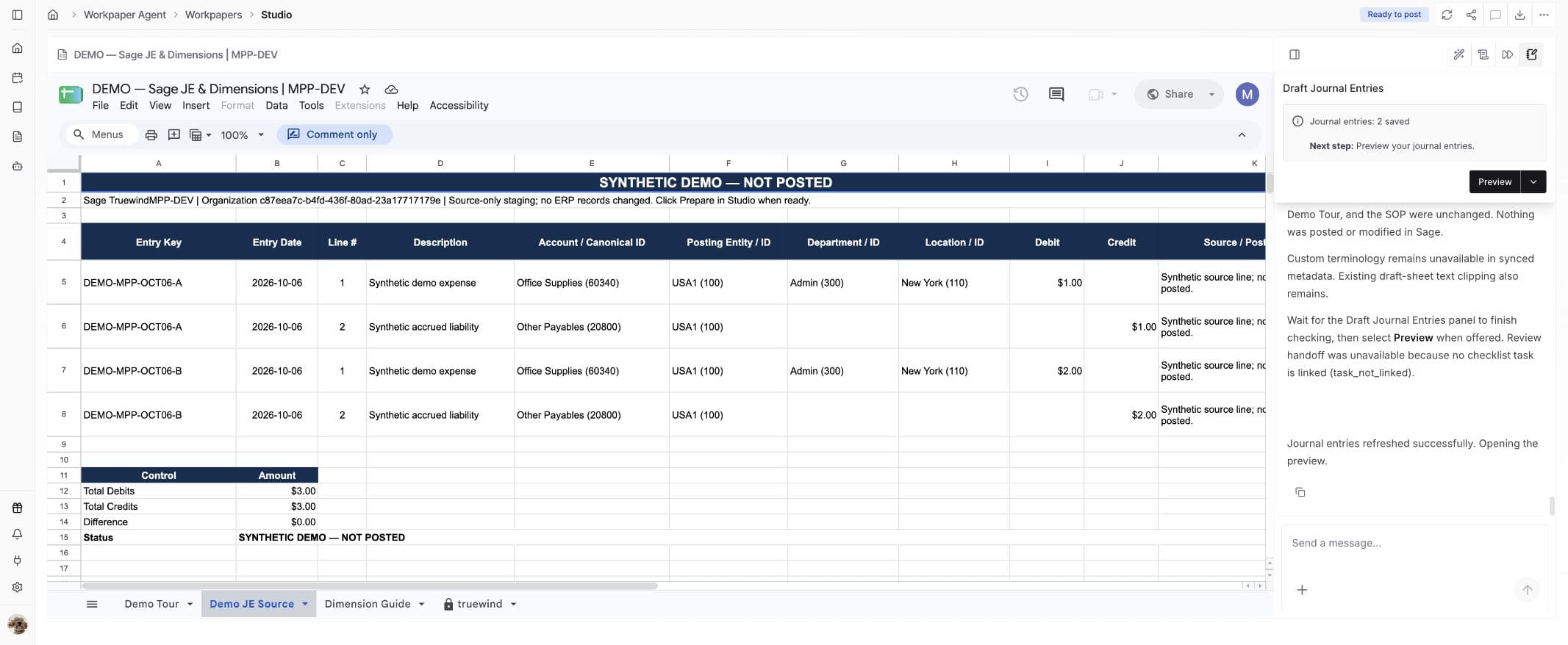
Click Draft Journal Entries above chat, then Prepare in the panel. Wait for the draft rows to be created.

Continue to Step 2 for mappings, or Step 7 for an error. If drafts already exist, follow the panel’s Next step message. The screenshot shows an existing draft, so its button says Preview instead of Prepare.

Sage Intacct workflow: Prepare your journal entries

Step 2

Review accounts, vendors/customers, and dimensions

If Review mappings appears, open it and match the workbook labels to Sage records.

Choose the active account. Check the vendor or customer ID and name, then complete required Department, Location, and other dimensions. Older workbooks may use the label Payee.

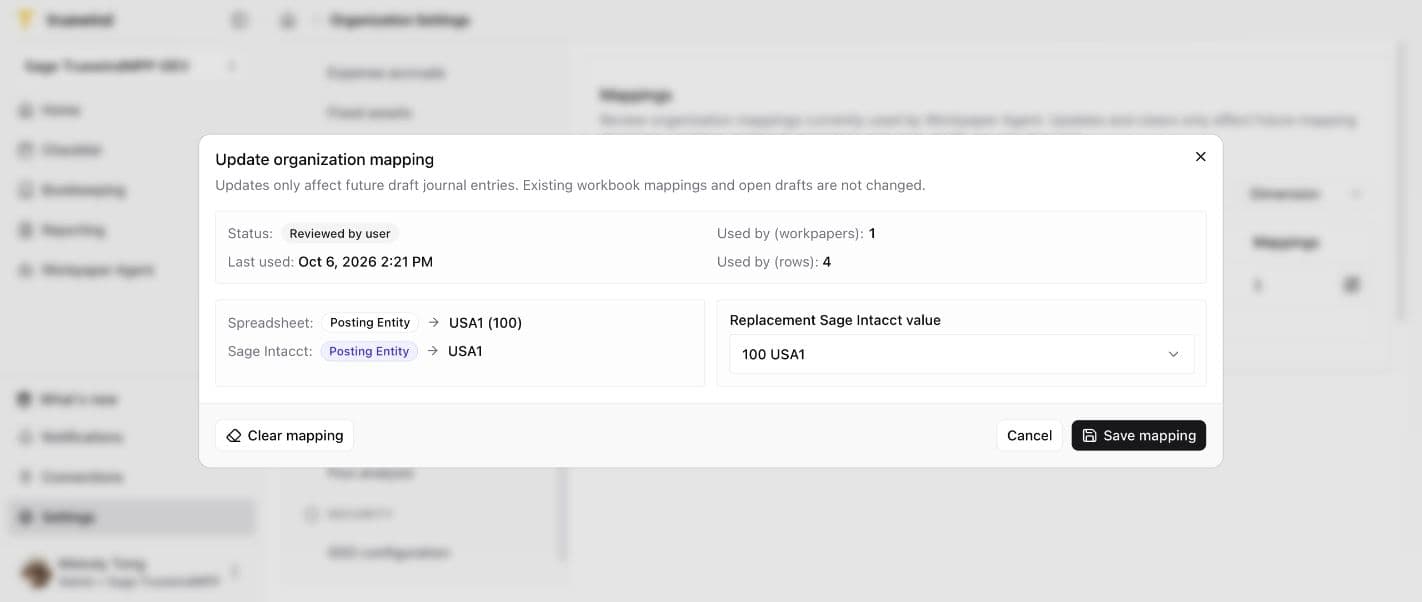
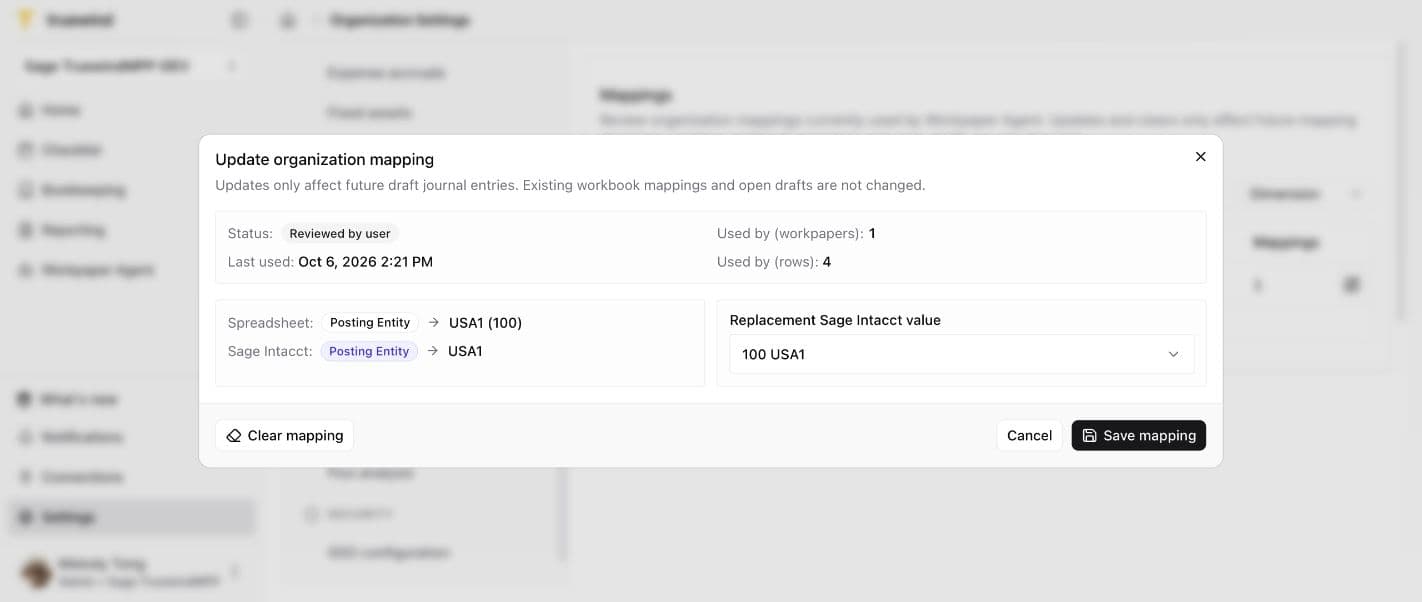
Posting entity is the Sage entity receiving the entry. Include it in your source or tell the Agent before Prepare. If the mapping dialog asks for an entity, select it there.

Skip a dimension only if the dialog allows it and your entry does not need it. In Preview, check the saved values and Posting entity above Memo. The screenshot shows a saved entity mapping.

Sage Intacct workflow: Review accounts, vendors/customers, and dimensions

Step 3

Check the Preview

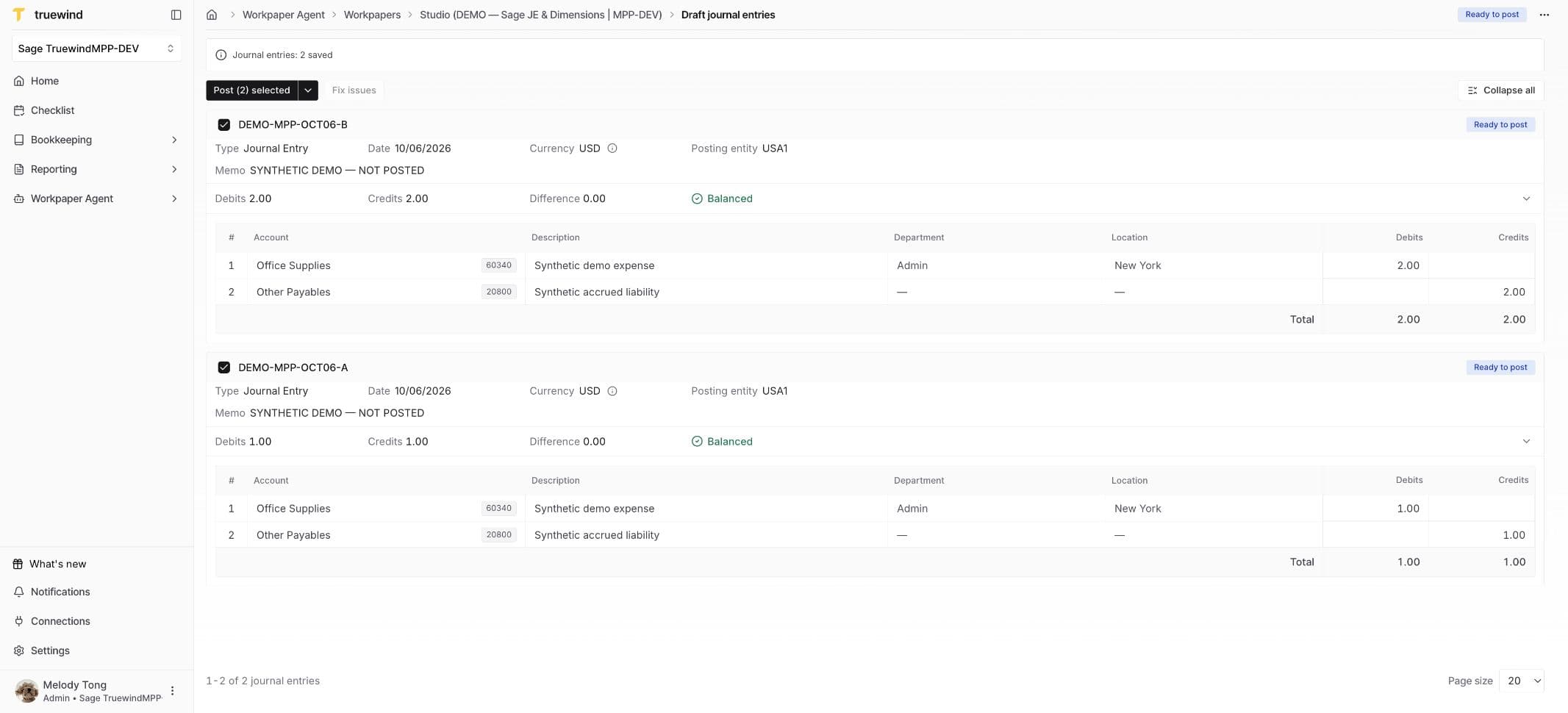
Open Preview in the Draft Journal Entries panel. Compare each entry with your source. Check the date and accounting period, memo, line descriptions, accounts, vendor/customer references, and dimensions. Also check Posting entity above Memo.

Check the debit and credit amounts on each line—not just the totals. Confirm Difference is zero and the entry is Balanced. “Ready” means product checks passed; complete your accounting review and any required sign-off.

For a draft value, use Step 6. For an error, use Step 7. For a source change, use Step 8; for a mapping, Step 9. Return here and review the updated Preview before posting.

Sage Intacct workflow: Check the Preview

Step 4

Post the reviewed entries

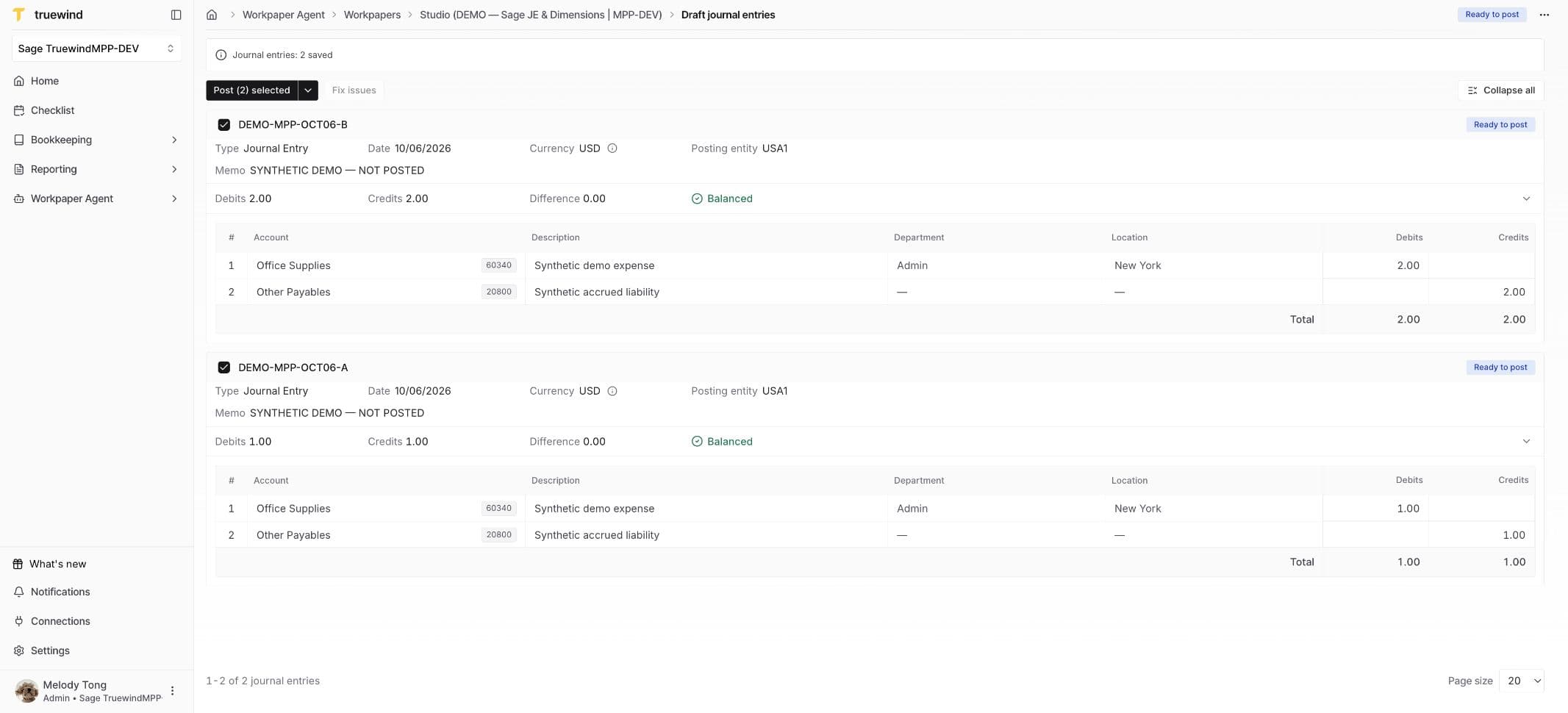
Select the entries you reviewed, then click the Post button in Preview (for example, Post (2) selected). This opens the posting confirmation dialog; nothing is submitted yet.

In the dialog, check the selected entry count and Journal book. Choose the intended Sage journal, or Use journal books from workpaper when offered and appropriate. Resolve any unavailable-journal warning before continuing.

Review Post as draft, which is off by default. Turn it on to create draft entries in Sage for later review and posting. This is an explicit choice, independent of whether your Sage company requires approval. Leaving it off requests posting; verify the final state in Sage.

Click the dialog’s final Post button once to submit. Then wait for the result; Posting means the request is still running.

If the result is unclear, check Journal Entries and your accounting system for the same reference, date, amount, and memo before retrying.

The screenshot shows the Preview button that opens the dialog, before final confirmation.

Sage Intacct workflow: Post the reviewed entries

Step 5

Confirm the posting result

Check the result for each selected entry and keep its reference. Investigate any failed entries separately.

If Truewind shows Posted but Sage shows Draft, the entry reached Sage and still needs Sage approval or posting. Do not send it again. Confirm Sage’s State is Posted to verify ledger completion.

The main workflow is complete. Use Steps 6–10 for changes or problems, and Steps 11–12 to check the saved records.

Sage Intacct workflow: Confirm the posting result

Step 6

Optional — Edit the draft, then Refresh

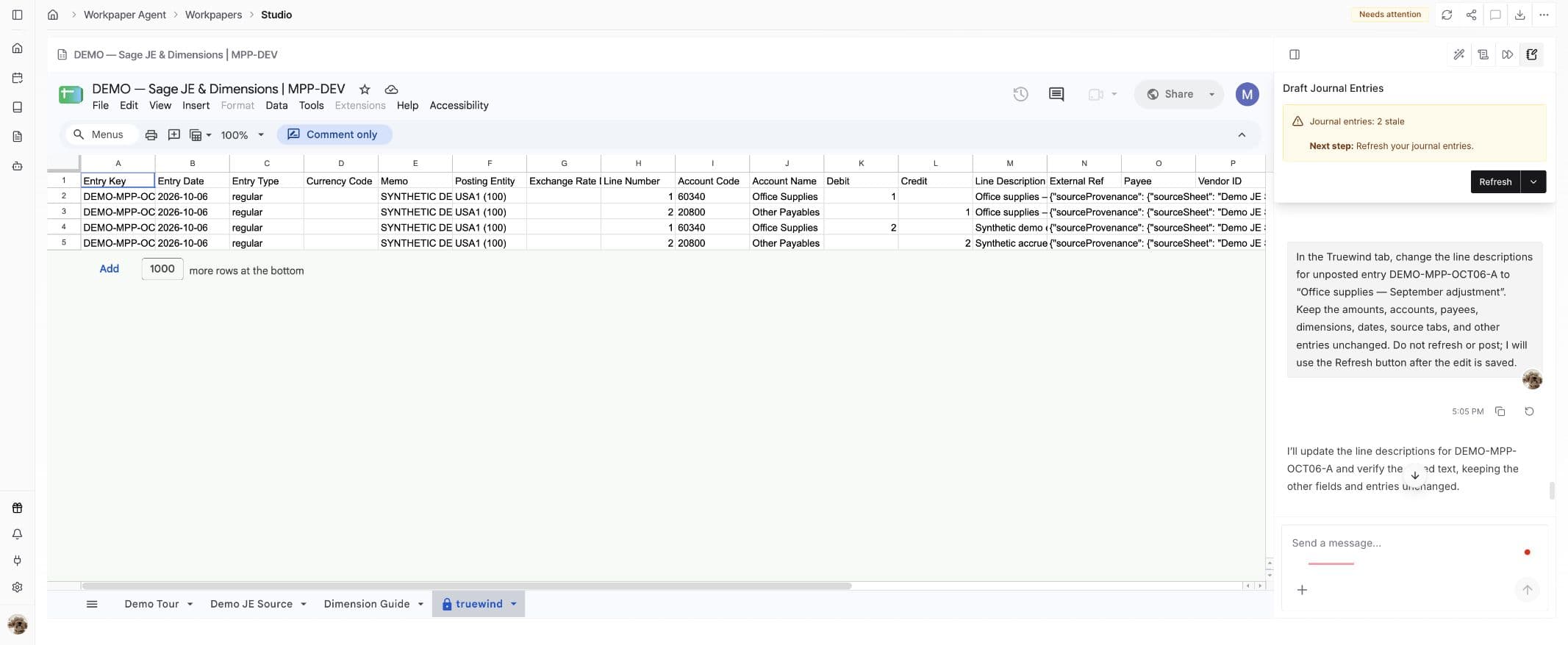
Return to Studio and edit the existing value in the Truewind tab, or ask the Agent. Keep the columns and layout intact.

Example: “In the Truewind tab, change the description for [entry reference, line number] to ‘Office supplies — September adjustment’. Keep amounts, accounts, and dimensions unchanged.” Replace the bracketed text with the entry you want to edit.

Wait for saving, then open Draft Journal Entries → Refresh. Confirm the change appears in Preview and that the other fields remain correct.

Sage Intacct workflow: Edit the draft, then Refresh

Step 7

Optional — Resolve an error

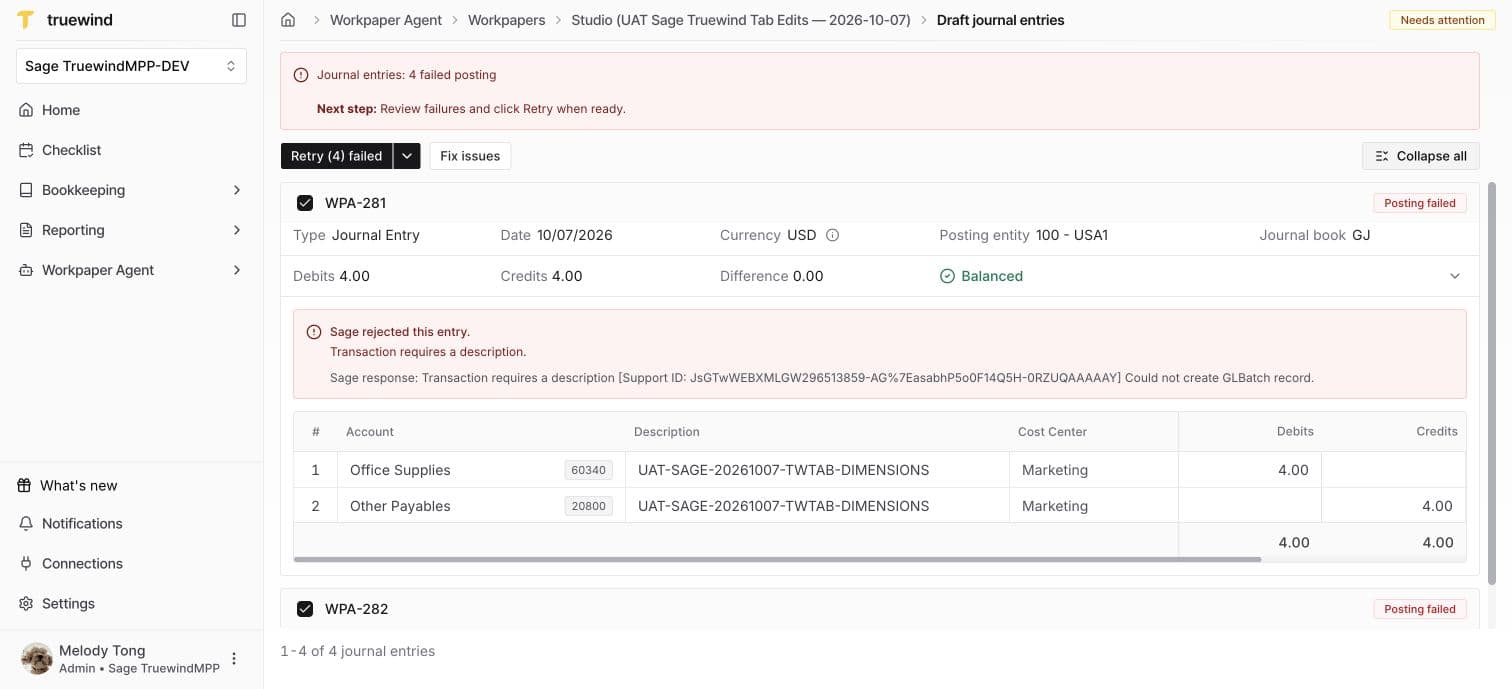
Open View errors and find the named field or row. Correct it, or use Fix issues if available. Check the Agent’s proposed changes to amounts, accounts, and dimensions before confirming.

After saving, follow the panel’s main action: Prepare for a first draft, Refresh for an existing draft, or Rebuild from source when required. Return to Preview and confirm the error is cleared.

Sage Intacct workflow: Resolve an error

Step 8

Optional — Update source or ERP information

Edit the source tab or ask the Agent, then wait for saving. Open Draft Journal Entries and follow its Next step message: Refresh, or Rebuild from source when required.

Before rebuilding, copy any direct Truewind-tab edits you want to keep into the source. Rebuild can replace those draft edits.

For new or renamed accounting records, use Sync with Ledger at the top right of Studio where available, then review the mappings and Preview.

Sage Intacct workflow: Update source or ERP information

Step 9

Optional — Change an existing mapping

In Studio, open Draft Journal Entries → the arrow beside its main button → Review mappings.

Choose the replacement account, vendor/customer, or dimension and confirm. In Preview, check that the intended lines use the new mapping. This reviews the current draft; saved organization mappings can also affect future drafts.

Sage Intacct workflow: Change an existing mapping

Step 10

Optional — Correct a posted entry

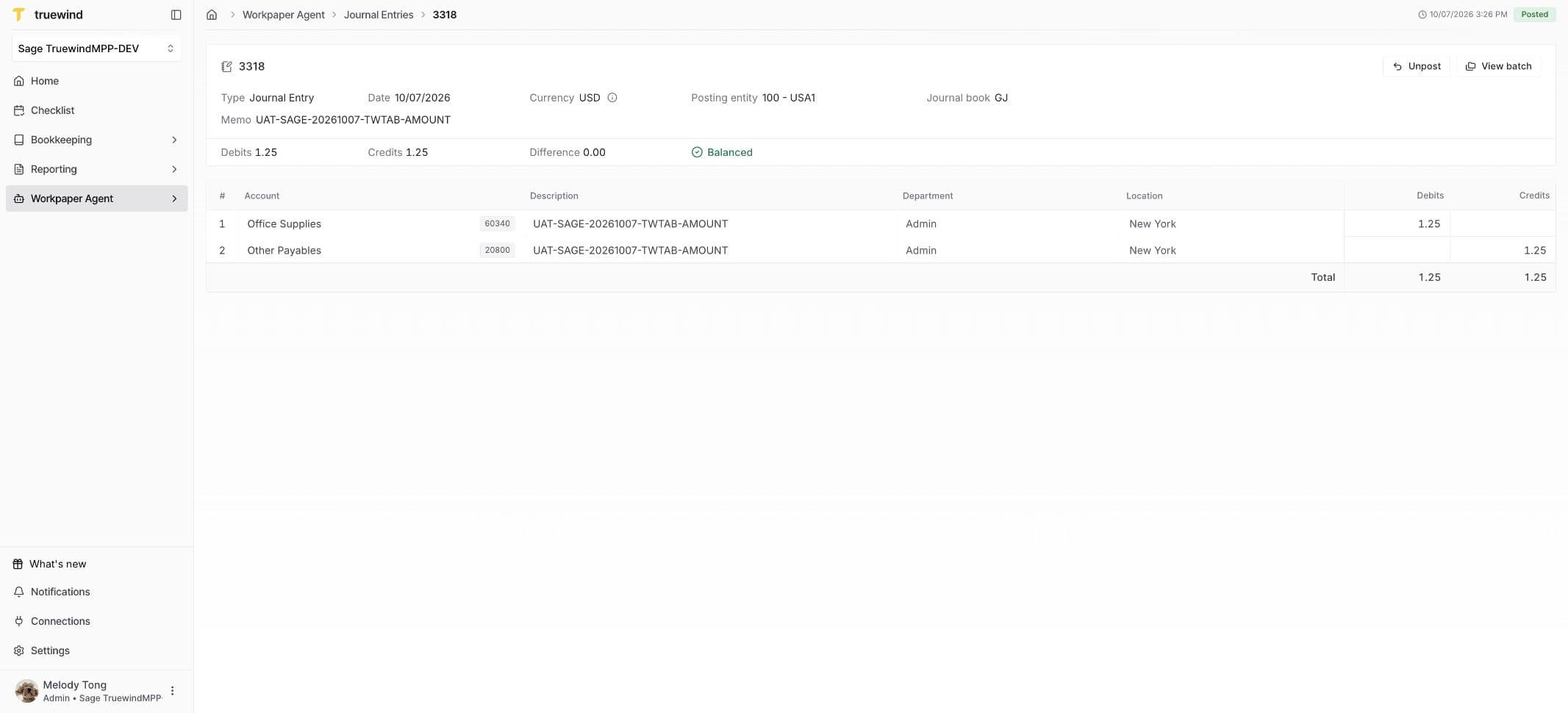
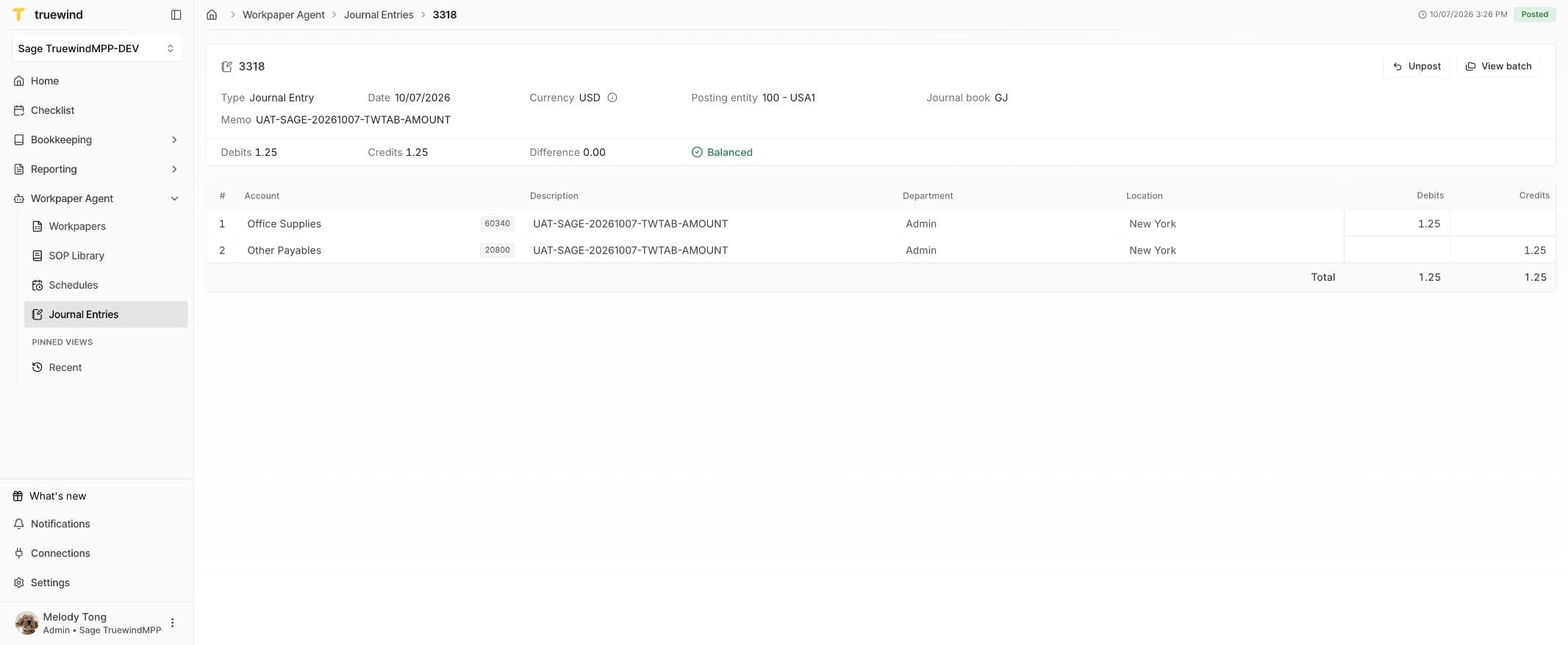
Open the posted entry from Workpaper Agent → Journal Entries and choose Unpost.

After unposting finishes, correct the draft, Refresh, review, and post again. If Unpost is unavailable, follow your firm’s correction process. Unposting and creating a reversing entry are different actions.

Sage Intacct workflow: Correct a posted entry

Step 11

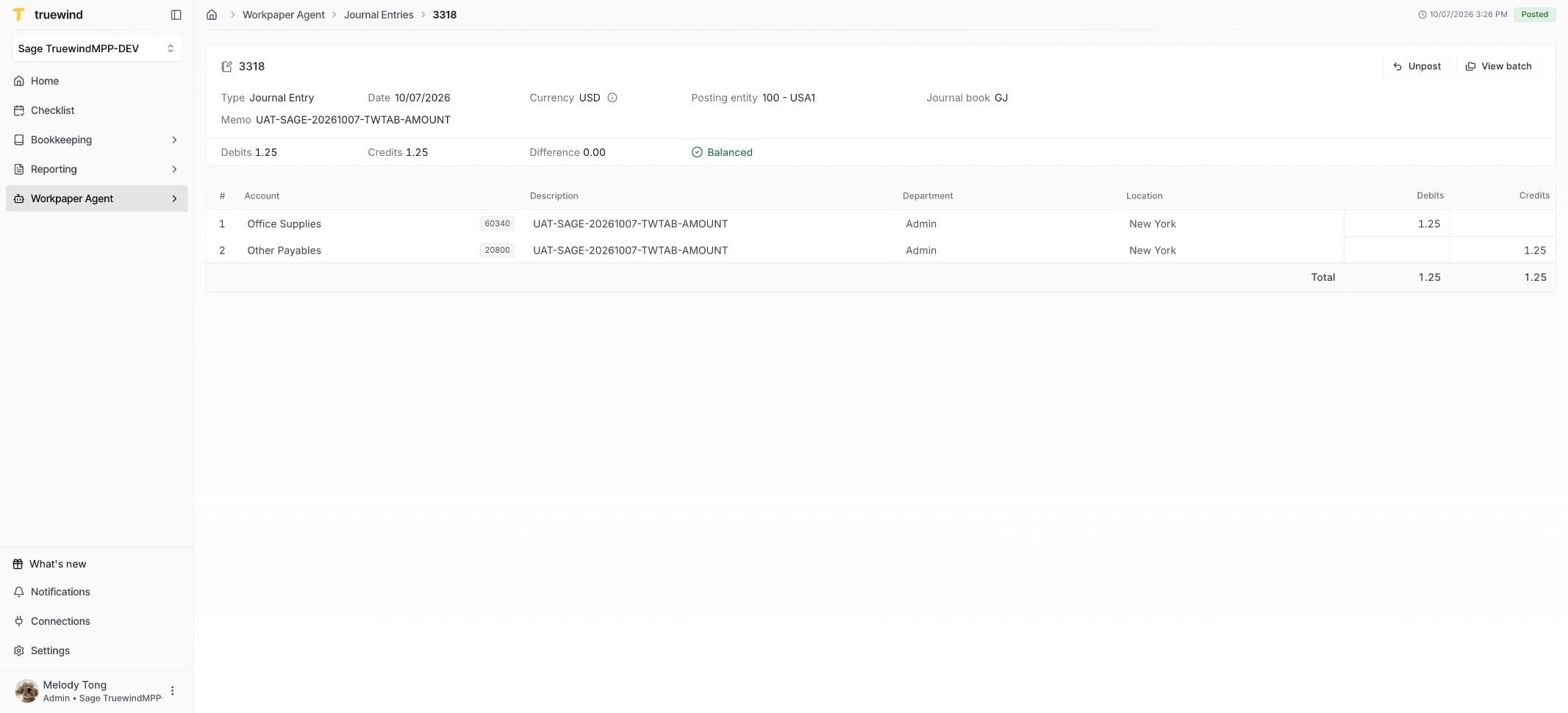
Recommended check — Open the saved JE in Truewind

Open Workpaper Agent → Journal Entries, find the entry, and open its saved detail. Compare the date, memo, amounts, accounts, vendor/customer references, and dimensions with your final Preview, and keep the reference for the ERP check.

Sage Intacct workflow: Open the saved JE in Truewind

Step 12

Recommended check — Find the JE in Sage Intacct

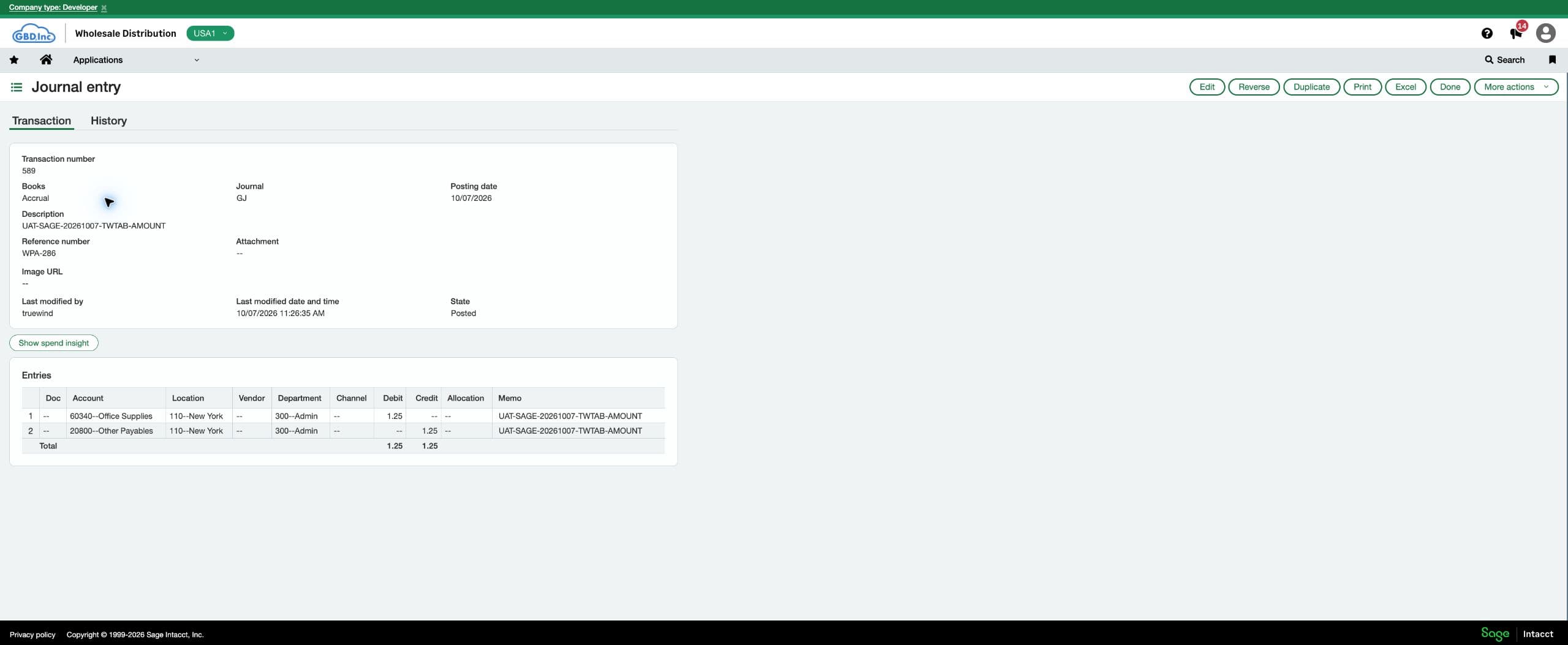
In the correct Sage company and entity, open General Ledger → Journal entries → the relevant journal → View transactions. Find your entry by reference, date, amount, and description, then choose View.

Compare the accounting details and check State. Posted means it has reached the ledger; Draft or pending approval still needs the Sage approval/posting process.

Sage Intacct workflow: Find the JE in Sage Intacct

Start with source journal entries already in your workpaper. Steps 1–5 cover the main workflow. Use Steps 6–10 only when you need a correction, then check the saved records with Steps 11–12.

Find your way

  • Studio: the workpaper screen with your spreadsheet and Agent chat.
  • Truewind tab: the prepared journal-entry rows in the spreadsheet.
  • Draft Journal Entries: the button above chat that opens the action panel.
  • Preview: the screen where you review and post drafts.
  • Sync with Ledger: the circular-arrow button at the top right of Studio, where available.
  • Journal Entries: the saved entry list under Workpaper Agent in the left sidebar.

Which button do I click?

  • Prepare: create the first draft from your source.
  • Refresh: update an existing draft after saving edits. Follow “Next step: Refresh your journal entries.”
  • Rebuild from source: use this when the panel says the draft requires rebuilding or the Truewind tab is missing.
  • Preview: open the current drafts to review them.

Follow the panel’s Next step message. A new or renamed record in your accounting system alone does not mean you need to rebuild. Use Sync with Ledger where available, then review the mappings.

To change the current draft’s mappings, use its Review mappings action. Organization-level saved mappings can apply to future drafts.

FAQ

Should I use Prepare, Refresh, or Rebuild from source?

Use Prepare for the first draft. After an edit, follow the panel’s Next step message: Refresh uses saved changes; Rebuild from source recreates unposted drafts when the panel requires it. Preview opens drafts that are ready to review.

Do I always need to review mappings?

Complete Review mappings when Truewind requests it. If it does not appear, still check the accounts, parties, and dimensions in Preview. Use the arrow beside the panel’s main button to reopen Review mappings when available.

Can I edit the prepared Truewind tab?

Yes, edit existing values when the sheet allows it, or ask the Agent. Keep the columns and layout intact. Wait for changes to save, then Refresh and check Preview again.

What if only some entries post, or the result is unclear?

Check each entry’s result and look for its reference, date, amount, and memo in Truewind and your accounting system. Investigate failed entries separately. Avoid resending an entry that already exists.

Why does Truewind show Posted while Sage shows Draft?

Truewind has sent the entry to Sage. If you enabled Post as draft in the confirmation dialog, creating a Sage draft was intentional. Sage approval or posting requirements may also affect its final state. Complete any remaining review and posting in Sage and check that State becomes Posted. Do not resend the entry from Truewind.

Will changing a mapping update future drafts too?

Use the current draft’s Review mappings action to correct that draft, then verify Preview. Organization-level saved mappings can apply to future drafts. Do not assume a change to one draft updates every existing entry.

Where can I get help?

Open your profile menu at the bottom left and select Support. Include the workpaper URL and the error message so the team can locate the problem.

Limitations

Required mappings must be complete

Accounts cannot remain unresolved. Required dimensions and vendor/customer fields depend on your Sage configuration. Department and Location may use custom names. Check the intended dimension and value, and skip only when the dialog explicitly allows it.

Rebuild can replace draft edits

Rebuild recreates unposted drafts from source. Copy any direct Truewind-tab edits you want to keep into the source first. If both the source and draft changed, reconcile them before refreshing.

Some cells and actions may be unavailable

If a cell is locked or the sheet is Comment only, ask the Agent to edit it. If Unpost is unavailable, use your firm’s correction process.

Balanced does not mean approved

A balanced entry and a Ready status do not replace accounting review or required sign-off. Sage may also require approval before an entry reaches the ledger.

Sage draft creation and ledger posting are different

Post as draft is off by default. Enabling it creates a draft in Sage even if your company does not require approval. A successful send from Truewind does not establish ledger completion; verify the entry’s State in Sage.

Was this helpful?

Need more help?

Ask for human help about this article and provide any feedback.