

When we talk to family office controllers, the same number comes up: 15 to 20 hours per week on reconciliation alone. Not close work. Not flux analysis or reporting. Just matching bank statements, custodian feeds, and intercompany balances to the GL across dozens of entities before the consolidated view is usable. Family office reconciliation time multiplies fast when each entity needs its own account-level tie-out and Sage Intacct's native reconciliation module was built for routine banking accounts, not investment portfolios. The difference between a 10-day close and a 3-day close is not how fast your team works but how much of that matching work runs on autopilot before a human reviewer ever opens the queue.
TLDR:
- Family offices managing 15+ entities lose 19 to 25 hours per week on reconciliation tasks that multiply across accounts, custodians, and intercompany ties.
- Brokerage account reconciliation consumes the most time: each custodian formats statements differently, and Sage Intacct lacks tools to normalize or match them automatically.
- Sage Intacct's native reconciliation module handles routine banking accounts but breaks down on investment accounts, K-1 allocations, and multi-entity intercompany eliminations.
- AI-assisted reconciliation automates statement ingestion, transaction matching, and exception routing while preserving dimension-aware posting and human review.
- Automating transaction coding (6 to 8 hours), custodian reconciliation (8 to 10 hours), and exception resolution (3 to 4 hours) reclaims the bulk of weekly reconciliation time.
Why Family Office Reconciliation Takes So Long
Family offices carry a reconciliation burden that most accounting teams don't face at the same scale. A single-entity business might close one set of books per month. A mid-sized family office managing assets across 15 to 30 entities, each with its own investment accounts, banking relationships, and ownership structures, runs that same reconciliation cycle 15 to 30 times over, often with a lean staff.
The volume compounds in ways that aren't obvious until you're inside it.
Where the hours actually go
Three structural factors drive the bulk of the time loss:
- Entity count multiplies every close task proportionally. If matching one entity's bank and investment accounts takes four hours, a 20-entity office is looking at 80 hours before a single consolidated view exists. Most family offices don't have 20 accountants but two or three.
- Investment account statements arrive in inconsistent formats. Custodians like Schwab, Fidelity, and Northern Trust each produce different statement layouts, date conventions, and transaction categorizations. Mapping those formats to a consistent GL structure in Sage Intacct is manual work every single period.
- Inter-entity transactions require matching from both sides. A capital transfer between entities creates two entries that need to tie. When those entries sit in different Sage dimensions or sub-ledgers, finding and confirming the match is a line-by-line exercise.
Finance teams consistently spend a significant portion of their time on data collection and processing tasks that could be automated. For family office accountants carrying a multi-entity reconciliation load, that burden runs even higher. The data collection problem alone, across custodian statements and bank feeds, can consume the first half of any close week. Research by Ardent Partners shows that best-in-class finance teams are 53% more likely to use automation for reconciliation tasks compared to their peers.
The Hidden Cost of Manual Reconciliation in Multi-Entity Structures
Family offices running 10 or more entities through Sage Intacct face a reconciliation burden that compounds in ways that aren't obvious until someone tries to close the books.
Each entity needs its own bank reconciliation, investment account tie-out, and intercompany balance verification before the consolidated view is usable. At 10 entities, that's a manageable workload. At 30 or 50, the arithmetic gets punishing fast.
The time cost breaks down across three layers:
- Account-level matching across every entity requires pulling statements, cross-referencing GL balances, and manually logging exceptions. For a family office with diverse asset classes across entities, this alone can consume 8 to 12 hours per close cycle.
- Intercompany eliminations require verifying that what one entity records as a receivable, another records as a payable, in the same amount, with the same date. Any mismatch has to be traced back to source transactions before the consolidation can close.
- Investment account reconciliation adds another layer when custodian statements don't arrive on a consistent schedule, or when positions span multiple accounts at multiple custodians across multiple entities.
The compounding effect is where teams lose control. A single exception in one entity can delay the entire consolidated close while someone traces it manually through GL detail. That delay ripples into reporting deadlines, LP distributions, and any downstream process that depends on a clean trial balance.
The question for most family office controllers isn't whether this workload is excessive. It clearly is. The question is which parts of it can be handled without a senior accountant doing the work by hand each month.
Brokerage Account Reconciliation: The Biggest Time Sink
Brokerage account reconciliation pulls more hours out of a family office accounting team than almost any other close task. Custodians like Schwab, Fidelity, and Pershing each format their statements differently, and matching those feeds to Sage Intacct positions, dividends, and cost basis entries requires line-by-line comparison across multiple accounts per entity.
For offices managing 10 or more entities, that volume compounds fast. A team matching 15 entities against three custodians works through dozens of statement formats every month, and any discrepancy requires tracing back through trade confirmations, corporate actions, or fee schedules before a close entry can post.
Where the Time Actually Goes
Three specific tasks account for most of the hours:
- Downloading and normalizing custodian feeds into a format Sage Intacct can read, since each custodian exports data in its own column structure and date convention, and there is no standard import template that works across all of them.
- Matching dividend income, realized gains, management fees, and interest entries from the custodian statement to the corresponding GL accounts in Sage, which requires both investment knowledge and accounting judgment on every line.
- Documenting exceptions and open items in a format the investment team, auditors, and principals can all review, which often means maintaining a separate workpaper outside of Sage entirely.
Each of those tasks is largely manual, and each one restarts from scratch the following month.
How Sage Intacct's Native Capabilities Fall Short for Family Offices
Sage Intacct handles multi-entity consolidation and dimension-based reporting well enough for most mid-market companies. Family offices push those capabilities past their limits fast.
The core issue is volume and asset class diversity. A single-family office managing a principal's portfolio might hold direct real estate, LP interests in a dozen funds, operating companies, and liquid securities across separate LLCs. Each entity needs its own account-level reconciliation before any consolidated view is possible.
Where the native tools break down
Sage Intacct's reconciliation module was built for routine banking accounts: bank, credit card, intercompany. It works at that layer. It does not handle:
- Investment account reconciliations where the source data comes from custodian statements, capital account notices, or fund administrator reports in inconsistent formats
- K-1 allocation tracking that ties LP income back to the correct entity and tax lot
- Carried interest and waterfall calculations that require custom GL logic outside standard dimension mapping
- Cash flow aggregation across entities where intercompany eliminations and timing differences create exceptions on every close cycle
The result is that family office accountants spend the first half of every close period manually pulling data from external sources, reformatting it, and building the reconciliation workpapers that Sage's native tools can't produce on their own. That manual layer is where most of the 20 hours per week goes.
What Automation Actually Means for Reconciliation Workflows
When finance teams talk about automating reconciliation, they often mean something narrower than they realize: eliminating the manual data entry, not the judgment layer on top of it.
In Sage Intacct, that distinction matters. The system stores transactions and dimensions well. What it doesn't do is match those transactions to external statements, flag variances, or route exceptions without a human pulling the pieces together.
Where the Time Actually Goes
Three tasks consume most of the reconciliation hours in a typical family office workflow:
- Pulling statements from custodians, banks, and fund administrators and getting them into a format Sage can work with. This step alone can take 3 to 5 hours per entity per period, especially when source formats vary across dozens of custodians.
- Matching GL balances to external statements line by line, then investigating anything that doesn't tie before the close can move forward.
- Documenting the outcome in a way that satisfies audit review, which usually means exporting, formatting, and filing evidence outside of Sage entirely.
AI-assisted reconciliation shortens all three stages. It ingests statements across formats, runs the match logic, and surfaces only the exceptions that need a human decision. Your team reviews the queue; the routine matches post automatically.
The goal is fewer hours on mechanical verification, with the same level of control over what actually hits the GL.
The 20-Hour-Per-Week Math: Where Time Gets Reclaimed
Family office reconciliation work is time-intensive by design. Each entity carries its own bank accounts, investment accounts, brokerage statements, and intercompany positions that all need to be tied out every period. When you multiply that across a typical family office structure with dozens of entities, the hours compound fast.
Here is where the time actually goes each week across a typical family office running on Sage Intacct.

Transaction Coding and Categorization
Most family offices handle a mix of operating expenses, capital activity, and investment transactions across every entity. Without automated coding rules that actually hold, accountants manually categorize each line. Across 10 to 15 entities, that work runs 6 to 8 hours per week on average. Industry data shows that consolidating sources into a single automated pipeline can decrease time spent on data gathering and reconciliation by up to 80%.
Bank and Custodian Reconciliation
Pulling statements from custodians like Schwab, Fidelity, or Northern Trust, matching them to the GL, and chasing down exceptions is the core of the weekly load. For multi-entity structures, expect 8 to 10 hours here.
Exception Research and Resolution
When a transaction does not match, someone has to find out why. That means cross-referencing source documents, reaching back to wire confirmations, or digging through PDF statements. This work is low-value and takes 3 to 4 hours per week on a typical book.
Intercompany and Investment Rollforward Review
Intercompany eliminations and investment position rollforwards require a second pass against the GL to confirm the entries are complete and accurate. Add another 2 to 3 hours.
TaskAvg. Hours/WeekTransaction coding and categorization6 to 8 hoursBank and custodian reconciliation8 to 10 hoursException research and resolution3 to 4 hoursIntercompany and rollforward review2 to 3 hoursTotal****19 to 25 hours
The math is not complicated. Automating the coding and matching work reclaims the bulk of that time, leaving the accountant to review exceptions and post.
Dimension-Aware Automation: Why Generic Tools Miss the Mark
Sage Intacct's dimensional structure is what makes it worth the investment for family offices. Every transaction can carry tags for class, department, location, project, and any custom dimension the office has configured. That granularity powers entity-level reporting, LP allocation tracking, and fund-level expense visibility that a flat chart of accounts cannot produce.
Generic reconciliation tools typically match at the account code level and stop there. When they post a matched entry back to Sage, it lands in the right account but carries none of the dimensional context that makes that account useful. A dividend receipt posts to investment income without a class tag. A management fee posts without a location or entity dimension. The GL balance ties, but the reporting layer is broken.
The downstream cost is manual rework. Someone has to go back into Sage and reapply dimensions to every entry the tool posted clean but incomplete. For a family office running 20 or 30 entities, that cleanup can consume more time than the reconciliation saved.
Dimension-aware automation pulls the full dimensional structure from Sage on connection and carries it through every step of the reconciliation. When a custodian statement line matches to a GL entry, the resulting posting includes account, class, location, and any custom dimension already configured in the client's Sage instance. Nothing gets stripped out. The matched entry that hits the GL is the same entry a senior accountant would have posted by hand, just without the hand.
Building a Reconciliation Workflow That Runs on Autopilot
Automating family office reconciliation in Sage Intacct starts with understanding where manual work actually accumulates. For most family offices, the bottleneck is not a single task but a cluster of repeating verification steps that compound across entities, accounts, and reporting periods.
There are a few structural decisions that determine whether a reconciliation workflow scales or stalls.
Set Your Entity and Account Hierarchy First
Sage Intacct's multi-entity architecture gives family offices the dimensional structure to separate entity-level books while consolidating reporting. Before any automation layer can work reliably, your entity hierarchy, intercompany elimination rules, and account tagging need to be clean. Automation applied to a poorly structured chart of accounts will reproduce the same errors faster.
Define Exception Routing Before You Build Rules
Most teams build matching rules and then figure out what to do with exceptions after the fact. Flip that order. Define your exception queue first: which variances route to a senior reviewer, which get auto-flagged for follow-up, and which fall below a materiality threshold that can be cleared without review. When exception handling is defined upfront, your rule set has a clear boundary and your reviewers spend time on actual judgment calls instead of triaging noise.
Match Automation Depth to Transaction Complexity
Not every account warrants the same automation approach. Cash and custody accounts with high transaction volume benefit from rule-based matching. Investment accounts with complex cost basis adjustments, capital call activity, or K-1 allocations need a layer that reads context beyond amounts alone. Building a single rule set for both is where most Sage configurations break down.
Exception Management: The Make-or-Break Factor
Even the best automated matching logic produces exceptions. How your family office workflow handles those exceptions determines whether reconciliation actually closes on time.
Most teams route exceptions into email threads or spreadsheet trackers maintained outside Sage Intacct. The result: items age, context gets lost, and senior accountants spend time reconstructing what happened to a transaction from two weeks ago.
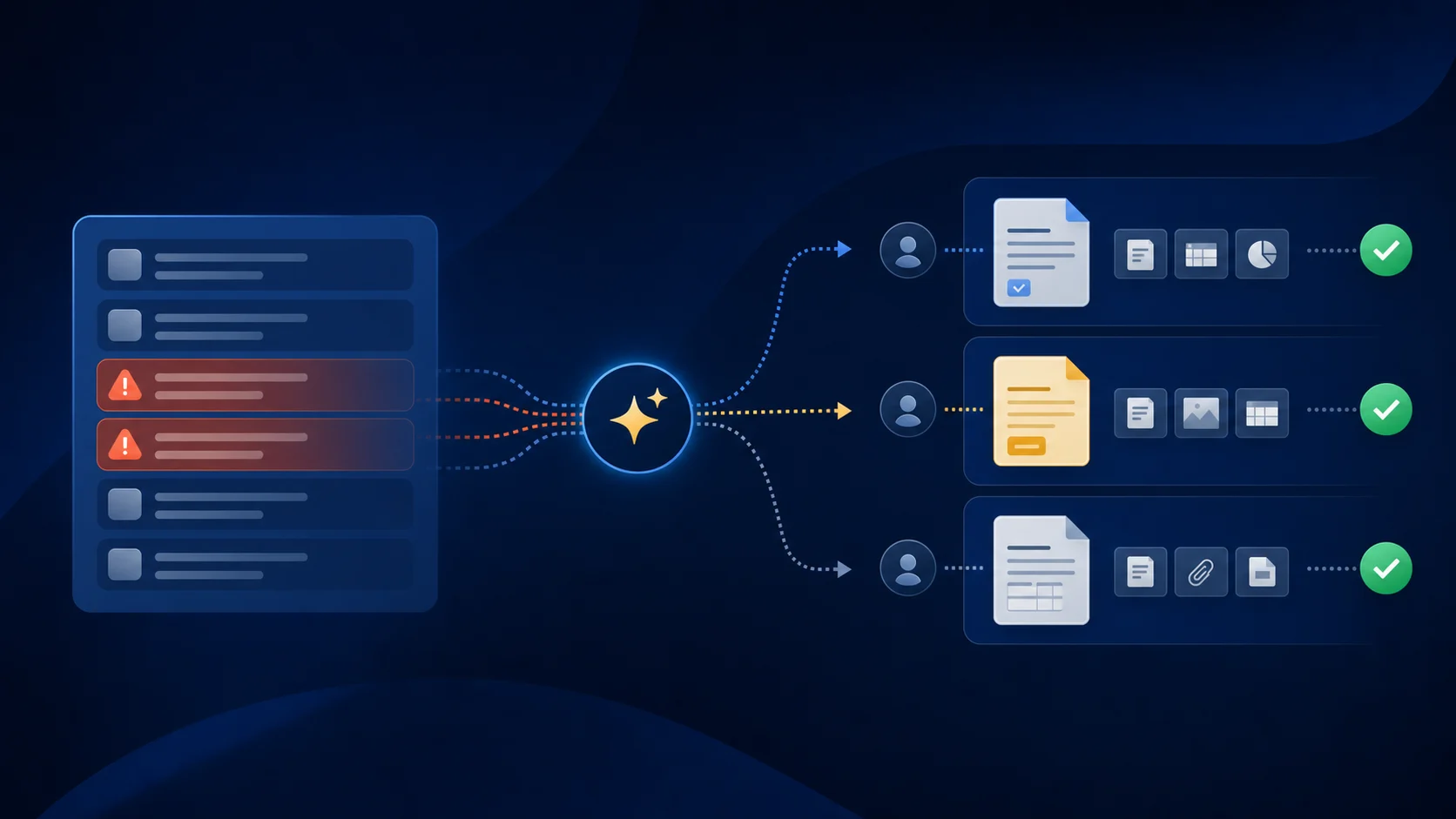
A structured exception queue changes that workflow. When Sage Intacct flags a mismatch, the item routes to an assigned reviewer with the original transaction detail, the expected amount, and the source document attached. Nothing lives in email.
What a Structured Exception Queue Covers
- Exception items get logged immediately with timestamp, entity, account, and dollar amount so nothing slips through without a record.
- Each exception carries its original source document, so the reviewer opens one screen instead of hunting through a custodian portal or a shared drive.
- Ownership is assigned at routing, not after a follow-up meeting, so accountability is clear from the start.
- Resolution notes stay attached to the item, giving auditors a complete trail without a separate documentation step.
The downstream effect matters as much as the intake process. When exceptions clear faster, the consolidated close starts on schedule instead of waiting for stragglers across multiple entities.
Month-End Close: From 10 Days to 3 Days
Family office month-end close is one of the most labor-intensive accounting workflows that exists. Each entity needs its own reconciliation pass, variance review, and sign-off before a consolidated close can start.
Where the Time Actually Goes
Most of the 10-day close burden falls into three repeating tasks:
- Transaction coding that never fully categorizes itself, leaving senior accountants triaging exceptions across dozens of accounts every cycle
- Reconciliation sign-off that depends on a single reviewer tracking status across entities manually, usually in a spreadsheet outside Sage Intacct
- Flux commentary written from scratch each period, even when the variance drivers are the same as last month
What a 3-Day Close Requires
Getting from 10 days to 3 days requires those three tasks to run in parallel, not sequentially. AI transaction coding handles categorization before the period closes. Reconciliation status rolls up automatically instead of getting assembled by hand. Flux commentary drafts from prior-period context.
The bottleneck moves from data gathering to review, which is where an accountant's judgment actually belongs.
How to Save 20 Hours Per Week on Family Office Reconciliation in Sage Intacct
Family office accounting teams running Sage Intacct often lose 15 to 20 hours per week on reconciliation work alone. The volume explains most of it: a single family office managing multiple entities, investment vehicles, and asset classes can face hundreds of account-level reconciliation tasks each month, each requiring its own GL tie-out, exception review, and sign-off.
The time pressure compounds at period-end. When reconciliation is largely manual, controllers and senior accountants spend the first several days of close just catching up on outstanding items before any actual close work can start.
Where the Hours Go
Three workflow areas account for the bulk of lost time in Sage Intacct reconciliation for family offices:
- Bank and custodian feed matching requires pulling statements from each financial institution, formatting them for import, and manually matching transactions to GL entries. When a family office holds positions across multiple custodians, this process runs in parallel for each one, with no shared queue or exception routing.
- Investment account reconciliation involves comparing portfolio-level activity reports against Sage sub-ledger balances, which often requires reformatting data from the custodian or prime broker before it can even be compared against the GL.
- Intercompany and entity-level tie-outs require verifying that related-party transactions zero out across entities, a step that grows proportionally with entity count and has no native automation path inside Sage Intacct alone.
Each of these tasks is repeatable, rule-based, and high-volume. That combination makes them good candidates for AI-assisted automation, where transaction-level matching and exception routing can happen before a human reviewer ever opens the queue.
FAQ
Can I automate family office reconciliation in Sage Intacct without replacing it as the system of record?
Yes. Sage Intacct stays the system of record; an AI execution layer sits on top of it, reading from and writing back through the same API connection. Transaction matching, custodian statement ingestion, and exception routing run before a human reviewer opens the queue, while final posting decisions stay with your team.
How much time does custodian reconciliation actually take across a 15-entity family office?
Bank and custodian reconciliation consumes 8 to 10 hours per week on average for a multi-entity family office running Schwab, Fidelity, or Pershing accounts. Each custodian exports in its own column structure and date convention, and Sage Intacct has no native tool to normalize those formats or run the matching automatically, so the work restarts from scratch every period.
What does "dimension-aware" reconciliation mean for Sage Intacct family office workflows?
Account-level matching tools post transactions to the correct GL account but strip out Sage Intacct's class, department, location, and project tags in the process. Dimension-aware reconciliation pulls the full dimensional structure from Sage on connection and carries it through every matching step, so the entry that posts to the GL includes all configured dimensions without a manual cleanup pass afterward.
Sage Intacct native reconciliation module vs. AI-assisted reconciliation for multi-entity family offices?
Sage Intacct's native reconciliation module handles bank and credit card accounts well but does not process investment account tie-outs, normalize custodian statement formats, or route intercompany exceptions across entities. AI-assisted reconciliation ingests custodian statements across formats, runs the match logic, and surfaces only the open items that need a human decision, covering the gap where Sage's native tools stop.
How long does it take to start recovering the 19 to 25 hours per week lost to manual family office reconciliation in Sage Intacct?
Most family offices see the first automated journal entry post directly to Sage Intacct within two weeks of setup. Time savings on high-volume transaction coding and custodian matching begin accumulating at that point, with full workflow optimization across all three task categories (coding, custodian matching, and exception resolution) taking one to two months depending on entity count and account complexity.
Final Thoughts on Automating Family Office Reconciliation Without Losing Control
Most family office controllers know the reconciliation burden is excessive. The real question is which parts can run without a senior accountant doing the work by hand each period. AI-assisted reconciliation handles the volume across entities and custodians while preserving the dimensional structure your Sage Intacct reporting depends on. Your team still owns the review, but the mechanical matching and exception routing happen before they open the queue. See a demo if you want to walk through how it works with your actual entity count and custodian mix.
FAQ
Can I build automated reconciliation workflows in Sage Intacct without adding another software layer?
Sage Intacct's native reconciliation module handles routine banking accounts like bank and credit card reconciliation, but it wasn't designed for investment account matching, multi-custodian statement processing, or high-volume multi-entity workflows. Family offices typically spend 8 to 10 hours per week manually pulling custodian statements, reformatting them, and matching transactions to GL entries because Sage lacks the automation layer to handle those workflows at scale.
How much time does brokerage account reconciliation actually take in a multi-entity family office?
For a family office managing 15 entities across three custodians like Schwab, Fidelity, and Pershing, brokerage reconciliation alone consumes 8 to 10 hours per week on average. Each custodian formats statements differently, and matching those feeds to Sage Intacct positions, dividends, and cost basis entries requires line-by-line comparison across dozens of accounts before any discrepancy can be resolved and a close entry can post.
What's the difference between dimension-aware automation and account-level matching?
Account-level matching tools match transactions to the correct GL account but strip out Sage Intacct's dimensional tags like class, department, location, and project during the posting process. Dimension-aware automation preserves the full dimensional structure from Sage through every reconciliation step, so when a custodian statement line matches to a GL entry, the resulting posting includes all configured dimensions without requiring manual rework after the fact.
Sage Intacct reconciliation vs. WorkPaper Agent automation for family offices?
Sage Intacct's reconciliation module handles bank and credit card accounts well but doesn't automate investment account tie-outs, custodian statement ingestion, or intercompany elimination verification across entities. AI-powered WorkPaper Agents ingest raw custodian statements in any format, generate GL-ready journal entries with full dimensional mapping, and produce audit-ready rollforward schedules without manual reformatting or line-by-line matching work each period.
How long does it take to reclaim 20 hours per week in a family office reconciliation workflow?
Most family offices using AI-assisted reconciliation in Sage Intacct deliver first production value within two weeks, with the first automated journal entry posting directly to the GL in that window. Full workflow optimization across transaction coding, custodian matching, and exception routing takes 1 to 2 months depending on entity count and account complexity, but time savings on high-volume reconciliation tasks start accumulating immediately after the first agent goes live.
Turn this into a close-ready workpaper
Start with sample files or upload your own statements to see how Truewind prepares review-ready workpapers and journal entries.