

Your Sage Intacct ledger can be complete while the close behind it still leans on entity workbooks and reviewer notes. For a controller managing several entities, AI belongs in the preparation before posting, not in the posting itself. It preserves dimensions, prepares due-to and due-from support, reconciles source activity, and routes exceptions for review. The accountant approves the treatment, and Sage Intacct records the approved result.
August 2026 TL;DR: Sage Intacct remains the accounting system of record. The AI layer sits upstream, where source files have to be assigned to entities, coded with the right dimensions, reconciled, and turned into workpapers. Due-to and due-from entries, elimination support, and unusual activity stay visible to the reviewer before approved output reaches Sage.
Key Takeaways:
- Keep Sage Intacct as the system of record for entity ledgers and approved entries.
- Use AI for recurring preparation, not open-ended accounting decisions.
- Preserve entity and dimensional context from the source file through the workpaper.
- Prepare both sides of intercompany activity and route mismatches to review.
- Treat exceptions as part of the control model, not as automation failures.
- Start with one recurring workflow that has known inputs and a prior approved result.
Why Sage AI Accounting Breaks at Entity Boundaries
Sage AI accounting breaks the moment one transaction carries different meaning across entities, accounts, and periods. A bank feed shows the amount and date. It cannot tell you which entity owns the activity, whether another entity funded it, or which elimination treatment the controller expects. That context has to survive preparation, or the reviewer rebuilds it by hand.
Multi-Entity Scale Is a Combination Problem
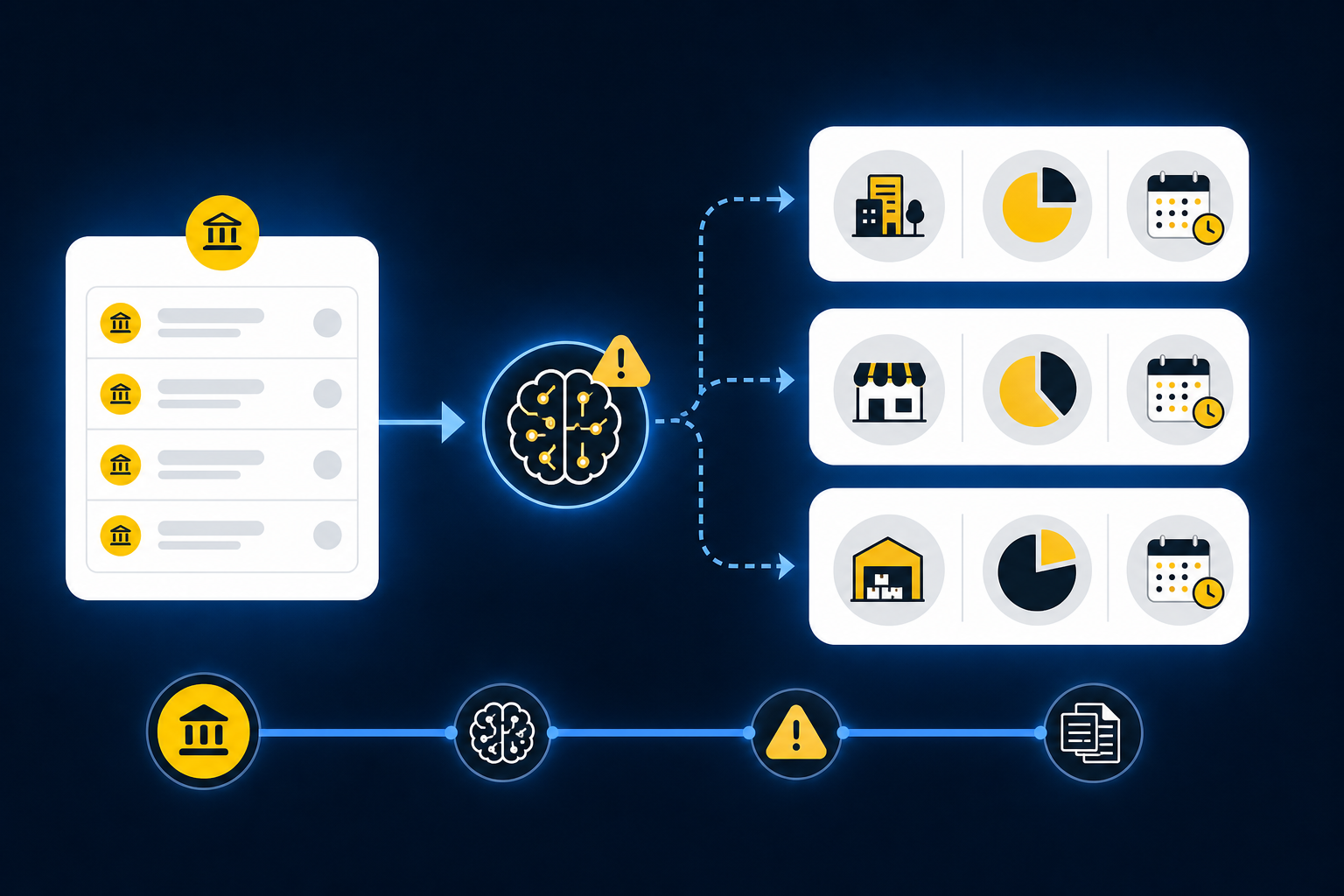
Picture a family-office controller at 7:30 on a Tuesday, opening current custodian statements for six entities in a shared drive. One statement matches last month's layout exactly. Another moved the fee column two positions to the right. A third folds in activity for an investment vehicle that needs different entity treatment from a near-identical account elsewhere in the book. Before consolidation can begin, someone identifies each document, assigns it, compares it against the prior period, and prepares the support the reviewer expects to see.
Volume alone isn't the issue. The hard part is the combination of volume, changing document formats, entity-specific rules, and one reviewer who signs off across the whole book. A single-entity coding tool can categorize a dividend or a management fee. It can't determine why the same label maps differently for two entities without the prior workpaper, the explicit rules, and the reviewer history behind that mapping.
Spreadsheets earn their place here. They're flexible, familiar, and easy to adjust when an unusual transaction appears, which is exactly why they stay embedded in multi-entity accounting. That same flexibility means entity logic ends up scattered across tabs, formulas, comments, and someone's memory. The ledger receives the final answer without ever holding the preparation history that produced it.
If you want to inspect how source-linked preparation can sit ahead of Sage review, use one recurring entity workpaper as the test case when you see Truewind in action.
Clean-Looking Output Can Hide the Real Risk
An obviously broken reconciliation gets attention. A polished workpaper with no visible source trail is far more dangerous, because the reviewer has to decide whether to trust the output or rebuild it from scratch. Clean formatting won't tell you which statement supplied a balance, how an allocation was applied, or why an intercompany difference was left open.
Exceptions belong in front of the accountant. A missing statement, an unexpected balance change, mixed activity, or an inconsistent classification may signal an incomplete source package, or it may be a real accounting question. Forcing those items into the nearest historical pattern makes the output look finished while it quietly hollows out the review. That's the trap: the more confident the formatting, the less the reviewer questions it.
Draw the boundary in ink. Recurring items with explicit rules can be prepared consistently, period after period. Novel activity, changed allocation logic, and unmatched due-to or due-from balances demand judgment. Reliable Sage accounting automation doesn't paper over that line. It renders the line in the workpaper so the reviewer sees exactly where prepared work ends and a decision begins.
How to Run Sage AI Accounting Across Multiple Entities
A workable operating model assigns each task to the system or person best suited to own it. Source intake and repetitive preparation move into an AI workflow. Sage Intacct records approved accounting, and the controller owns review. Evidence follows the transaction through both layers so nothing arrives at the GL without a traceable path back to its source.
Check Whether the Workflow Is Ready First
The first workflow shouldn't be the one that sounds most impressive. It should be recurring, bounded, supported by known inputs, and backed by a prior approved workpaper. In one Sage Intacct evaluation described in a customer conversation, a lean accounting team scoped candidates by entity, account, source availability, preparer, reviewer, and implementation dependency before choosing where to begin. That ordering wasn't accidental. Source availability killed more candidates than complexity did.
A workflow isn't ready when the accounting policy is still unsettled or the team can't explain its own current process. AI reproduces a defined treatment and surfaces deviations from it. It can't repair a policy gap by guessing. Before selecting a workflow, ask:
- Do the same source types arrive each period?
- Is there a prior approved workpaper or entry?
- Are entity and dimensional rules documented or visible in prior treatment?
- Can the reviewer explain which differences require escalation?
- Is the expected output clear enough to compare against a known answer?
If any answer is no, resolve that gap before automating. The diagnostic is blunt: if an experienced preparer can't walk you from source file to approved workpaper out loud, the AI layer has no stable process to follow, and automating it just makes the confusion faster.
Assign Ownership Before You Automate
Sage Intacct should own the recorded books, not every preparation step that feeds them. Source platforms own the original activity. The preparation layer organizes, codes, reconciles, and explains that activity. Accountants approve treatment, and Sage records the approved output. Blur those lines and you lose the ability to say who is accountable when a number is wrong.
Ownership gets easy to test when every task has one system owner, one human control, and one retained form of evidence. Here is how a multi-entity workflow maps out:
| Task | System owner | Automation opportunity | Human control | Evidence retained |
|---|---|---|---|---|
| Source intake | Source platform and preparation layer | Identify file type and proposed entity | Confirm missing or misassigned files | Original file and intake record |
| Entity coding | Preparation layer | Apply prior mappings and dimensions | Approve changed or ambiguous coding | Source link and mapping used |
| Reconciliation | Preparation layer | Match source activity to ERP balances | Review open items and adjustments | Reconciliation and support schedule |
| Posting | Sage Intacct | Receive approved structured output | Final accountant sign-off | Approved entry and source references |
A responsibility gap shows up fast in that table. If nobody owns entity assignment before coding, or if source references disappear before review, the workflow is incomplete on paper before anyone touches it. Automation should expose those gaps first, not execute them faithfully every period.
Preserve Dimensions From the First Source File
Dimensions aren't cleanup you bolt on after reconciliation. They follow the transaction from intake through the workpaper, because entity, fund, department, location, or purpose can determine how the activity is coded and reviewed. Once that context is flattened into a single net figure, a bank amount can't reconstruct it.
A nonprofit deposit makes the stakes concrete. The bank shows one net amount. The donor platform and processor exports carry the fund, campaign, fees, refunds, and timing detail the accounting actually needs. The operating model described in the Sage Intacct nonprofit close workflows applies just as cleanly to family offices: preserve the source dimensions before the amounts get combined, because after that point they're gone.
Three rules keep dimensional preparation reviewable:
- Carry source context forward: Keep entity and other relevant dimensions attached to the underlying activity.
- Apply only explicit allocation rules: Use prior approved treatment or a current rule the reviewer can inspect.
- Route ambiguity to review: If one source item could belong to several entities or purposes, don't force a split.
Dimensional coding is highly repeatable. Rule changes are not. When a new entity, fund, or allocation basis appears, the reviewer approves the change before that logic becomes part of the next period's default.
Close Governance Starts With the Exception Queue
Exception routing is the control that separates prepared work from approved accounting. The reviewer shouldn't have to recheck every recurring item to find the two that changed. Each workpaper should show what followed the known process and what fell outside it, in that order.
Reviewer attention belongs on missing statements, unexpected balance movements, changed dimensions, unreconciled items, and inconsistent classifications. Each of those items needs the related source, the proposed treatment, and the reason it was flagged. A bare warning creates another research task. A source-linked exception creates a review decision the accountant can make in minutes.
The workpaper should present information in a stable order:
- Source documents and completeness status
- Calculation and reconciliation support
- Proposed accounting treatment
- Open exceptions and differences
- Reviewer corrections and sign-off
A review session pays off most when you bring one current workpaper, its prior approved version, and the exception rules your controller already follows to a Truewind demo. That grounds the discussion in a real accounting boundary instead of a generic AI prompt. Close quality is won here, in the exception queue, long before anyone posts.
Pilot Checklist for Controllers
A controlled pilot reproduces known work before it expands anything. Start with one account or workflow, load the prior approved result, prepare the current period, and compare the two. Reviewer corrections should become explicit operating context, not comments buried in a separate email thread that nobody reads next month.
The strongest opposing case is fair: implementation creates work, especially when historical files are inconsistent or review rules live in people's heads. That cost is real, and pretending otherwise would be dishonest. It's also the exact reason the pilot must stay bounded. A narrow workflow lets the team document one process, test one review surface, and decide whether the prepared output is understandable enough to trust before they widen the blast radius.
Common implementation pitfalls include:
- Starting with a novel or policy-heavy workflow
- Loading current files without the prior approved workpaper
- Treating vendor names as sufficient coding rules
- Combining entities before dimensional review
- Measuring success only by posting speed
- Allowing exceptions to disappear into a general task list
Use the following checklist before expanding:
- Select a recurring workflow with stable source types.
- Gather the prior workpaper, prior entry, and reviewer notes.
- Document entity, dimension, cutoff, and allocation rules.
- Define which differences require accountant review.
- Compare prepared output with a known approved result.
- Capture corrections in the workflow.
- Expand only after the reviewer can trace and re-perform the work.
Four Questions Controllers Ask
Controllers repeatedly ask four questions about running AI in a multi-entity close. The answers set the boundary.
Does AI replace Sage Intacct? No. Sage Intacct remains the system of record for the books and approved output.
Should AI post entries automatically? No. Reviewed output can move into Sage Intacct only after accountant sign-off.
Where should the evidence live? In the workpaper, alongside the source, calculation, treatment, exception status, and reviewer sign-off.
Can every schedule be automated at once? No. Start with schedules that have recurring inputs and approved prior treatment. Prepaid and fixed asset workflows are useful examples because the source and rollforward logic can be inspected, as shown in Sage Intacct schedule preparation.
How the Platform Prepares Work Before Sage
The preparation layer turns recurring source files into review-ready accounting without taking ownership away from the accountant. In the Truewind model, multi-source ingestion, historical treatment, reconciliation, and exception detection feed a single workpaper. Nothing moves downstream without review and sign-off.
Source-Linked Preparation and Exception Review
As documented on its support pages, Truewind accepts recurring source materials such as bank activity, processor exports, custodian statements, prior workpapers, and operational-system files. It structures those inputs for coding and reconciliation, applies the team's approved historical treatment, and preserves entity or other dimensional context where the rules are explicit.
In the described multi-source reconciliation workflow, records that describe the same activity in different formats get aligned to each other. Unreconciled items aren't forced to agree. Missing files, unexpected changes, mixed activity, and inconsistent classifications surface with source context through the human review workflow. The reviewer can confirm, adjust, or return the prepared work before it reaches Sage.
Workpaper generation carries the same control into the next period. Prior balances and current sources feed the rollforward, and reviewer corrections stay attached to the workflow rather than scattering into email. The mechanism is the point: preparation repeats only what the team already approved, and the exceptions stay visible whenever the current period refuses to fit the pattern.
Approved Output Moves Into Sage Intacct
As described in Truewind's Sage Intacct integration, the boundary between preparation and recordkeeping holds. After reviewer confirmation, structured output moves to the connected Sage instance with coding, dimensions, and source references preserved. Sage Intacct still owns the posted ledger, and nothing lands there without a sign-off behind it.
The documented Sage Intacct connection flow reflects that order plainly. Connect the ERP, prepare the work upstream, review the proposed output, then hand approved accounting to Sage. Posting waits for reviewer confirmation, and the platform doesn't decide accounting policy for novel items on its own.
A useful evaluation should follow the same sequence as your close. Bring a recurring reconciliation, its source package, the prior approved workpaper, and the exceptions your reviewer expects to see when you get a Truewind demo.
Keep Sage Intacct as the System of Record
Sage AI accounting works when each layer has a clear job. Source systems provide the activity. The preparation layer applies known entity rules, builds reconciliations and workpapers, and routes differences to the accountant. Sage Intacct records what the reviewer approves, and only that.
For a multi-entity controller, control doesn't come from touching every line by hand. It comes from seeing the source, the treatment, the exception, and the sign-off before an entry ever reaches the GL. Keep Sage as your source of truth. Make the work before Sage repeatable and reviewable, and the close stops depending on who remembers what.
Frequently Asked Questions
How do I prepare for a multi-entity close?
Start by selecting a recurring workflow that has known inputs and a prior approved workpaper. Ensure that entity and dimensional rules are documented and visible. It's also crucial to confirm that the reviewer can explain which differences require escalation. This preparation helps create a stable process before automating any tasks.
What if I encounter exceptions during the close?
When you find exceptions, make sure to route them to the accountant for review. Common exceptions include missing statements or unexpected balance changes. Each workpaper should clearly show these items, along with the source documents and proposed treatments. This way, the reviewer can make informed decisions quickly.
Can I automate all my workflows at once?
No, it's best to start with workflows that have recurring inputs and previously approved treatments. Focus on simpler schedules, such as prepaid and fixed asset workflows, where the source and rollforward logic can be easily inspected. This approach helps ensure that the automation process is manageable and effective.
How do I ensure my accounting logic is preserved?
To maintain your accounting logic, ensure that dimensions and relevant context follow the transaction from intake through the workpaper. Use explicit allocation rules and document any changes. This way, you keep a clear trail of how each item was prepared, which is essential for review and compliance.
When should I involve my accountant in the process?
Involve your accountant at key points, especially before posting any entries to the general ledger. They should review the prepared workpapers, reconciliations, and schedules to ensure everything aligns with prior approved treatments. This human oversight is crucial for maintaining accuracy and accountability.
Turn this into a close-ready workpaper
Start with sample files or upload your own statements to see how Truewind prepares review-ready workpapers and journal entries.