
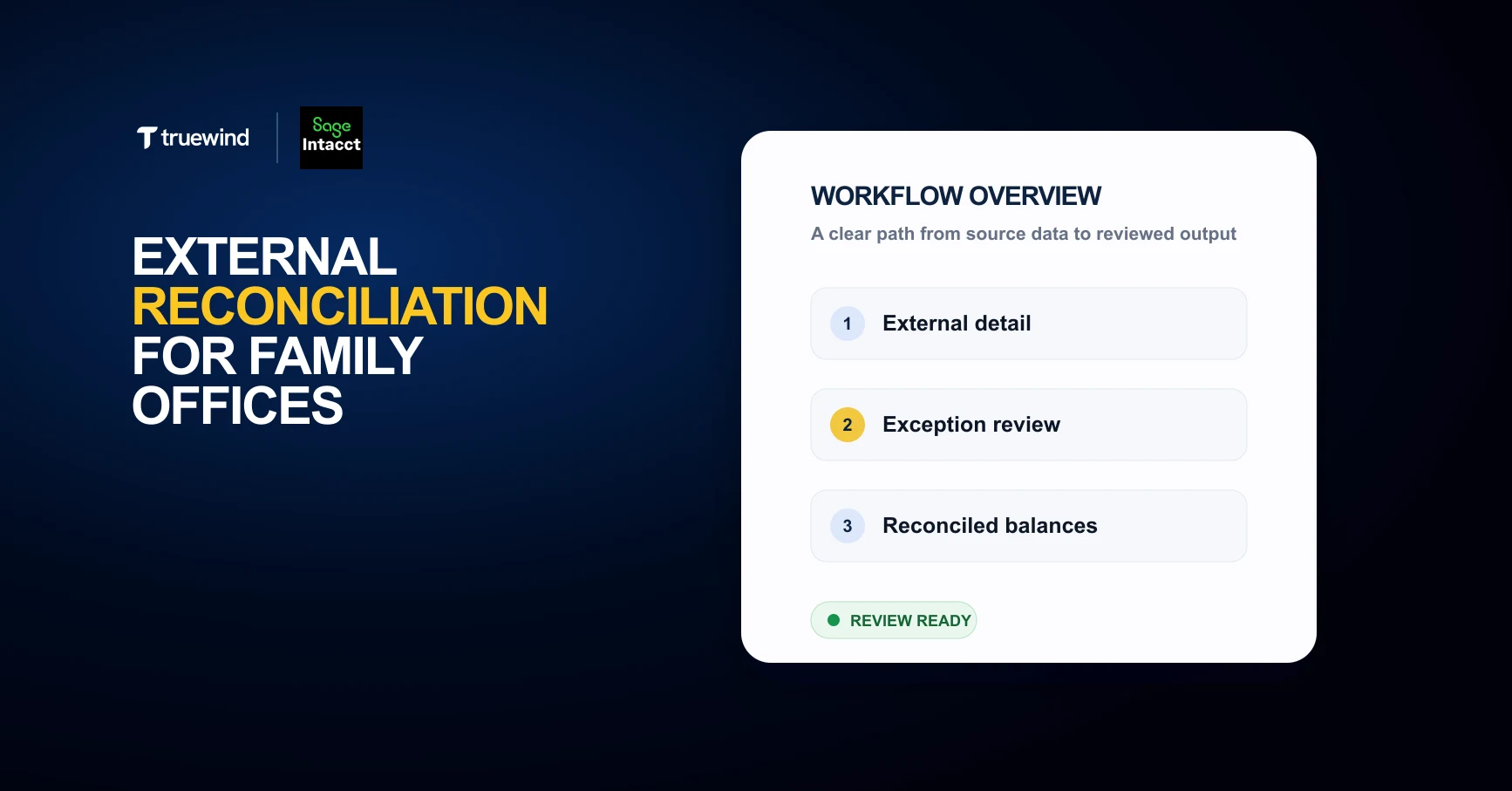
Your team just finished verifying 60 entities in Sage Intacct. You matched custodian statements to GL balances, traced capital calls across the entity tree, and logged every exception in a shared spreadsheet your senior accountant maintains outside the system. Sage stores the correcting entries once you post them, but the work of catching the discrepancy, routing it for review, and tracking whether it cleared happens entirely outside the GL. Family office accounting automation solves what Sage Intacct reconciliation limitations create: a verification layer that scales with entity count and transaction volume without adding headcount. When you're managing 200 brokerage accounts across 50 entities, you need a family office reconciliation layer that sits on top of Sage and handles the matching work the GL was never designed to run.
TLDR:
- Family offices with 50+ entities face 320-480 individual reconciliation tasks per close cycle.
- Sage Intacct stores transactions but cannot flag custodian mismatches or capital call gaps.
- Manual reconciliation consumes 30-40% of close time across hundreds of accounts per entity.
- AI reconciliation learns from historical patterns to catch exceptions rule engines miss.
- Truewind automates reconciliation across all entities and posts corrections to Sage via API.
What Multi-Entity Reconciliation Actually Means for Family Offices
Multi-entity reconciliation for a family office is not the same problem it is for a corporate finance team running a handful of subsidiaries. A family office managing wealth across 50 or more legal entities, each with its own investment accounts, bank relationships, capital call schedules, and distribution activity, faces a reconciliation burden that compounds with every entity added to the structure. Practical and financial challenges multiply across disconnected systems and reporting requirements. Multi-entity consolidation and partnership accounting create structural complexity that generic accounting platforms struggle to handle at scale.
The math is straightforward. If a family office holds 80 entities and each entity requires reconciliation across four to six accounts every month, the team is looking at somewhere between 320 and 480 individual reconciliation tasks per close cycle. Sage Intacct can store the results of that work. It does not generate it.
Where the Burden Actually Sits
The gap between what the GL records and what the reconciliation process requires is where family office accounting teams lose the most time:
- Each entity often holds a mix of liquid accounts, private equity positions, and alternative investments that require sourcing data from custodians, prime brokers, and fund administrators before any matching can begin.
- Capital calls and distributions require tracing cash movements across entities and verifying that intercompany eliminations are reflected accurately at the consolidated level.
- Exchange rate exposures across foreign accounts add a currency-translation layer that Sage Intacct does not automatically apply to each entity's reconciliation output.
The question facing most family office controllers is not whether reconciliation needs to happen. It is whether the GL is the right place to run it.
The Gaps Legacy Accounting Systems Create
Sage Intacct handles the general ledger well. It stores transactions, maintains chart of accounts structure, and supports multi-entity reporting. What it was not built to do is catch discrepancies across investment accounts, capital call activity, and custodian statements in real time.
Family offices running 10 or more entities face a specific compounding problem. Each entity carries its own set of bank accounts, brokerage accounts, and alternative investment positions. Each of those positions generates its own statements on its own schedule. Tying all of that back to the GL in Sage requires manual data pulls and variance tracking. At any meaningful scale, that work expands faster than headcount can.
Where the Gaps Show Up
- Bank and custodian feeds import into Sage, but the matching logic stops at the transaction level. When a wire hits the account three days after the expected settlement date, or a dividend posts across two line items instead of one, Sage stores what arrived . Flagging that something is wrong is your team's job.
- Capital call and distribution tracking across LP interests requires cross-referencing fund statements against committed capital schedules. Sage holds the journal entries, but the verification layer sits outside it, usually in a spreadsheet.
- Intercompany eliminations across related entities need a separate reconciliation pass before consolidated reporting can close. There is no automated exception queue in Sage that routes mismatches for review.
The result is GL accuracy through manual close work, but the work itself is still manual. That gap is where errors compound and close timelines stretch.
Why Sage Intacct Cannot Match Brokerage Accounts
Sage Intacct is built around a general ledger. It records journal entries, tracks dimensions, and closes books. What it was never designed to do is pull live data from a brokerage custodian, match positions across accounts, or flag discrepancies between a portfolio statement and what's posted in the GL.
For a family office, that gap is where reconciliation actually lives.
Brokerage accounts held at custodians like Schwab, Fidelity, or Pershing generate daily position files, transaction feeds, and end-of-period statements. Tying those back to the GL requires matching individual lots, tracking accrued income, and catching settlement-date differences. Sage Intacct has no native mechanism for any of that. Sage stores entries without custodian awareness.
Where the Breakdown Happens
The reconciliation gap shows up in three specific places:
- Sage cannot ingest custodian data feeds directly, so any comparison between the GL and a brokerage statement requires manual data pulls, formatting, and side-by-side review outside the system entirely.
- Unrealized gains, accrued dividends, and unsettled trades sit in custodian systems until someone posts them. Sage cannot surface the delta or tell you whether a position in the GL matches what the custodian reports as of the same date.
- When discrepancies exist across multiple accounts or entities, there is no exception queue in Sage to route them. The accountant owns that triage manually, account by account.
A family office running 15 or 20 brokerage relationships does not have a Sage problem. It has a structural gap that Sage was never intended to fill.
The Hidden Cost of Manual Reconciliation Workflows
Family offices running 50 or more entities spend an estimated 30 to 40 percent of their close cycle on reconciliation work alone. Across hundreds of accounts per entity, that time compounds fast.
| Entity Count | Accounts per Entity | Monthly Reconciliation Tasks | Estimated Close Time on Reconciliation |
|---|---|---|---|
| 10 entities | 4 to 6 | 40 to 60 | 15 to 20% |
| 50 entities | 4 to 6 | 200 to 300 | 30 to 40% |
| 80 entities | 4 to 6 | 320 to 480 | 40 to 50% |
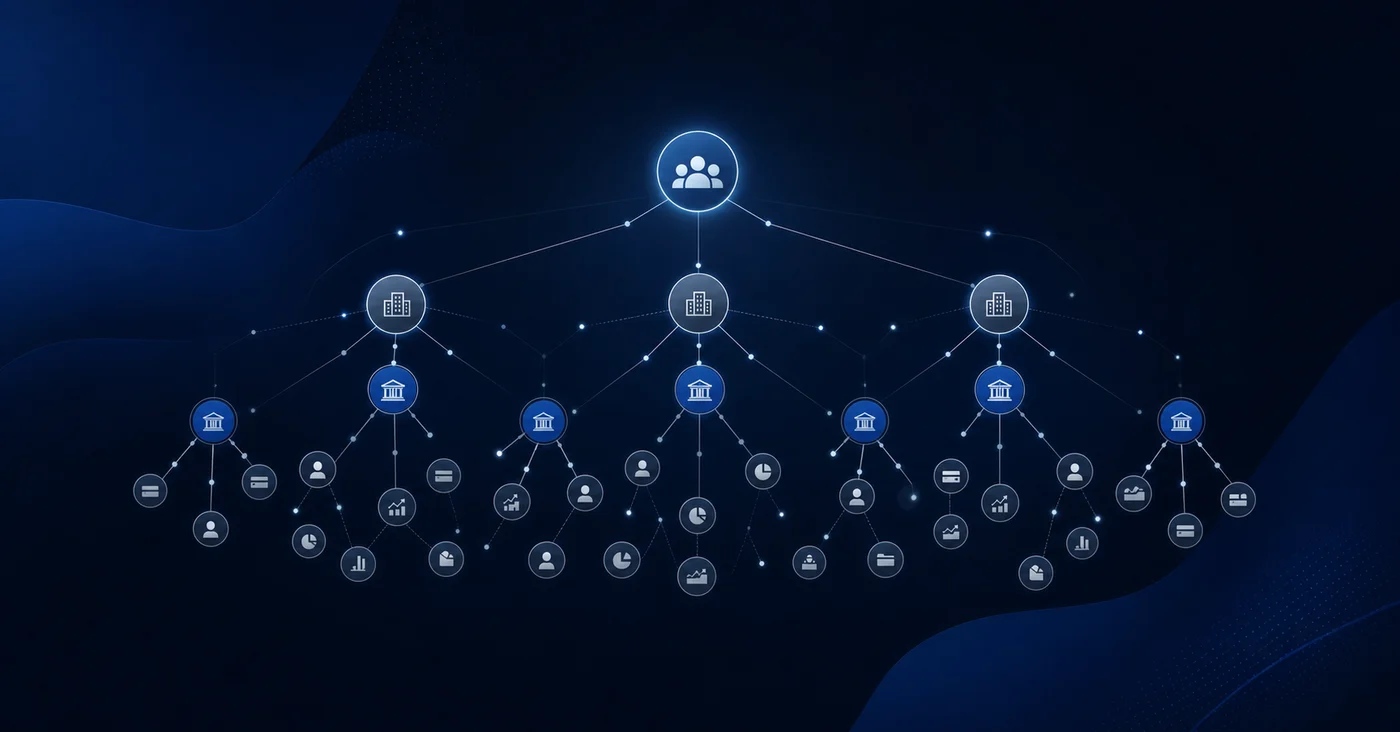
The core problem is structural. Sage Intacct stores what posted. It does not track whether that posting was verified against an external source, whether a position was matched to a custodian statement, or whether a prior-period exception was cleared. Each of those checks falls back on the accounting team to run manually, outside the GL.
Where the Hours Go
- Bank and custodian reconciliation requires pulling statements from each custodian, mapping them to the GL by account and entity, and manually flagging discrepancies. With 10 custodians across 50 entities, that is 500 discrete matching exercises per period.
- Investment position reconciliation means cross-referencing trade confirmations, NAV statements, and capital account balances against what was posted in Sage. When positions move mid-month, the differences require manual investigation before the close can proceed.
- Intercompany elimination checks require verifying that every intercompany payable has a corresponding receivable across the entity tree before consolidation can start.
None of this tracking lives inside Sage Intacct. The status of each reconciliation, who owns it, and what remains open is managed in spreadsheets outside the GL.
What a Reconciliation Layer Outside the GL Actually Does
A reconciliation layer outside the GL sits between your source data and your books. It pulls transaction activity from custodians, banks, fund administrators, and investment managers, then matches that data against what's posted in Sage Intacct before your team touches it.
The distinction matters for family offices because Sage Intacct stores what you've posted. It doesn't hold the raw inbound data from a prime broker, a capital call notice, or a private equity statement. When those sources don't match the GL, Sage has no mechanism to surface the gap automatically.
What the Layer Handles
A dedicated reconciliation layer covers three functions Sage Intacct leaves to your team:
- Ingesting and normalizing data from disparate sources, including custodians, fund admins, and alternative investment managers, into a consistent format before any matching begins.
- Running match logic across entity-level positions, cash balances, and transaction records, and routing exceptions into a structured queue for review.
- Tracking reconciliation status across all entities and accounts, so your team sees what's cleared, what's pending, and what needs escalation without manually checking each one.
The Three Reconciliation Workflows Family Offices Cannot Outsource
Three reconciliation workflows sit at the core of family office accounting, and each one breaks down in a predictable way when you try to run it through Sage Intacct alone.
Investment Account Reconciliation
Custodian statements arrive in formats that Sage was never designed to ingest automatically. Positions, dividends, accrued interest, and unrealized gains each need to tie back to the GL, across every entity in the structure. With 10 entities, that's manageable. With 50 or more, the volume compounds faster than any manual process can keep up with.
Capital Call and Distribution Tracking
Each call or distribution touches multiple entities simultaneously, often with different ownership percentages and waterfall structures. Sage stores what was posted. It doesn't catch what was missed or flag when a distribution hits one entity but not another.
Cash and Bank Reconciliation Across Entities
Family offices typically run separate bank accounts per entity. Matching each one in Sage requires opening each entity individually, verifying transactions, and carrying exceptions forward manually. There's no consolidated exception view across the structure.
Why AI-Powered Reconciliation Beats Rules-Based Matching
Rules-based matching works until the volume, entity count, or asset complexity makes the rule set unmanageable. For a family office running 30+ entities across private equity, real estate, and liquid portfolios, the number of matching rules needed to cover every custodian feed, capital call, distribution, and intercompany transfer grows faster than any team can maintain it.
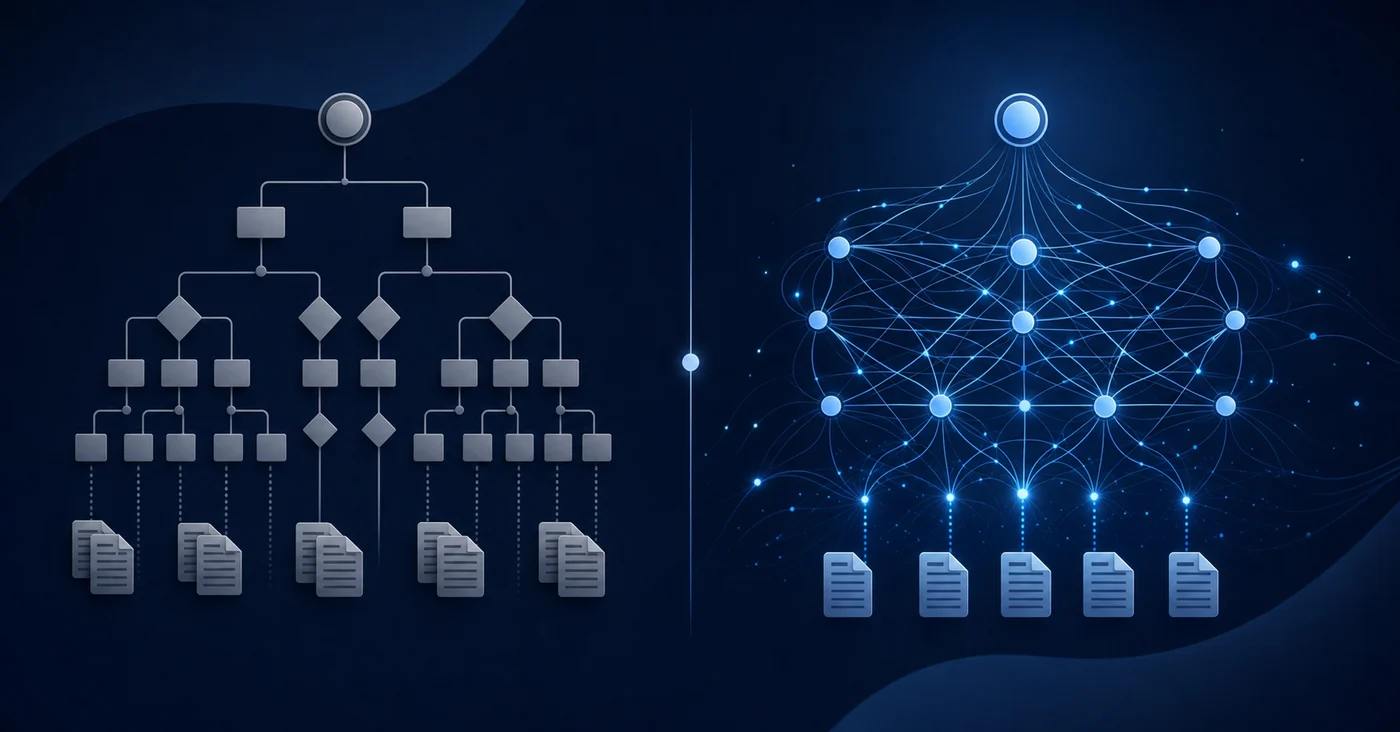
AI-driven reconciliation takes a different approach. Instead of asking accountants to pre-define every matching condition, it learns from historical transaction patterns and flags exceptions that deviate from them. The result is a reconciliation layer that gets more accurate as transaction volume grows, not one that degrades as edge cases accumulate.
Where AI Matching Pulls Ahead
- Rules engines require a human to anticipate every exception before it happens. AI matching identifies patterns across historical data and catches exceptions that no one thought to write a rule for, including timing differences, partial matches, and multi-leg entries across entities.
- For family offices with illiquid holdings, AI can match capital call drawdowns to LP commitment schedules even when amounts and dates vary by GP, something a static rule engine cannot handle without constant manual updates.
- Exception queues stay focused. AI triage routes only genuine discrepancies to the accountant, keeping review time proportionate to actual problems instead of noise from rule gaps.
Human review stays in the loop. AI surfaces the match or the exception; the accountant confirms it.
How Truewind Serves as the Reconciliation Layer for Sage Intacct Family Offices
Truewind sits on top of Sage Intacct as an AI execution layer, automating the reconciliation work that Sage's native tools leave to your team. Where Sage stores balances and transactions, Truewind reads that data through an API-level integration and runs the matching, exception routing, and status tracking that close requires.
For family offices managing dozens or hundreds of entities, that distinction matters. Truewind handles reconciliation across all entities in a single interface, flags discrepancies for human review, and posts correcting entries back to Sage without requiring your team to toggle between workpapers, spreadsheets, and the GL.
What This Looks Like in Practice
- Each entity's accounts are matched against source data, with unresolved items routed into an exception queue for your reviewers to clear.
- Correcting journal entries are prepared with dimension-aware coding and posted directly to Sage through the same API connection, preserving your chart of accounts structure.
- Reconciliation status rolls up across all entities so your controller can see, at a glance, what is cleared, what is in review, and what remains open before consolidated close .
Your team owns every final posting decision. Truewind handles the matching, the prep work, and the exception surfacing.
Final Thoughts on Family Office Reconciliation Workflows
Sage Intacct was built to store transactions and maintain a chart of accounts across entities. It was never designed to match custodian feeds, flag capital call discrepancies, or route exceptions for review. For family offices managing hundreds of accounts per close, that's where the actual work lives. If you're building that reconciliation layer manually, see how Truewind runs it on top of your GL.
FAQ
Can I match brokerage accounts directly in Sage Intacct without a separate tool?
No. Sage Intacct stores journal entries and tracks balances, but it cannot pull live position data from custodians, match individual lots across accounts, or flag discrepancies between portfolio statements and posted GL entries. For family offices with multiple custodian relationships, that reconciliation work happens entirely outside Sage.
What's the difference between a reconciliation layer and a general ledger for multi-entity family offices?
The GL stores what you've posted and maintains the chart of accounts structure. A reconciliation layer sits between your custodian feeds, bank statements, and fund administrator data and the GL. It ingests raw source data, runs match logic across all entities, and routes exceptions to reviewers before anything posts. Sage Intacct holds the final entries; it doesn't generate or verify them.
How much time does manual reconciliation actually take for a family office running 50+ entities?
If each entity requires reconciliation across four to six accounts per month, you're looking at 200 to 300 discrete matching exercises every close cycle. For offices with custodian relationships, capital call activity, and intercompany eliminations across that structure, reconciliation work can consume 30 to 40 percent of the total close timeline.
Why does rules-based matching break down at scale for family offices?
Rules work until the volume, entity count, or asset complexity makes the rule set unmanageable. When you're tracking private equity positions, real estate holdings, and liquid portfolios across dozens of entities, the number of matching conditions needed to cover every custodian feed, capital call variation, and distribution timing grows faster than any team can maintain it.
Sage Intacct reconciliation limitations vs AI reconciliation layer for family offices?
Sage Intacct requires manual data pulls and side-by-side comparison for each custodian statement, with no automated exception routing or consolidated status tracking across entities. An AI reconciliation layer ingests custodian data automatically, runs pattern-based matching across all accounts, and surfaces only genuine discrepancies for review, keeping reconciliation time proportionate to actual problems instead of total account volume.
Turn this into a close-ready workpaper
Start with sample files or upload your own statements to see how Truewind prepares review-ready workpapers and journal entries.