
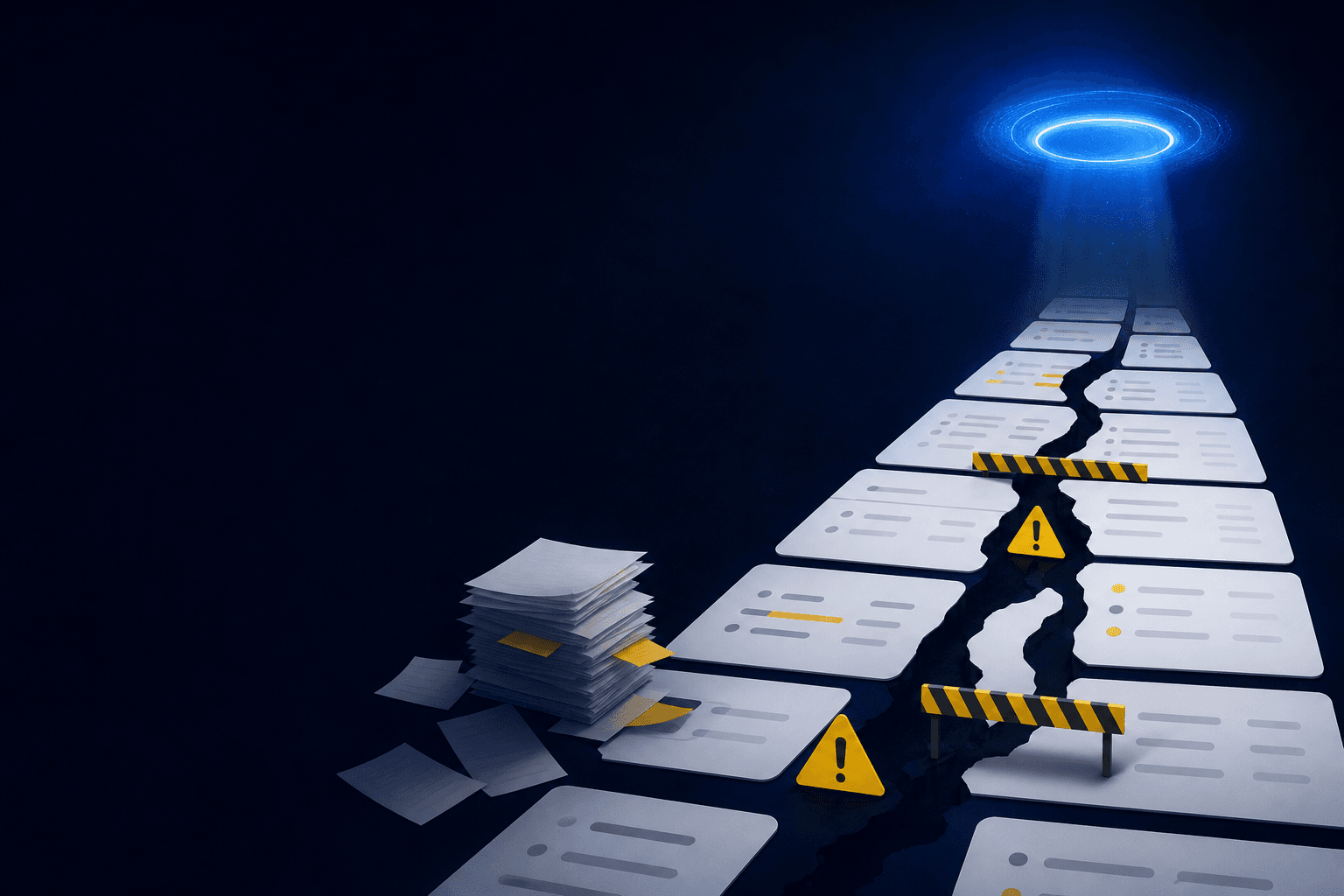
QuickBooks Online is ready for the journal entry. The journal entry is not ready for QuickBooks Online. A processor report still has to be matched to the bank, fees have to be separated from deposits, and the resulting entry has to carry the right account and dimensional coding. By the time the work reaches the ledger, most of the effort has already happened somewhere else.
That somewhere else is usually a collection of PDFs, spreadsheets, portal downloads, prior workpapers, and reviewer notes. The work is not limited to extracting numbers. Your team has to determine what each file represents, whether the period is complete, how the activity maps to the GL, and what changed from last month. Each decision has to survive review.
What accountants waste time on is the preparation between source and ledger. The close checklist may show one reconciliation task, but that task contains file collection, normalization, coding, matching, exception research, workpaper preparation, and reviewer follow-up. Treating all of that as data entry misses the accounting work inside it.
Where accounting time disappears before review
The first drain is source-file preparation. A bank feed may already be available, while the processor detail arrives as a CSV and the support for a balance sits inside a PDF statement. A nonprofit may need donor-platform activity, payment-processor settlements, and bank deposits in the same reconciliation. A family office may need custodian statements organized by entity before investment activity can be prepared.
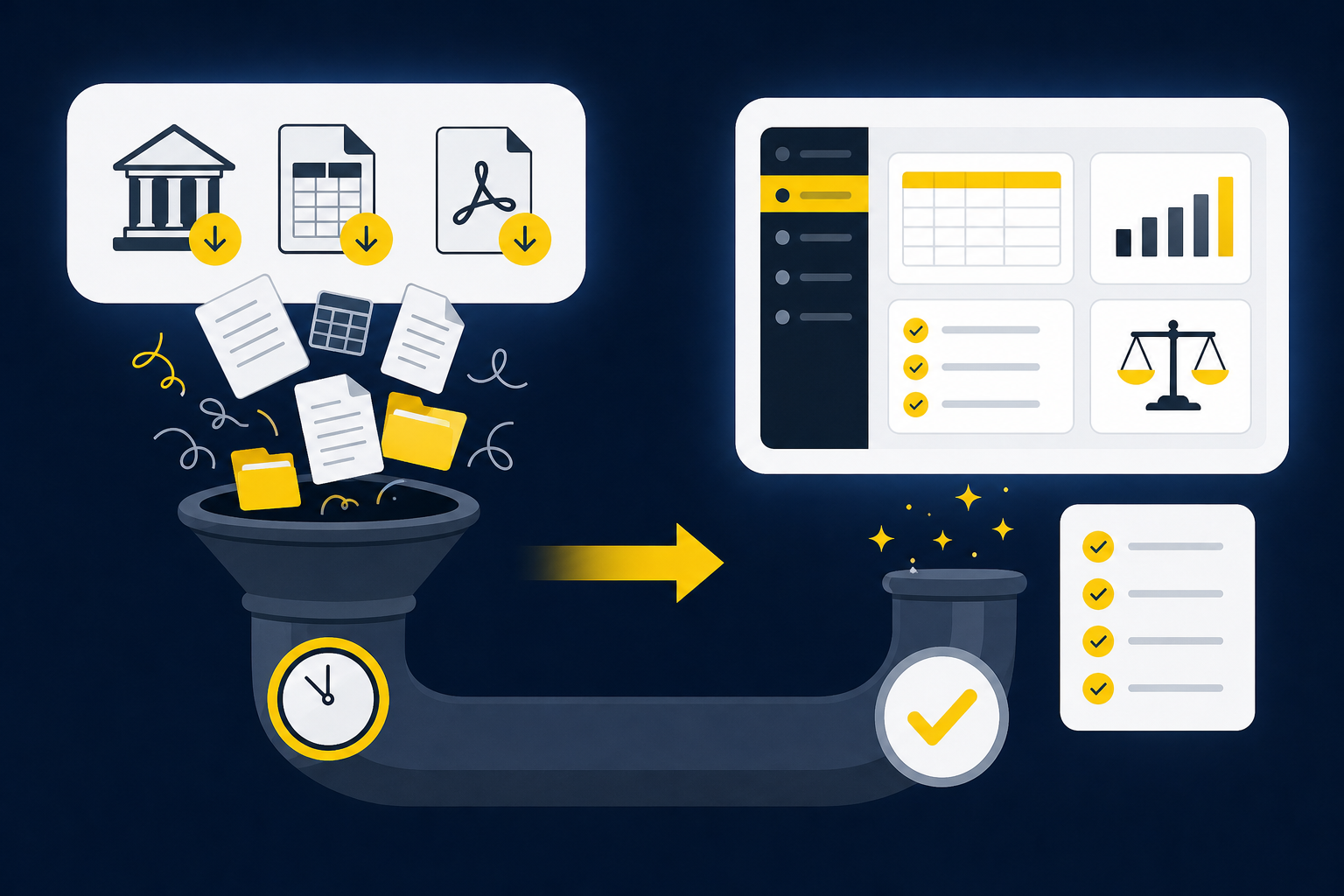
Collecting those files is only the start. The team still has to decide which period each file covers, whether anything is missing, and how the columns or statement sections correspond to the workpaper. A changed export format can break a spreadsheet that worked last month. A new statement layout can force the preparer to reconstruct a familiar schedule from unfamiliar source material.
Coding creates another layer of work because recurring transactions are not always generic. The same vendor can require a different account, department, fund, or entity treatment depending on context. Prior workpapers and reviewer corrections often contain the real operating rules, but those rules may be scattered across formulas, comments, and email. The preparer has to find them before applying them again.
Reconciliation then brings several descriptions of the same activity together. The processor reports gross activity, fees, refunds, and settlements. The bank records deposits. The ERP records whatever the team posted. If the sources do not agree, someone has to determine whether the difference is timing, missing activity, an incorrect classification, or an item that requires judgment.
Review adds work when the prepared output does not carry its own explanation. A clean journal-entry draft is not enough if the reviewer has to reopen the statement, trace formulas across tabs, and ask how the treatment was chosen. The workpaper needs to show the source, calculation, treatment, exceptions, and sign-off in a form the reviewer can inspect.
Truewind prepares that review surface from the source files and historical accounting context already used by the team. The specific handoff from source-linked preparation to accountant review is easier to understand when you can inspect it directly, so See Truewind in action and follow an item from its supporting file through the workpaper and exception queue. Sage Intacct or QuickBooks Online remains the system of record after the accountant approves the output.
A clean answer is not the same as reviewable work
Controllers are not only evaluating whether an AI-produced number appears correct. They need to know how the number was produced, which source supports it, what rule was applied, and whether the current period differs from the approved prior period. A polished answer without that context can create more review work because the reviewer has to rebuild the reasoning independently.
The workpaper is where preparation becomes usable. It keeps the current-period source beside the calculation and accounting treatment, then separates prepared items from exceptions that require a decision. A reviewer can trace the work, re-perform the important steps, correct the treatment, and sign off without reconstructing the process from disconnected files.
Source traceability also matters after the close. A question from an auditor, board member, or finance leader may arrive after the original preparer has moved on to another period. If the source and reviewer decision remain attached to the workpaper, the team can inspect what happened. If they do not, the explanation has to be rebuilt from folders, spreadsheets, and inboxes.
Customer conversations show why the distinction matters, but they should not be treated as universal benchmarks. In one case, an accounting firm reported reducing the time spent categorizing credit-card transactions by approximately 75%. Its description of the mechanism was direct: “Truewind automates a huge chunk of that busywork.” The firm connected that reduction to where its staff could spend attention, saying, “It's not just about making bookkeeping simpler; it's about freeing up teams, and helping them focus on higher-value projects.”
A lead-generation company described a similar shift after using Truewind for recurring bookkeeping and categorization. The company reported reducing monthly bookkeeping from about ten hours to under 30 minutes, an observed customer result rather than a promise for another team. Its assessment was equally direct: “It's essentially perfect. Categorization is accurate, and we stopped having to double-check everything.” The relevant point is not that review disappeared; it is that recurring preparation followed known treatment closely enough for attention to move toward the items that needed it.
Exceptions belong in front of the accountant
An exception is not evidence that accounting automation failed. It is evidence that the current period does not fit the learned process closely enough to proceed without judgment. Missing statements, unexpected balance changes, mixed personal and business activity, and inconsistent classifications belong in front of an accountant with the supporting source attached.
Silent resolution would remove the very control the reviewer needs. A missing statement should not be treated as a zero balance. An unexpected classification should not inherit last month’s treatment without inspection. An unreconciled difference should not be forced into agreement merely because the workpaper is expected to tie.
Useful exception handling starts with a defined process. The workflow knows which inputs are expected, how the team treated comparable activity before, and which totals or dimensions should agree. Current-period preparation can then be compared with that context. Items that fit proceed into the prepared workpaper, while items outside the process move to a review queue.
The accountant still owns the call. A reviewer can confirm the proposed treatment, adjust it, or return the item for more preparation. Capturing that decision against the workflow matters because the next period should reflect the team’s confirmed treatment without changing accounting policy on its own.
Truewind’s Proactive Anomaly Detection follows that pattern. It compares current preparation with the learned process and prior workpapers, then presents unusual items with source links for review. The capability does not resolve exceptions autonomously or post a correction to the GL. It gives the accountant a smaller, better-supported set of judgment items to inspect.
For teams evaluating how that exception queue connects to the workpaper, Book a Truewind demo and use one of your recurring reconciliations as the reference point. The useful test is whether your reviewer can distinguish completed preparation from unresolved judgment without reopening every source file. That review pattern matters more than a generic automation claim.
What preparation automation should actually do
Preparation automation should begin with a recurring workflow the team already understands. Good candidates have known source files, a prior approved workpaper, established accounting treatment, and a reviewer who can evaluate the result. A donation reconciliation, processor settlement reconciliation, brokerage rollforward, prepaid schedule, or fixed-asset schedule can provide that boundary.
The first step is structuring the inputs. Truewind accepts recurring sources such as bank activity, credit-card statements, processor and donor-platform exports, custodian statements, payroll registers, prior workpapers, and operational-system exports. Those files become inputs for coding, reconciliation, schedule creation, and workpaper preparation. Coverage still depends on the source types the team connects; unsupported documents are not interpreted without review.
Historical context comes next. Truewind records confirmed treatment and reviewer corrections, including coding decisions, allocation choices, and classification splits. The next period can use that history during preparation, while rule changes and novel items remain visible to the reviewer. Historical learning is bounded by the team’s rules and corrections, not an independent accounting policy engine.
For recurring accounts, Workpaper Generation and Rollforward combines the prior workpaper, current source documents, and ERP balances. Balances roll forward, supporting schedules update, and any required journal-entry draft is prepared with source-linked support. The platform surfaces exceptions instead of resolving them, and the accountant retains ownership of review and posting.
Multi-Source Reconciliation addresses workflows where several systems describe the same activity differently. Truewind can align a donor platform, payment processor, and bank, or a custodian statement, investment-vehicle statement, and ERP balance. Fees, refunds, and timing differences remain tied to the underlying sources, while unreconciled items go to the accountant rather than being forced to agree.
Dimensional and Allocation Preparation preserves the context that a flat bank feed cannot provide. Program, fund, department, location, purpose, or entity coding can follow explicit team rules, including reviewable split allocations. Edge cases and rule changes remain visible in the workpaper. The system does not make an autonomous allocation decision when the existing rule does not cover the activity.
The resulting work moves into Truewind’s Human-in-the-Loop Review Workflow. Accountants inspect workpapers, reconciliations, schedules, journal-entry drafts, source links, and exceptions before anything is used downstream. They can confirm an item, adjust it, or send it back for preparation. Nothing leaves review without accountant sign-off.
After approval, Truewind can push structured output to Sage Intacct or QuickBooks Online with coding, dimensions, and source references preserved. Those are the documented ERP targets. Truewind remains upstream, and the connected ERP remains the system of record. No entry is pushed without reviewer confirmation.
Start with proof your reviewer can inspect
A broad promise to automate the close is difficult to test. A bounded workflow is not. You can compare the prepared output with a known answer, inspect every difference, confirm whether the source trail is complete, and see whether corrections remain available to the next period.
Choose the workflow by evidence, not visibility. The first candidate should recur, have stable source availability, and produce an artifact the reviewer already knows how to evaluate. Work with a prior approved workpaper and current-period files. A workflow with unclear ownership or changing accounting policy is a poor starting point because the team cannot separate preparation quality from unresolved process design.
Review should include more than whether the ending balance ties. Check whether every expected source arrived, whether dimensions survived preparation, whether exceptions are complete, and whether the proposed treatment matches the team’s approved process. Ask the reviewer to trace selected lines back to source and explain what would prevent an unapproved item from reaching the ledger.
Corrections are part of implementation. Early review may reveal an account mapping that was never documented, an allocation rule that only existed in one preparer’s workbook, or a cutoff convention that changed by entity. Capturing those decisions makes the workflow more explicit. It does not transfer ownership of the decision away from the accountant.
Expansion should follow the same pattern. Once one recurring workflow produces understandable workpapers and appropriate exceptions, the team can evaluate the next account or entity. Controlled iteration gives reviewers evidence from their own process rather than asking them to trust a general claim about AI.
Truewind is not designed for a team seeking autonomous posting or a replacement for its ledger. It assumes an established close, recurring source flows, prior examples, and an accountant who owns review. If those conditions match your preparation process, Get a Truewind demo and bring the source files and approved workpaper from one bounded workflow. The discussion can then stay on the accounting work your reviewer needs to inspect.
Move accounting effort toward judgment
The recurring work accountants waste time on is rarely one dramatic task. It is the accumulation of source collection, format changes, repeated coding, reconciliation differences, workpaper rollforwards, and review questions that arrive before judgment can begin. Each step matters, but each step does not require the same level of human attention.
The better division of work is specific. Software prepares recurring work from known sources and historical treatment, produces a traceable workpaper, and surfaces what does not fit. The accountant reviews the treatment, resolves the exceptions, and approves what reaches the GL.
Sage Intacct and QuickBooks Online still record the books. The reviewer still owns the result. What changes is the work placed in front of that reviewer: prepared support tied to source, visible exceptions, and an approval step that stays with the accounting team.
Frequently Asked Questions
How do I manage source-file preparation for reconciliation?
To manage source-file preparation effectively, start by gathering all relevant documents like bank statements, processor reports, and prior workpapers. Ensure you understand the period each file covers and check for any missing documents. Next, align the columns or sections of each file with your workpaper structure to avoid confusion during reconciliation. This step is crucial as mismatched formats can lead to errors and delays.
What if my reconciliation shows discrepancies?
If you encounter discrepancies during reconciliation, first verify the source documents to ensure all data is accounted for. Check for timing differences, missing transactions, or incorrect classifications. If items still don’t match, document the differences and prepare them for review. This process helps maintain clarity and ensures that the accountant can make informed decisions on how to resolve the discrepancies.
Can I automate journal entry preparation?
While you can streamline the process, automation requires structured inputs and historical context. Start by using Truewind to ingest your recurring source files, which will help prepare your journal entries. However, remember that all outputs must go through human review before posting to your general ledger. This ensures that the entries are accurate and aligned with your accounting standards.
When should I surface exceptions for review?
You should surface exceptions for review whenever there are items that do not fit the learned process. This includes missing statements, unexpected balance changes, or inconsistent classifications. Present these items to the accountant with the necessary source context, allowing them to make informed judgments. This approach helps maintain control over the accounting process and ensures that exceptions are handled appropriately.
Why does my workpaper need to show source traceability?
Source traceability is vital because it allows reviewers to understand how figures were derived and ensures transparency in the accounting process. A workpaper that links back to the original source documents helps prevent confusion and errors during review. It also aids in audits, as it provides a clear trail of how each figure was calculated and who approved it, making the entire process more reliable.
Turn this into a close-ready workpaper
Start with sample files or upload your own statements to see how Truewind prepares review-ready workpapers and journal entries.