

A processor changes its settlement export, and the deposit that tied last month no longer ties the same way. The bank shows one net amount. The processor separates fees, refunds, and timing differences. Your prior workpaper contains the mapping logic, but the new file has to be interpreted before that logic can be applied. Nothing is ready for review yet.
An open-ended AI prompt can produce an answer from part of that information. It cannot, on its own, establish which sources are complete, preserve the team’s dimensional treatment, surface the unmatched items, and stop the work before an unapproved entry reaches the GL. Those are workflow requirements, not writing tasks. They are also the practical difference between automation that produces output and automation an accounting team can control.
What controlled automation means is straightforward: the system performs defined preparation work, shows how it reached the result, routes exceptions to an accountant, and requires approval before anything is used downstream. The accountant still owns the policy, treatment, and sign-off. The automation handles repeatable execution inside those boundaries.
Controlled automation starts before the ledger
Most close automation discussions begin too late. They start with the journal entry or the balance in Sage Intacct or QuickBooks Online, after someone has already gathered the files, normalized their structures, applied the mappings, and resolved the obvious discrepancies. The ERP records the result. It does not prepare every piece of work required to make that result reviewable.
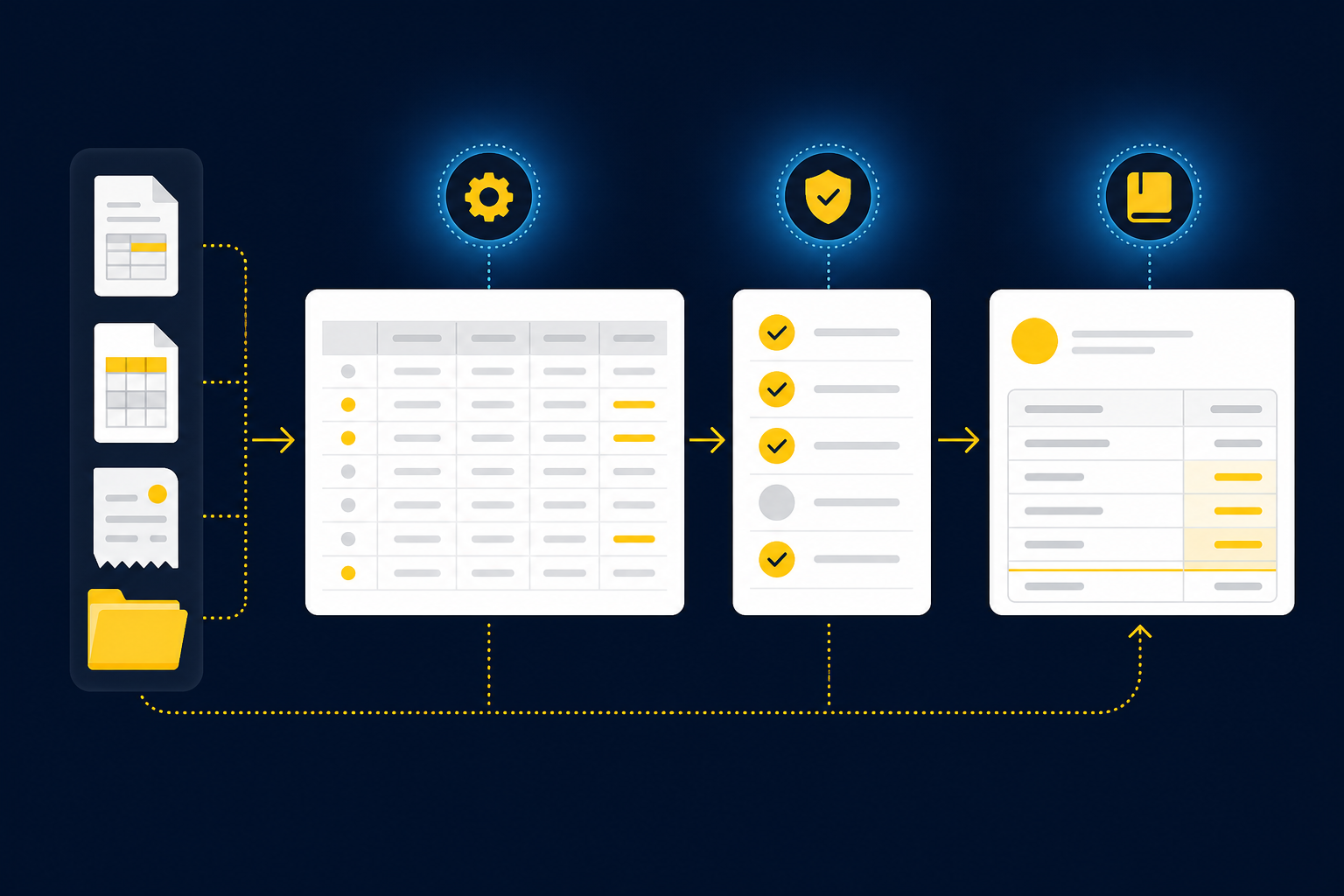
The preparation layer starts with the source material your team actually receives. A nonprofit may need to combine donor-platform activity, processor settlements, and bank deposits while preserving fund or campaign coding. A family office may need to read custodian statements across several entities and apply different treatment by account. A CAS practice may receive a different mix of PDFs, spreadsheets, and operational exports from every client. Clean bank activity is only one source among many.
Controlled automation treats that inconsistency as part of the accounting workflow. The system has to determine what each document represents, structure the relevant activity, apply the team’s existing rules, and tie the prepared output back to source. When a format changes or a required statement is missing, the workflow should surface the problem rather than fill the gap with an assumption.
Truewind is built for that source-to-review path. It ingests supported recurring source files, structures them for coding and reconciliation, and prepares workpapers, schedules, and journal-entry drafts for accountant review. If you want to inspect that preparation flow from source material through reviewer sign-off, you can See Truewind in action in the context of a recurring close workflow.
Manual touch is not the same as operational control
A spreadsheet-driven process can feel controlled because every step has a person attached to it. Someone downloads the report. Someone updates the workpaper. Someone checks the formulas and emails the reviewer. The process is visible, but the control is often spread across files, inboxes, folder conventions, and decisions that were never recorded outside a preparer’s notes.
Operational control asks different questions. Which source supported the number? Which rule produced the classification? What changed from the prior period? Which items did not fit the expected pattern? Who approved the final treatment before the entry moved into the ledger? A process is controlled when the team can answer those questions from the work itself, not when a person has manually touched every row.
That distinction matters as the close grows across entities and account types. If a manager has to take over for an unavailable preparer, the workflow cannot depend on memory alone. The prior workpaper, source files, mapping decisions, and reviewer corrections need to carry the process forward. Repeating the work manually is not the same as repeating it consistently.
Customer language makes the capacity point plainly. One accounting-firm customer said, “Truewind automates a huge chunk of that busywork.” The same customer explained the consequence: “It's not just about making bookkeeping simpler; it's about freeing up teams, and helping them focus on higher-value projects.” Those comments describe one customer’s experience, not a universal result, but they capture the practical goal. Preparation moves into a defined workflow so experienced accountants can spend more of the close investigating changes and reviewing judgment items.
The workpaper is where automation becomes reviewable
A clean journal-entry draft is not enough. The reviewer needs the source, calculation, accounting treatment, exceptions, and approval history that sit behind it. Without that support, a polished entry can create more work because the accountant has to reconstruct the reasoning before deciding whether the result is usable.
The workpaper provides that review surface. It brings current-period source documents together with the prior approved treatment, rolls the relevant balances or schedules forward, and shows where the current period differs. The reviewer can trace a prepared line to its source, inspect the classification or allocation applied, and decide whether an exception requires a new treatment. Review stays attached to the accounting work instead of moving into a separate email thread.
Controlled automation also keeps preparation and approval distinct. The system may propose coding based on user-defined rules and prior reviewer corrections. It may prepare a reconciliation across systems that describe the same activity differently. The reviewer still confirms the treatment, adjusts it where needed, and signs off before the output moves downstream.
Truewind’s human-in-the-loop review workflow presents prepared work with source links, exceptions, and reviewer actions. Corrections and confirmations remain connected to the workflow so they can inform later periods without changing accounting policy on their own. To see how that review surface handles source support and exceptions, you can Book a Truewind demo around one of your existing workpapers.
Exceptions are part of the control design
Missing statements, unexpected balance changes, mixed personal and business activity, and inconsistent classifications should not disappear inside automation. Each one signals that the current period does not fit the process the system was given. Resolving it may require information the source files do not contain or judgment that belongs to an accountant.
A controlled workflow identifies the mismatch and hands it to the reviewer with the relevant source context. It does not force totals to agree or apply a new classification because the old one no longer fits. The goal is not to eliminate exceptions. The goal is to separate prepared work from items that require a decision.
That separation changes review. Instead of rechecking every line because the reviewer cannot tell what the system did, the accountant can inspect the prepared work and focus attention on what changed. The exception remains visible, the reviewer’s decision is captured, and a similar item can follow the confirmed treatment in a later period. Novel items still return to the accountant.
One customer described the broader experience by saying, “If I had to describe Truewind in one word: Lifechanging.” Another said, “Truewind has been amazing.” Those statements come from individual customer accounts and should be read that way. The mechanism behind them is more useful than the adjectives: recurring work was prepared inside a process that retained human review rather than asking the customer to accept an unexplained answer.
Start with a bounded recurring workflow
Controlled automation is adopted through comparison, not a leap of faith. The first workflow should have recurring inputs, an established preparation process, a prior approved result, and a reviewer who knows what acceptable work looks like. A brokerage rollforward, processor reconciliation, prepaid schedule, or recurring account workpaper can fit that pattern when the source files and treatment are already understood.
Start by giving the system the prior workpaper, current-period sources, applicable ERP balances, and the team’s existing rules. Compare the prepared result with the known process. Review what matched, inspect what differed, and record the corrections. The workflow earns a broader role when the team can see that its sources, calculations, exceptions, and reviewer decisions remain inspectable.
A practical evaluation should answer five questions:
- Are the source files complete and retained with the workflow?
- Does the preparation preserve the required account, fund, department, or entity dimensions?
- Can the reviewer trace each material result to its supporting source?
- Are unusual items surfaced instead of resolved without approval?
- Does anything reach the GL before an accountant signs off?
A workflow that cannot answer those questions is not controlled merely because it uses AI. A workflow that can answer them gives the team a basis for deciding where to expand next. The rollout can move from one recurring workpaper to adjacent reconciliations or schedules after the known process has been reproduced and reviewed.
The accounting-firm customer’s phrase is useful here too: “Truewind automates a huge chunk of that busywork.” The chunk matters. It is defined preparation with known inputs and an expected output, not every accounting decision the team could encounter. Controlled scope is what makes review possible.
Where Truewind fits in the close
Use those same review questions when evaluating Truewind. Truewind sits between recurring source files and the general ledger. Multi-source ingestion structures supported inputs such as bank activity, processor exports, donor-platform files, custodian statements, prior workpapers, and operational-system exports. Historical-example learning then applies the team’s captured coding decisions, allocation choices, and reviewer corrections to the current period, subject to review.
For reconciliations, Truewind aligns activity across sources, accounts for supported fees, refunds, and timing differences, and prepares a reconciliation and support schedule tied back to those sources. Unreconciled items are surfaced to the accountant. The system does not force the numbers to agree, resolve the exception on its own, or post a reconciling entry without approval.
For recurring workpapers, Truewind loads the prior workpaper, current-period documents, and ERP balances. It rolls balances forward, updates supporting schedules, prepares required journal-entry drafts with source-linked support, and sends exceptions to the reviewer. Prepaid and fixed-asset schedule preparation follows the team’s existing treatment; it does not create amortization, depreciation, or accounting policy independently.
Reviewer sign-off remains the boundary. Once the accountant confirms the prepared output, Truewind can push structured output to Sage Intacct or QuickBooks Online with coding, dimensions, and source references preserved. Those systems remain the source of record. Truewind does not replace the GL and does not post without reviewer confirmation.
The fit is specific. Truewind is designed for accounting teams that already have a recurring close, prior examples, and a reviewer who owns the result. It is not designed for personal finance, businesses without a dedicated close process, buyers seeking autonomous posting, or teams trying to replace their ERP. If your team has a bounded workflow with source files and a known review standard, you can Get a Truewind demo focused on that exact process.
Control stays with the accountant
Controlled automation does not ask you to choose between manual rigor and unsupervised AI. It moves repeatable preparation into a defined workflow while keeping accounting judgment, exception handling, and final approval with the people responsible for the books. The source remains visible. The treatment remains reviewable. The GL remains the system of record.
The useful question is not whether AI can produce a journal entry. It is whether your reviewer can see where that entry came from, understand what rules were applied, inspect what did not fit, and approve the result before it posts. When those controls are built into the workflow, automation becomes part of the close without taking ownership away from the accountant.
Frequently Asked Questions
How do I handle exceptions in my accounting process?
To manage exceptions effectively, start by ensuring your workflow identifies any discrepancies, such as missing statements or unexpected balance changes. Truewind surfaces these issues for review, meaning you can focus on judgment items rather than rechecking every detail. Make sure your team is familiar with the source context of these exceptions so they can make informed decisions. This way, you maintain control over the process while still benefiting from automation.
What if my source files are inconsistent?
Inconsistent source files can complicate your accounting workflow. To address this, ensure that your system, like Truewind, is set up to ingest various formats and organize them into a structured workflow. This preparation layer allows your team to focus on coding and reconciliation without getting bogged down by formatting issues. Always review the structured outputs to confirm they align with your existing accounting rules and practices.
How do I ensure my accounting team maintains control over automation?
To keep control over automation, implement a human-in-the-loop review process. This means that even as Truewind prepares workpapers and journal entries, your accountants should review and approve each output before it reaches the general ledger. This way, you preserve the necessary oversight while benefiting from the efficiency of automation. Make sure your team is trained to trace prepared work back to its source for full transparency.
When should I consider using Truewind for my finance team?
Consider using Truewind if your team has a recurring close process with established inputs and a known review standard. If you frequently handle tasks like reconciliations, workpaper rollforwards, or journal-entry drafting, Truewind can streamline these processes while ensuring all outputs are review-ready. Start by assessing whether your current workflow can be improved with structured automation while retaining the necessary human oversight.
Turn this into a close-ready workpaper
Start with sample files or upload your own statements to see how Truewind prepares review-ready workpapers and journal entries.