
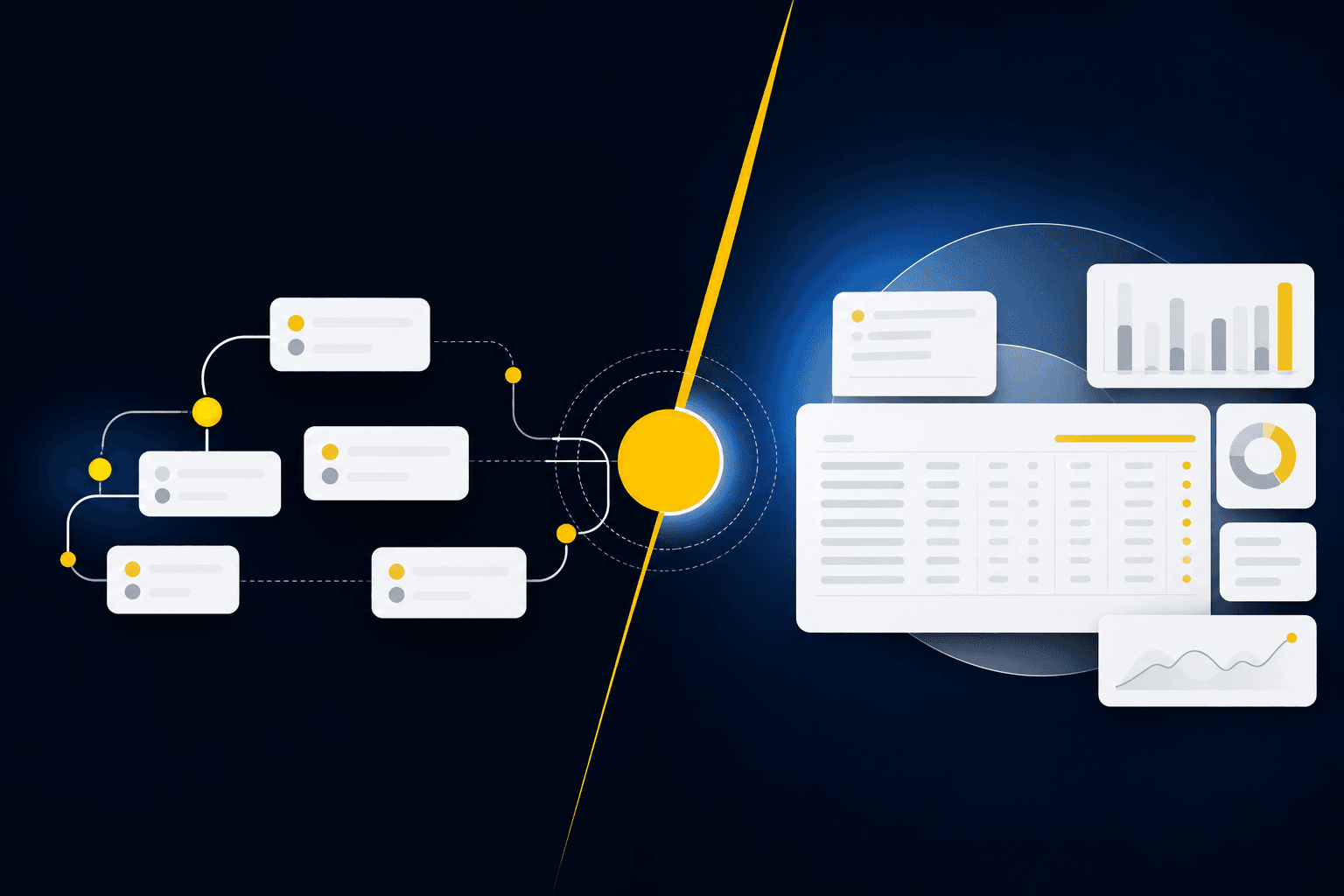
A month-end close can fall behind even when every task has an owner. The missing work may happen earlier, when accountants are combining source files, applying dimensions, reconciling balances, building support schedules, and preparing journal entries for review. Choosing financial close management software starts with identifying which part of that operating chain still depends on manual effort.
Two Different Approaches to Automating the Financial Close
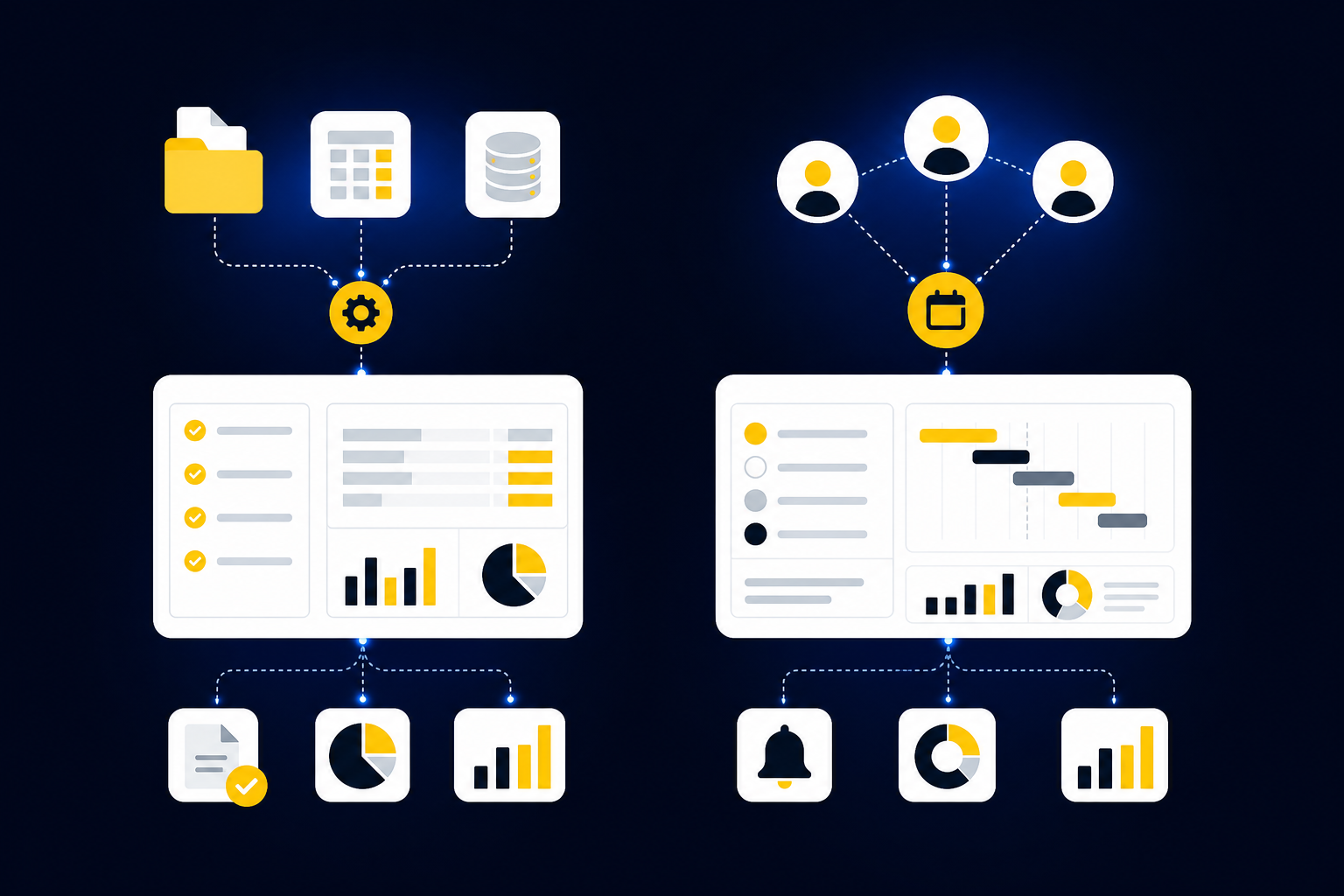
Financial close automation generally addresses one of two operating problems: preparing accounting work or coordinating the close around it. Preparation begins with source files, mappings, reconciliations, schedules, and workpapers; close management begins with tasks, owners, deadlines, sign-offs, and status. The distinction matters because each approach removes a different bottleneck.
Quick Comparison by Operating Model
A preparation-first approach handles the accounting work that must happen before a reviewer can approve a reconciliation, schedule, or journal entry. It addresses the path from operational source material to a review-ready accounting artifact.
A close-management approach organizes the people, controls, and deadlines around period-end work. It helps a controller see what is complete, what is late, who owns the next action, and whether required evidence or approval has been recorded.
Financial Close Automation Approaches at a Glance
| Evaluation Area | Preparation-First Approach | Close-Management Approach |
|---|---|---|
| Primary job to be done | Prepare recurring accounting work | Coordinate and govern period-end work |
| Starting point | Statements, reports, exports, prior workpapers, and GL data | Close calendar, checklist, assignments, and policies |
| Source-document handling | Interprets and structures supported source files | Tracks tasks and evidence associated with the close |
| Workpaper preparation | Produces schedules, reconciliations, and journal-entry support | Organizes prepared work within the close process |
| Task coordination and visibility | Secondary to accounting preparation | Central operating focus |
| Best-fit bottleneck | Accountants still assemble the work manually | Work is prepared but difficult to monitor and control |
Key takeaways
- Preparation automation addresses source files, coding, reconciliations, schedules, and workpapers before an accountant begins the final review.
- FloQast focuses on close coordination, accountability, reconciliations, journal-entry workflows, compliance, and period-end visibility.
- Quote-based pricing makes a workflow-specific demonstration and clearly scoped proposal important parts of the evaluation.
- The deciding question is whether your bottleneck is producing accounting work or coordinating work that is already prepared.
Choose Between Close Coordination and Accounting Preparation
Choose close coordination when prepared work is difficult to track, and choose preparation automation when creating that work still consumes the team. A checklist can expose late reconciliations, but it does not necessarily assemble the supporting schedule. The practical test is simple: identify where accountants spend effort before review can begin.
Close Management Organizes Work and Accountability
Close management gives the controller an operating view across tasks, deadlines, dependencies, preparers, and reviewers. That matters when work is spread across entities or departments and the team needs a consistent process for proving that required steps were completed.
Consider a reconciliation that is already prepared in a spreadsheet. The immediate management questions are about ownership and control: Who prepared it? Has the reviewer signed off? Is supporting evidence attached? Is an unresolved item holding up another task? Close orchestration software creates structure around those questions.
The close-management model is useful when the accounting work itself is largely under control. The team knows how to prepare its workpapers and journal entries, but status lives in meetings, messages, spreadsheets, or disconnected trackers. Centralizing the close can improve visibility without changing the accounting process underneath it.
Preparation Automation Produces Review-Ready Accounting Work
Preparation automation starts earlier. The problem is not that a task lacks an owner. The problem is that the owner must download a processor report, combine it with bank activity, apply account and dimension mappings, check totals, investigate differences, update a workpaper, and draft the journal entry before anything is ready for review.
That work is accounting, not simple file movement. A source-to-GL workflow has to determine what each file represents, how it relates to prior periods, which accounting rules apply, and where the evidence belongs. It also has to stop when the available information does not support the expected treatment.
The output should therefore be more than extracted rows. A useful preparation layer produces a workpaper that connects the source, calculation, accounting treatment, exceptions, and reviewer decision. The accountant still owns the result. Automation handles the repeatable preparation while preserving the review surface where judgment belongs.
The Right Choice Depends on Where Manual Work Persists
Map one recurring workflow from receipt of source material through approval. Do not start with a software feature list. Start with the actual work performed by the preparer and reviewer.
If most of the effort happens after the accounting artifact exists, close management is likely the closer fit. Your team may need clearer deadlines, stronger sign-offs, better evidence collection, and a consolidated view across the close.
If most of the effort happens before the artifact exists, task visibility will only expose the bottleneck. The team may still be combining files, applying classifications, maintaining schedules, reconciling external activity to the GL, and writing reviewer notes manually.
Three questions usually clarify the decision:
- Does the accountant begin with a prepared workpaper or a folder of source files?
- Is review delayed by missing status, or by missing accounting support?
- Would another qualified accountant understand the treatment from the source, calculation, exceptions, and recorded approval?
Some teams need both operating layers. That does not make the products interchangeable. It means preparation and close coordination solve adjacent parts of the same process.
Where FloQast Fits in the Financial Close
FloQast fits teams that need a structured layer for managing and controlling the period-end close without replacing the ERP. Its published materials cover close workflows, reconciliations, journal-entry processes, compliance, and AI-assisted capabilities (FloQast). That makes it relevant when preparation exists but coordination and visibility need more discipline.
Strengths: Close Visibility, Accountability, and Audit Support
FloQast centers the period-end process around close tasks, ownership, deadlines, sign-offs, reconciliations, journal-entry workflows, and status visibility (FloQast). That gives controllers a common operating layer for tracking work across the close rather than relying on separate checklists and status meetings.
Its spreadsheet-aligned model is also relevant for teams that want additional governance without abandoning familiar workpapers. The platform is positioned alongside existing finance systems rather than as a replacement general ledger, including availability through the Microsoft commercial marketplace.
Audit support is another defined part of the product story. FloQast promotes evidence collection, documented controls, and audit-ready workflows as components of financial close management (FloQast audit evidence guidance). That can help teams standardize how support and approval are captured across entities and periods.
FloQast has also announced expanded AI capabilities, including an AI agent builder for accounting workflows (FloQast press release). Buyers should evaluate those capabilities against a defined workflow rather than treating the presence of AI as proof that every preparation step is covered.
Limitations: Specialized Preparation May Remain Outside the Platform
The central tradeoff follows from the product category. Close management can coordinate reconciliations and journal-entry processes without necessarily preparing every specialized workpaper from raw operational source data. FloQast’s public positioning emphasizes close organization, reconciliation, compliance, and control (FloQast).
That distinction matters for workflows involving inconsistent PDFs, processor exports, donor reports, custodian statements, or entity-specific allocation logic. Buyers should ask for a demonstration using their own representative files and expected output. A general reconciliation capability does not establish support for every source-document format, dimensional rule, or specialized schedule.
Available G2 reviews can help buyers investigate usability, support, integration, and performance experiences, but individual reviews should not be treated as universal results. Use them to develop diligence questions, then test those questions in the context of your close volume, ERP, entity structure, and review policy.
Pricing and Best-Fit Teams
FloQast does not publish standard list prices on its official pricing page. Pricing is quote-based, so third-party annual figures should be treated as estimates rather than current official rates.
The platform is a natural fit for mid-market or enterprise controllers whose accounting work is largely prepared but whose close needs stronger task coordination, deadlines, sign-offs, reconciliation control, audit evidence, and organization-wide visibility. It is particularly relevant for teams comfortable with spreadsheet-aligned workflows.
Smaller teams should compare the quoted scope with the specific coordination burden they need to solve. The useful question is not whether close management has value. It is whether the team has enough recurring coordination, control, and reporting complexity to justify the implementation and subscription.
How Truewind Is Different
Truewind differs by working upstream of close coordination, where source files become accounting outputs that a reviewer can inspect. It applies the team's rules, prepares workpapers and supported schedules, reconciles sources, and surfaces exceptions before approval. Sage Intacct or QuickBooks Online remains the system of record.
From Raw Source Data to Review-Ready Workpapers
Truewind reads supported source materials such as bank statements, credit card activity, payout reports, PDFs, spreadsheets, payroll data, and brokerage statements. It structures that information for accounting work, applies user-defined coding logic, and incorporates prior corrections into later preparation.
The point is not extraction alone. The platform connects source material to proposed categorizations, prepaid and fixed-asset schedules, reconciliations, journal entries, and supporting workpapers. Reviewers can inspect the source, calculation, accounting treatment, and exceptions instead of receiving a clean-looking answer without preparation history.
The preparation approach fits recurring workflows where the team already has prior-period inputs, an approved workpaper, and established review conventions. If you want to examine the preparation flow with a representative workflow, See Truewind in action.
Exception-Based Review With Human Approval
The review model separates prepared work from items that still require accounting judgment. When source records do not match the expected pattern, discrepancies, missing items, or unusual activity are surfaced for investigation rather than pushed through.
Human approval remains the control point. Accountants inspect proposed journal entries and workpapers, make corrections, approve the final output, and retain an audit trail of proposals, edits, and approvals. The system prepares the work. The accountant owns the accounting treatment and sign-off.
That changes the reviewer’s job without removing it. Instead of rebuilding the entire workpaper to understand the result, the reviewer can focus on the evidence, exceptions, calculations, and decisions that matter.
ERP Fit, Buyer Fit, and a Controlled Starting Point
Truewind is suited to nonprofit controllers and lean mid-market accounting teams whose bottleneck is recurring preparation across fragmented source files, dimensional coding, reconciliations, schedules, and source-linked workpapers. It is especially relevant when Sage Intacct or QuickBooks Online must remain the system of record.
Adoption should begin with a bounded workflow that has known inputs and a prior approved result. A prepaid schedule, for example, provides source documents, an existing workpaper, defined accounting treatment, and a reviewer who can compare the prepared result with the known answer. The team can capture corrections before expanding.
That is controlled iteration, not turnkey autonomy. Teams should define the expected artifact, required sources, reviewer, acceptance criteria, and GL handoff before implementation. To discuss that starting point for your team, Book a Truewind demo.
Truewind vs FloQast Comprehensive Comparison
| Evaluation Criterion | Truewind | FloQast | Buyer Question |
|---|---|---|---|
| Core product category | Accounting preparation layer | Financial close management layer (FloQast) | Are you preparing the work or coordinating it? |
| Primary workflow focus | Source files through review-ready output | Close tasks, reconciliations, entries, and compliance (FloQast) | Where does manual effort concentrate? |
| Raw source-document ingestion | Supports defined financial source files | Validate workflow-specific scope during evaluation | What arrives before preparation starts? |
| Team-rule transaction coding | Applies user-defined coding rules | Evaluate against the required transaction workflow | Must coding reflect entity and dimension context? |
| Multi-source reconciliation | Compares supported external data with the ledger | Reconciliation workflows are part of the platform (FloQast) | Which sources must be combined and tied out? |
| Workpaper generation and rollforward | Produces review-ready workpapers using accounting context | Spreadsheet-aligned close workflows (FloQast) | Who creates and updates the workpaper? |
| Prepaid and fixed-asset schedules | Supported preparation workflows | Validate specialized schedule requirements | Which schedules remain manual today? |
| Close checklists and orchestration | Not positioned as a replacement for close management | Core platform focus (FloQast) | Do you need cross-close status and deadlines? |
| Exception handling | Routes discrepancies and unusual items to accountants | AI and close automation capabilities available (FloQast AI announcement) | What should stop for judgment? |
| Human review and approval | Required before downstream use | Sign-offs and controls support close governance (FloQast) | Where is approval recorded? |
| Audit trail and source traceability | Connects source, proposal, edits, and approval | Supports audit evidence and documented controls (FloQast guidance) | Can the reviewer re-perform key steps? |
| Dimensional preparation | Applies team-defined accounting logic | Validate required dimensional workflow | Must treatment vary by entity, class, or department? |
| ERP relationship | Approved outputs flow to Sage Intacct or QuickBooks Online | Operates alongside existing finance systems (Microsoft Marketplace) | Which platform remains the system of record? |
| Pricing transparency | Contact sales | Quote-based (FloQast pricing) | Is the proposal scoped to the actual bottleneck? |
| Buyer fit | Lean teams with recurring preparation work | Teams needing close coordination and control | Which description matches your current process? |
If your accounting work is prepared but difficult to govern, FloQast aligns with that operating problem. If accountants still spend the close assembling source data into reviewable workpapers, evaluate the preparation layer directly. Get a Truewind demo using a recurring workflow and ask to see the source, accounting logic, exceptions, reviewer action, and approved handoff.
The decision should follow the work. Map one workflow, find the manual bottleneck, and choose the platform category that addresses it without weakening accountant ownership.
Frequently Asked Questions
How do I choose between Truewind and FloQast?
To decide between Truewind and FloQast, first identify where your bottleneck lies. If your team struggles with preparing accounting work from raw source files, Truewind is likely a better fit. It automates the preparation of workpapers and reconciliations before review. On the other hand, if your work is already prepared but difficult to track and manage, FloQast may be more suitable as it focuses on coordinating tasks, deadlines, and approvals around the close process.
What if my accounting team still uses spreadsheets?
If your team relies heavily on spreadsheets, consider how Truewind can help streamline your processes. Truewind can ingest various source documents like bank statements and credit card activity, transforming them into structured workflows. This reduces the manual work of formatting and consolidating data, allowing your team to focus on higher-value tasks, such as reviewing and approving prepared workpapers rather than assembling them from scratch.
How do I ensure accurate coding in Truewind?
To ensure accurate coding in Truewind, start by defining your team's user-defined coding rules clearly. Truewind applies these rules to categorize transactions based on past corrections, which helps maintain consistency. Regularly review the outputs generated by Truewind to confirm they align with your accounting practices. This way, you can catch any discrepancies early and refine the coding process over time.
When should I implement Truewind for my accounting processes?
Consider implementing Truewind when your accounting team faces repetitive preparation tasks that consume a lot of time, such as reconciling multiple source files or preparing workpapers. Truewind is especially beneficial for teams that already have prior-period inputs and an established review process. Start with a specific, bounded workflow to test Truewind's capabilities and ensure it meets your needs before expanding its use.
Why does Truewind require human review?
Truewind requires human review to maintain control and oversight over the accounting process. While it automates the preparation of workpapers and reconciliations, the final judgment on journal entries and exceptions rests with the accountant. This ensures that any discrepancies or unusual items are properly investigated and addressed before posting to the general ledger, preserving the integrity of the financial reporting process.
Turn this into a close-ready workpaper
Start with sample files or upload your own statements to see how Truewind prepares review-ready workpapers and journal entries.