

A donor-platform export arrives with campaign detail, a processor report separates fees and refunds, and the bank records one net deposit. All three describe the same activity. None uses the same structure. Before a reviewer can approve the reconciliation, someone has to combine the files, preserve the fund and program coding, investigate timing differences, and explain why the totals do or do not agree.
The ledger does not perform that work. Sage Intacct and QuickBooks Online record the approved result, but they do not determine what an emailed statement represents or how a changed export should map to the chart of accounts. Spreadsheets usually fill the gap. They are flexible, familiar, and capable of carrying complex accounting logic, but they also leave the process dependent on manual assembly and the person who understands the workbook.
That is where the real cost of a manual close accumulates. Staff time is one part of it. Rework, reviewer effort, inconsistent treatment, and delayed investigation are the rest. You cannot evaluate that cost by counting journal entries alone, because most of the work happens before an entry is ready to review.
The close begins in the source files
Source-file inconsistency is not a minor preprocessing issue. It is the accounting problem upstream of the GL. A PDF statement may include the balance a reviewer needs, but the treatment may depend on footnotes, prior-period classifications, entity context, and a supporting schedule stored somewhere else. Extracting a number is only the first move.
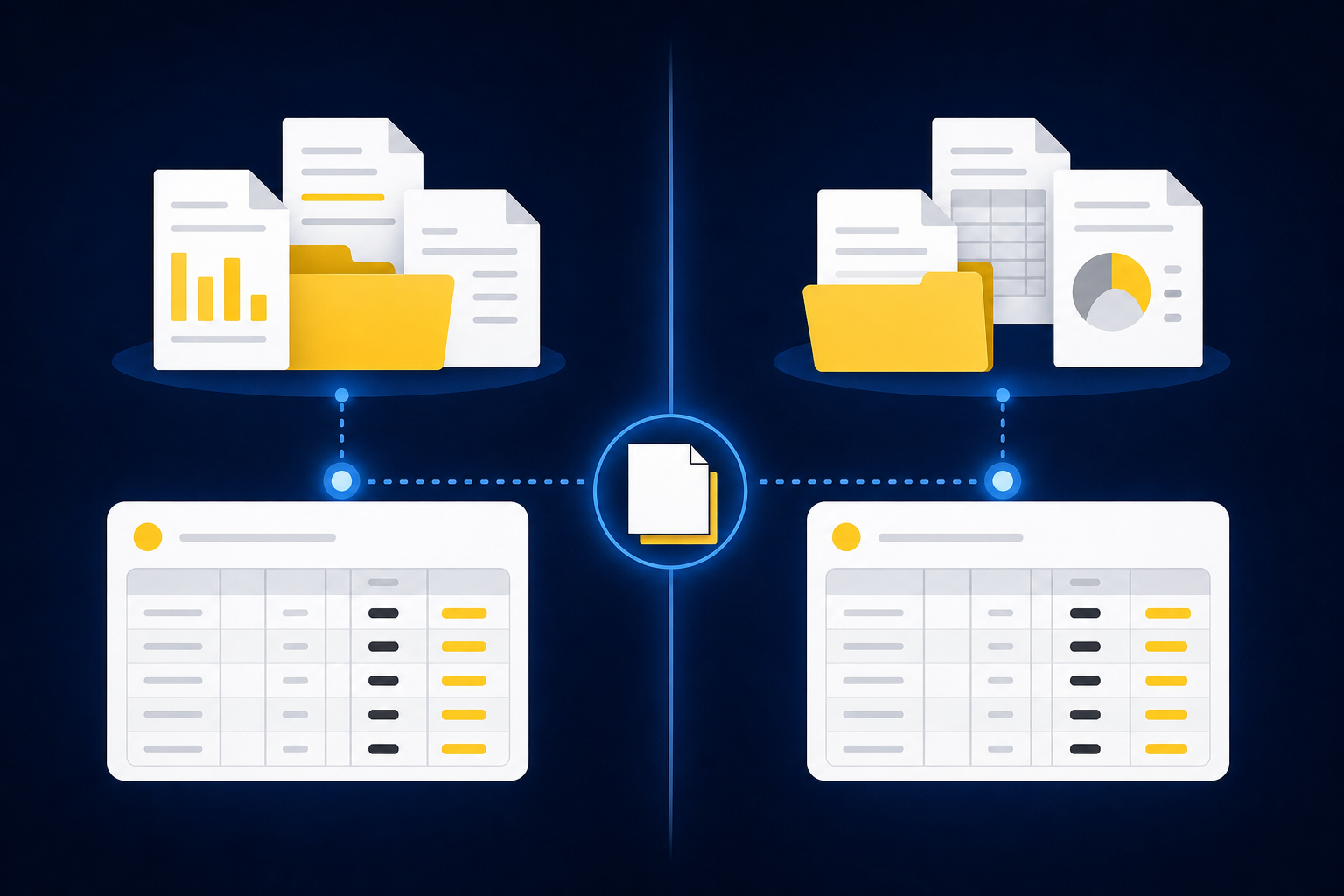
The same distinction applies to clean-looking exports. A processor file can list gross activity, refunds, fees, and settlements without explaining how those fields relate to the deposits in the bank. A donor platform may preserve campaign detail that disappears once several contributions settle as one amount. The preparer still has to determine completeness, apply dimensions, reconcile timing, and document exceptions.
Manual intake also creates variability before accounting judgment begins. One preparer may rename columns, another may add a lookup tab, and a third may copy last period’s formulas into a new workbook. Each method can produce the right answer. The problem is that the reviewer must understand how that particular preparer assembled it before reviewing the accounting treatment itself.
A preparation layer has to carry the work further. It should structure the source materials, apply the team’s established mappings, prepare the reconciliation or schedule, and keep each result tied to the document that produced it. Seeing that source-to-workpaper handoff matters because a feature list cannot show whether the review trail survives preparation; you can See Truewind in action using one of your recurring source-file workflows.
Manual preparation creates more than a labor cost
The visible cost is the time spent downloading statements, updating workbooks, applying coding, and gathering support. The less visible cost appears when the work reaches review. If the workpaper does not show where a number came from or why a treatment was applied, the reviewer has to reconstruct the preparation before deciding whether it is right.
Review becomes a second preparation pass
A reviewer should be evaluating treatment, completeness, and exceptions. Instead, many reviewers begin by checking formulas, finding source files, and tracing unexplained adjustments across tabs. The first preparation pass created the output. The review pass rebuilds enough of the process to establish whether that output can be trusted.
A reconciliation that ties can still be difficult to approve. The total may agree with the bank while masking a missing statement, a stale allocation, or a classification copied from the wrong entity. Clean presentation does not resolve those questions. Source, calculation, treatment, exceptions, and sign-off have to remain visible in the workpaper.
Controllers evaluating AI often focus on the same point. An obviously wrong answer is easy to reject. A polished answer with no visible reasoning is harder, because it asks the reviewer to choose between accepting an opaque result and repeating the work. Model quality cannot substitute for a review surface.
Historical logic stays trapped in people and files
Recurring accounting work is specific to the team running it. Two organizations may both prepare a prepaid schedule or donation reconciliation while using different cutoffs, account mappings, dimensional rules, and reviewer conventions. A generic template can reproduce the shape of the workpaper without reproducing the accounting process inside it.
Prior workpapers contain much of that process. They show which classifications were accepted, where allocations changed, how timing differences were handled, and what the reviewer corrected. When that history remains scattered across spreadsheets and reviewer notes, the team has to recover it each period.
The cost becomes more obvious when the usual preparer is unavailable or a manager takes over. The work can still get done, but the manager has to locate the current source, understand the prior workbook, and separate standing logic from one-time judgment. Capacity disappears into reconstruction before review can begin.
Exceptions compete with assembly work
Missing support and unexpected balance changes deserve experienced attention. Yet they arrive in the same queue as file formatting, transaction matching, and schedule rollforward. When preparation consumes the available time, exception investigation gets compressed into the end of the close.
The accounting work is not less important because it recurs. Reconciliation and support schedules are how the team establishes that the ledger is complete and explainable. The issue is where human effort belongs. Accountants should own accounting treatment and sign-off, while repeatable assembly follows the process the team has already approved.
One buyer described the distinction directly: “Truewind automates a huge chunk of that busywork.” The phrase refers to repetitive assembly, not the judgment embedded in the result. Another phrasing captures the capacity argument: “It's not just about making bookkeeping simpler; it's about freeing up teams, and helping them focus on higher-value projects.”
Nonprofit complexity is operational before it is regulatory
Nonprofit accounting is often discussed through audits, restrictions, and reporting requirements. Those matter, but the day-to-day burden starts earlier. Finance teams have to assemble evidence across donor platforms, payment processors, bank activity, grants, programs, and fund records before they can apply the required treatment consistently.
Consider one deposit that represents contributions from several campaigns. The donor export contains donor and campaign detail. The processor report contains fees, refunds, and settlement timing. The bank contains the net cash amount. A valid reconciliation must connect those records without losing the dimensions the ledger needs.
A bank feed cannot supply the missing context by itself. It can confirm the amount that settled, but it does not know which fund, program, chapter, or purpose belongs on each underlying contribution. It also cannot decide whether a difference is a fee, a refund, a timing item, or missing activity. Those decisions depend on the source records and the organization’s established rules.
The same operating problem appears outside nonprofits. Family offices need entity boundaries and investment treatment preserved across custodian statements. CAS practices need repeatable review artifacts without erasing each client’s accounting rules. Mid-market companies still prepare accruals, prepaids, fixed assets, and processor reconciliations from files that do not share a common structure.
The useful question is not whether a platform can read a PDF or categorize a transaction. Ask whether it can prepare the artifact your reviewer expects, preserve the relevant dimensions, and show the source behind each line. If your current process makes the reviewer rebuild that path, Book a Truewind demo around a bounded reconciliation or workpaper that your team already knows well.
Reviewability changes what automation should produce
An answer is not enough for recurring accounting work. A reviewer needs the source records, the calculation, the applied treatment, the exceptions, and the evidence of approval in one place. Without those elements, automation moves work around rather than removing the need to reconstruct it.
The workpaper is the practical interface between preparation and judgment. It gives the system a defined output and gives the accountant a familiar review surface. The reviewer can trace a prepared balance to source, inspect the logic, adjust the treatment, and decide whether the item is ready for the ledger.
Exceptions belong on that surface as well. A missing statement, unexpected balance movement, mixed activity, or inconsistent classification should not be forced into agreement. It should appear with enough source context for the accountant to make the call. Reliable preparation makes unresolved items more visible, not less.
Reviewer corrections also need to survive the period. If an accountant changes an allocation or classification, the decision should become part of the workflow’s operating context rather than disappear into an email or overwritten cell. The next period can then apply the confirmed treatment while still routing novel items back to the reviewer.
Customer outcomes illustrate what becomes possible when preparation and review are connected, but they are examples rather than universal benchmarks. In one customer case, a lead-generation company reported that monthly bookkeeping fell from about ten hours to under thirty minutes. The customer said, “It's essentially perfect.” They added, “Categorization is accurate, and we stopped having to double-check everything.”
Another customer described the experience with the words, “Truewind has been amazing.” A marketplace customer summarized its outcome differently: “If I had to describe Truewind in one word: Lifechanging”. Those statements belong to the customers who made them. The transferable lesson is the mechanism behind the result: recurring source work was prepared through a defined process, while the people responsible for the books retained review and approval.
How Truewind prepares work upstream of the GL
Truewind sits between recurring source files and Sage Intacct or QuickBooks Online. Multi-Source Ingestion accepts bank activity, card statements, processor and donor-platform exports, custodian statements, prior workpapers, and other documented source types. The platform structures those inputs for coding, reconciliation, schedule preparation, and workpaper generation while retaining the source files against the workflow.
Multi-Source Reconciliation then connects systems that describe the same activity differently. Truewind can align donor, processor, and bank activity or compare custodian activity with an investment schedule and ERP balance. Fees, refunds, and timing differences are prepared within the reconciliation, while unreconciled items remain visible for reviewer judgment rather than being forced to agree.
Historical-Example Learning applies the team’s confirmed treatment from prior workpapers and reviewer corrections. Account mappings, allocation choices, and classification splits become context for the next period. Learning remains bounded by the team’s rules, so it does not create accounting policy or decide novel treatments on its own.
Workpaper Generation and Rollforward brings the prior workpaper, current source documents, and ERP balances into the current period. Balances roll forward, supporting schedules update, and any required journal-entry draft retains source-linked support. Truewind also supports source-based preparation of prepaid and fixed-asset schedules, with amortization and depreciation logic following the team’s existing treatment.
The Human-in-the-Loop Review Workflow is where the accountant confirms, adjusts, or returns prepared work. Source links sit beside prepared items and exceptions, and reviewer actions remain attached to the workflow. Proactive Anomaly Detection surfaces items that fall outside the learned process, including missing statements, unexpected balance changes, mixed activity, and inconsistent classifications.
Nothing posts on its own. After sign-off, reviewed output can move to Sage Intacct or QuickBooks Online with coding, dimensions, and source references preserved. The ERP remains the system of record, and the accountant remains responsible for treatment and approval.
Start with a workflow your reviewer already understands
The first workflow should not be the largest or most impressive item in the close. It should be recurring, bounded, supported by known source files, and backed by a prior approved result. A processor reconciliation, prepaid rollforward, or donation reconciliation gives the team something concrete to compare.
Run the current period through the preparation workflow and compare the output with the known process. Inspect the mappings, calculations, dimensions, exceptions, and reviewer actions. Corrections should be explicit, and the next period should show whether those decisions carried forward as intended.
Expansion should follow evidence from that controlled test. A team can add another workflow after the first one produces an understandable workpaper and a repeatable review path. If you have a recurring account with prior workpapers and a reviewer who owns sign-off, Get a Truewind demo using that workflow as the starting point.
Truewind is not the fit for a team seeking autonomous posting or a replacement for its general ledger. It also assumes an established accounting process, recurring source flow, and a reviewer who can confirm the result. Without those prerequisites, there is no approved process for the system to reproduce and no accountable review step before posting.
The real cost is not that accountants touch the close. Their judgment is necessary. The cost comes from making them rebuild source context, repeat established preparation, and search for exceptions before that judgment can begin. Controlled preparation moves that effort into a reviewable workflow while leaving the books, the rules, and the final decision with the accounting team.
Frequently Asked Questions
How do I manage source file inconsistencies?
To manage source file inconsistencies, start by standardizing the formats of incoming documents. Use Truewind to ingest various source files like bank statements and processor reports, which helps structure the data for easier processing. After ingestion, ensure that your team applies consistent coding and reconciliation rules to maintain clarity. This approach minimizes confusion during the review process and helps ensure that all relevant dimensions are preserved.
What if my team struggles with manual reconciliation?
If your team struggles with manual reconciliation, consider using Truewind to automate much of the repetitive preparation work. Start by uploading your source documents to Truewind, which organizes them into a structured workflow. This way, your team can focus on reviewing the output rather than spending time on manual data entry and formatting. Ensure that the review process remains in place, as human judgment is essential for final approvals.
Can I improve the speed of my month-end close?
To improve the speed of your month-end close, first streamline your data intake process. Use Truewind to automate the ingestion of various source files, which reduces the time spent on manual data collection. Next, implement a structured workflow for preparing reconciliations and workpapers, allowing your team to focus on review rather than assembly. Lastly, ensure that your team is familiar with the established mappings and rules to avoid delays during the review phase.
When should I involve my reviewers in the process?
Involve your reviewers early in the process, especially when using Truewind for automation. After the initial data ingestion and preparation, present the structured workpapers to your reviewers for their input. This ensures that any exceptions or discrepancies are addressed before finalizing the entries. By keeping the reviewers engaged throughout, you can enhance the accuracy of the close and reduce the need for extensive rework later.
Turn this into a close-ready workpaper
Start with sample files or upload your own statements to see how Truewind prepares review-ready workpapers and journal entries.