

If your close runs 15 days, your senior accountants are consumed through the third week of every month. The rest of the finance org is waiting on numbers that landed two weeks late, and your CFO is making decisions on data that was already outdated before it reached the board. The cost is more than just hours. A slow close drives up month end close cost by burning senior labor on reconciliation exceptions and manual journal prep, inflates close cycle cost accounting across every entity relationship that requires sequential sign-off, and compounds slow close impact by compressing the time your team has for variance analysis and forecast updates. For Sage Intacct teams running 10 or more entities, that 15-day cycle is not a process problem. It is a structural bottleneck that costs more than most teams realize.
TLDR:
- A 15-day close runs twice the APQC median of 6 days and costs a five-person team $24,500 in labor before any analysis gets done.
- Multi-entity Sage Intacct teams lose days to intercompany eliminations and dimension validation that compounds across each entity.
- Compressing from 15 to 8 days recovers $138,000 annually in labor and frees senior accountants for variance analysis instead of reconciliation catch-up.
- Sage's native close checklist tracks task completion but doesn't validate the underlying work or automate transaction coding.
- Truewind automates transaction coding, close orchestration, reconciliation tracking, and flux reporting in one interface on top of Sage Intacct.
The Real Cost of a 15-Day Close Cycle for Sage Intacct Teams (June 2026)
For Sage Intacct teams running multi-entity books, a 15-day close cycle carries costs that rarely show up in a budget line. The time lost is visible. The downstream consequences are less so.
APQC benchmarks put the median close at approximately 6 days. Teams sitting at 15 days are operating at more than twice that pace, and the gap compounds across every entity in the structure.
The real cost breaks into three categories:
- Reporting delay cuts the window executives have to act on period data, which means decisions get made on information that is already weeks stale by the time it reaches the board.
- Staff time skews toward low-judgment work. Senior accountants spend close week on transaction review and manual reconciliation instead of flux analysis and variance investigation.
- Audit exposure grows with cycle length. Longer closes mean more manual touchpoints, more spreadsheet handoffs, and more places for a control to break down quietly.
The question worth asking is where the time goes: how many days the close takes matters less than which days are being lost and why.
How a 15-Day Close Compares to 2026 Industry Benchmarks
According to APQC benchmarks, the median close cycle runs about 6 days, with top-quartile finance teams finishing in 4.8 days or fewer. A 15-day close sits well outside that range, closer to the bottom quartile of performers.
Here is where a 15-day close lands against current benchmarks:
| Close Cycle Length | APQC Benchmark Tier |
|---|---|
| 4.8 days or fewer | Top quartile |
| ~6 days | Median |
| 8-10 days | Bottom quartile |
| 15+ days | Below benchmark floor |
For Sage Intacct teams managing multiple entities, the gap widens further. Each entity requires its own reconciliation pass, and intercompany eliminations cannot start until subsidiary books are closed. A 15-day cycle in a multi-entity structure often means the consolidated close is not even beginning until the third week of the month.
Why Sage Intacct Teams Take Longer: The Structural Bottlenecks
Sage Intacct's multi-entity architecture is genuinely powerful, but that same architecture creates compounding close work that single-entity teams never face.
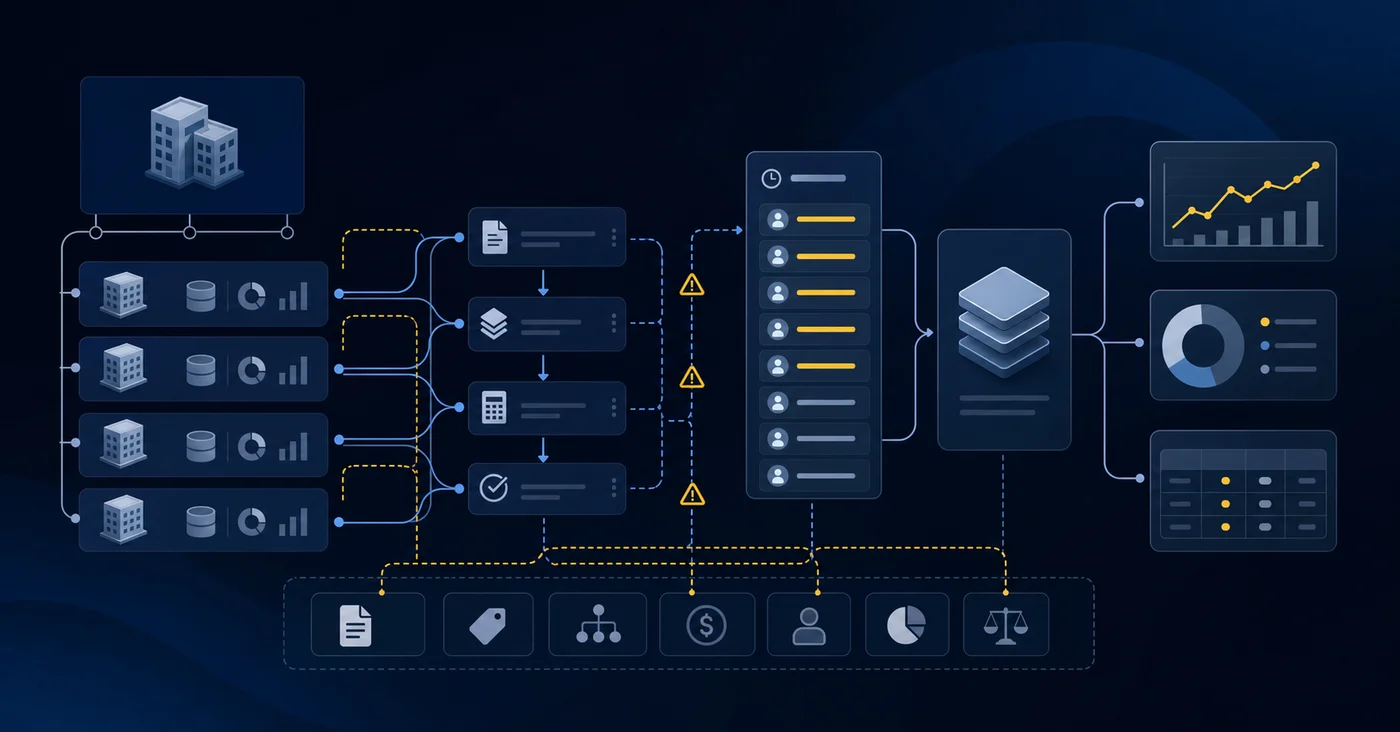
The structural bottlenecks that stretch close cycles past 15 days fall into a few predictable categories:
- Inter-company eliminations require each entity relationship to tie out before consolidation can start, meaning one lagging subsidiary holds up the entire roll-up.
- Dimension tagging across class, department, location, and project has to be validated at the transaction level before the trial balance will tie out cleanly at the consolidated layer.
- Approval workflows in Sage route journal entries through human queues, and those queues don't move on weekends or when reviewers are out.
- Multi-currency revaluations run sequentially, and any rate discrepancy surfaces late, often after teams have already completed their entity-level reconciliations.
The result is a close that depends heavily on coordination across entities, approvers, and systems, with each handoff adding calendar days beyond work hours. For teams running 10 or more entities, those handoffs compound fast.
The Hidden Costs Beyond Labor Hours
Labor hours are the most visible line item, but the real cost of a slow close runs deeper. A 15-day cycle compresses the time available for analysis, investor reporting, and board prep: work that actually requires senior judgment.
Where the Cost Accumulates
Three categories account for most of the hidden burden:
- Delayed decisions carry real weight. When management accounts land two weeks after period-end, business decisions get made on stale numbers. That lag has a cost that never shows up in close metrics.
- Audit and compliance exposure grows with cycle length. Manual workarounds, late reconciliations, and undocumented adjustments create the kind of control gaps that auditors flag and that finance teams spend time defending.
- Staff retention pressure is underreported. Controllers and senior accountants running a chaotic 15-day close burn out faster. Replacing a senior accountant costs far more than any software subscription.
Opportunity Cost: What Your Team Could Be Doing Instead
When close runs 15 days, your senior accountants are fully consumed through the third week of every month. That leaves roughly one week for everything else: forecasting support, audit prep, board reporting, covenant tracking, and any analysis that actually informs decisions.
The arithmetic is straightforward. A controller billing at $120 per hour who spends 60 hours per close cycle on manual reconciliations and journal entry prep is consuming $7,200 per month in senior labor on work that produces no forward-looking insight. Multiply that across a two or three-person close team and the number clears $20,000 monthly before you account for overtime or contractor support during crunch periods.
The subtler cost is queue depth. Strategic analysis requests from FP&A, auditors, or the CFO that arrive during close simply wait. By the time the team surfaces, the decision window has often closed too.
The question worth asking: what is the actual value of the work your team is not doing because close is still running on day ten?
What Drives a Close From 15 Days to 5 Days
The gap between a 15-day close and a 5-day close rarely comes down to one bottleneck. It comes down to several compounding ones that each add days.
Where the Days Go
Most Sage Intacct teams running a 15-day cycle are losing time in roughly the same places:
- Manual intercompany eliminations and consolidation entries , often by a senior accountant who has to reconstruct the logic from prior-period workpapers because there is no living record of what changed.
- Reconciliations sit in queue waiting for a preparer to finish before a reviewer can start, so the two tasks run sequentially instead of in parallel.
- Variance analysis and flux commentary get written after the numbers are finalized, which means they are the last thing done and the first thing rushed when a deadline slips.
- Transaction coding backlogs accumulate mid-month because no one is categorizing in real time, leaving the first days of close as catch-up work before substantive close tasks can even begin.
The Structural Fix
Teams that close in five days tend to share one structural trait: close work happens continuously across the month, not in a burst after period-end. Reconciliations get prepared as activity posts. Transaction coding stays current. By day one of close, the open items are exceptions, not the entire workbook. Industry best practices for month-end close favor this continuous approach over batch processing.
The question worth asking is how much of your current 15-day cycle is close work versus catch-up.
The ROI Math on Close Cycle Compression
Every day shaved off a 15-day close cycle carries real dollar value, and the math is straightforward enough to run against your own headcount.

Quantifying the Cost of Close Labor
If a five-person accounting team earns an average fully-loaded cost of $85,000 per year each, that team costs roughly $1,633 per day in labor. A 15-day close consumes about $24,500 in salary expense alone before a single board report gets delivered. Compress that to eight days and you recover nearly $11,500 per close cycle, or close to $138,000 annually across twelve months.
That figure understates the real opportunity. It excludes:
- Overtime and contractor spend during crunch weeks, which often runs 15 to 25 percent above base labor cost for the same period
- Opportunity cost from senior accountants pulled off FP&A, audit prep, or entity expansion work to chase reconciliation exceptions
- Audit fee exposure when close documentation is rushed, incomplete, or inconsistently formatted across entities
What Faster Closes Actually Buy
The recovered capacity has a compounding effect. Teams that close in eight days or fewer report spending the reclaimed time on variance investigation, forecast model updates, and proactive lender or board communication. Those activities carry far more strategic weight than the data-gathering tasks a slow close demands.
The question for Sage Intacct teams running 15-day cycles is not whether compression is worth pursuing. It is where those 15 days are actually going.
How Sage Intacct's Native Close Tools Stack Up
Sage Intacct ships with a close checklist module and period management controls that work well enough for straightforward single-entity books. You can lock periods, assign task owners, and track completion status across a defined checklist. For teams closing one or two entities with predictable transaction volume, that coverage holds.
The gap appears when you scale. Sage's checklist tracks whether a task is marked complete; it does not validate the underlying work. A reconciliation item gets checked off when someone clicks it, not when the numbers tie. There is no built-in flux analysis, no automated reconciliation matching, and no transaction coding layer that learns from your GL history. Each of those workflows requires either manual effort or a separate tool.
For Sage Intacct teams running 10 or more entities, that means:
- Close status lives in the checklist, but reconciliation status lives in a spreadsheet, so the two views of "where are we?" rarely agree without someone manually syncing them .
- Variance commentary drafted outside Sage , which breaks the audit trail and adds a review round.
- Transaction coding falls back to the staff accountant's judgment each period, with no accumulated rule set to draw from.
The native tooling gives you visibility into task completion. It does not give you control over close quality.
Where Teams Add Execution-Layer Automation on Top of Sage
Sage Intacct handles the GL well. What it doesn't do is automate the execution layer sitting between raw transactions and a closed period. That gap is where most teams lose time during close, and it's where a category of add-on tools has grown up to help.
Most of those tools handle one workflow at a time. A dedicated close-management tool tracks checklist status. Separate reconciliation tools manage sign-off. Standalone AP tools handle coding. Each solves a real problem, but the result is a fragmented stack where data moves between systems and your team context-switches between interfaces.
Truewind is positioned differently. It functions as a digital staff accountant sitting directly on top of Sage Intacct through an API-level integration, covering transaction coding, close orchestration, reconciliation tracking, and variance analysis through flux reporting in one interface. The same connection that codes bank transactions also runs close checklists and tracks reconciliation status across entities.
That architecture matters for multi-entity teams in particular. When your close spans dozens of entities, each requiring its own reconciliation pass before consolidated reporting can start, the overhead of coordinating across separate tools compounds quickly.
The question worth asking is whether your current stack closes that execution gap, or just monitors it.
Final Thoughts on Close Cycle Cost for Multi-Entity Teams
A 15-day close cycle costs more than labor hours. It costs decision speed, audit exposure, and the capacity your senior team needs for work that moves the business forward. For Sage Intacct teams running multiple entities, those costs compound fast because each handoff adds calendar days while the same reconciliation and coding work repeats across every subsidiary. The gap between where you are and where benchmarks sit is usually a few predictable bottlenecks that automation can close. If you're losing time to manual intercompany eliminations, sequential reconciliation queues, or transaction coding backlogs, see how Truewind compresses that cycle.
FAQ
How much does a 15-day close cycle cost in labor expense?
A five-person accounting team with a fully-loaded average cost of $85,000 per year consumes roughly $24,500 in salary expense during a 15-day close cycle before delivering a single board report. That figure excludes overtime, contractor spend during crunch periods, and the opportunity cost of pulling senior accountants off FP&A or audit prep work to chase reconciliation exceptions.
What separates a 15-day close from a 5-day close for multi-entity teams?
Teams running a 5-day close handle most close work continuously across the month instead of in a burst after period-end. Reconciliations get prepared as activity posts, transaction coding stays current, and by day one of close, the open items are exceptions, not the entire workbook. Teams running a 15-day close are catching up on work that could have been done earlier, with intercompany eliminations and consolidation entries built manually each month.
Can Sage Intacct's native close tools handle multi-entity reconciliation at scale?
Sage Intacct's close checklist tracks whether a task is marked complete, but it does not validate the underlying work. A reconciliation item gets checked off when someone clicks it, not when the numbers tie. For teams running 10 or more entities, close status lives in the checklist while reconciliation status lives in a spreadsheet, so the two views rarely agree without someone manually syncing them.
Where do the extra days go in a 15-day close cycle?
Most Sage Intacct teams running a 15-day cycle lose time in predictable places: intercompany eliminations get built manually each month by a senior accountant reconstructing logic from prior-period workpapers, reconciliations sit in queue waiting for a preparer to finish before a reviewer can start, and transaction coding backlogs accumulate mid-month. The first days of close become catch-up work before substantive close tasks can begin.
Turn this into a close-ready workpaper
Start with sample files or upload your own statements to see how Truewind prepares review-ready workpapers and journal entries.