

A reviewer asks why a processor deposit was split across three funds. The journal entry is correct, but the support lives in one spreadsheet, the allocation logic sits in another, and the preparer explained the timing difference in an email six months ago. No single artifact shows how the entry moved from source to GL. The team can reconstruct it, but reconstruction is not the same as reviewability.
That gap is where hidden audit risk accumulates. It does not always appear as a wrong balance or a failed reconciliation. More often, it appears as work that cannot be traced, treatment that changed without a visible decision, or an exception that disappeared into a preparer’s inbox. The ledger may be right while the evidence behind it remains fragmented.
To spot hidden audit risk, start upstream of the general ledger. Look at how your team combines source files, applies mappings, checks totals, handles exceptions, and prepares the workpaper a reviewer signs. Sage Intacct or QuickBooks Online records the approved result. It does not preserve every decision that produced it unless the preparation workflow does that work first.
Audit risk begins in the preparation layer
Most close controls are designed around the final output. Teams verify that the reconciliation ties, the journal entry balances, and the reviewer approved the workpaper. Those checks matter, but they can miss what happened before the finished artifact reached review.
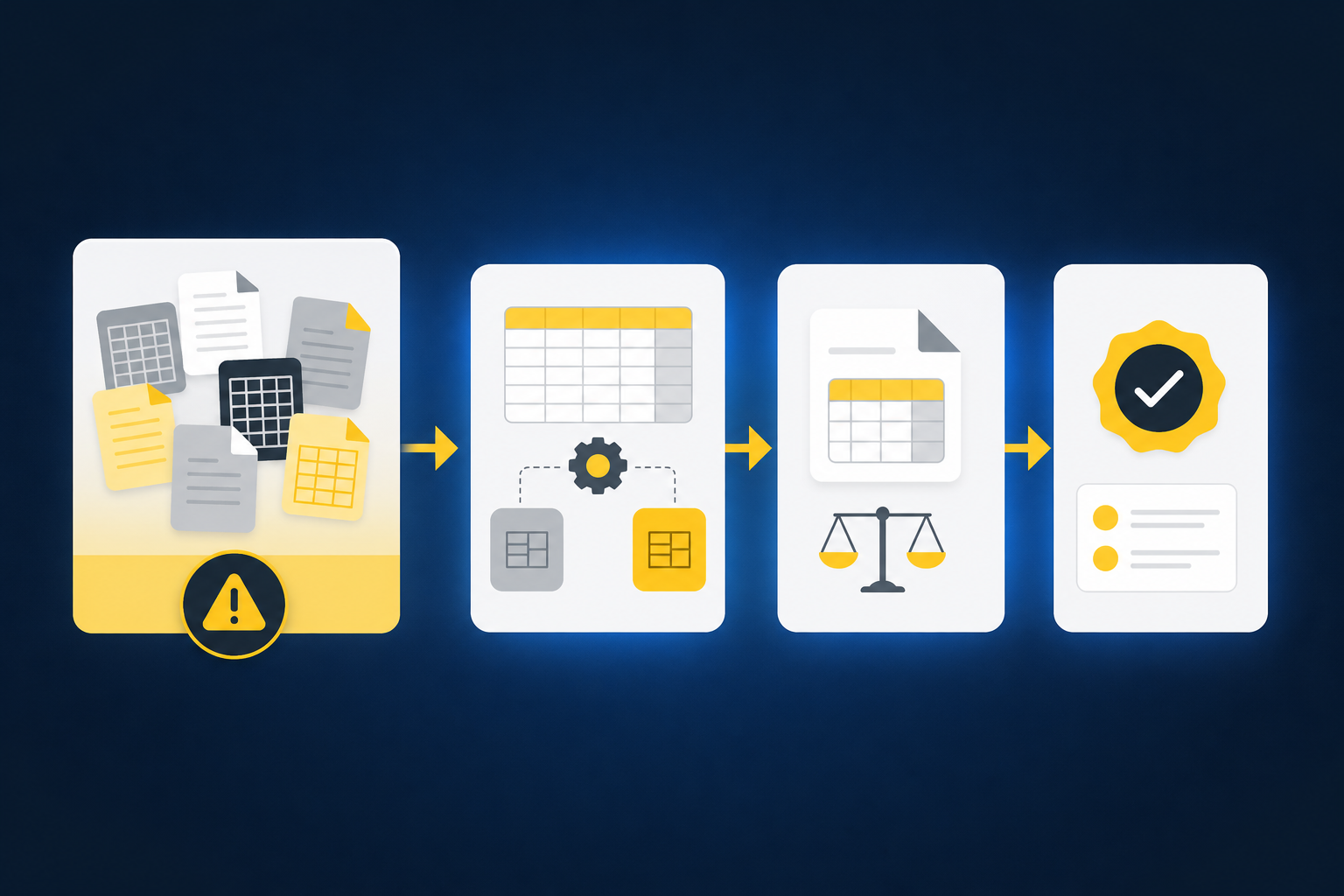
A processor report may show gross activity, fees, refunds, and settlement timing, while the bank records one net deposit. A nonprofit may also need the donor-platform export to preserve fund, campaign, or restriction detail. When the preparer combines those sources manually, the workpaper needs to show which files were used, how the totals were matched, and why any differences remain. A tie-out without that reasoning can look complete while leaving the reviewer unable to re-perform the work.
The same problem appears in recurring schedules. A prepaid or fixed-asset workpaper may roll forward every month, but its formulas can carry old assumptions, missing support, or treatment that no longer applies. Copying the prior file preserves structure. It does not prove that the current-period inputs are complete or that an exception received fresh review.
Manual preparation feels controlled because every step has a person attached to it. Yet the control often depends on that person remembering where the file came from, which mapping applied, and what the reviewer decided last period. When those decisions stay in email or workbook comments, the process is visible only to the people who already know it.
A stronger preparation workflow keeps the source, applied treatment, exceptions, and reviewer action together. If you want to inspect how that review surface works before approved output reaches the ledger, See Truewind in action.
A correct balance is not enough evidence
Audit readiness depends on more than whether the numbers agree. A reviewer needs to see how the team moved from source activity to the recorded balance, including the calculations and accounting treatment applied along the way. Without that chain, review becomes a second preparation exercise.
The problem becomes harder when several systems describe the same transaction differently. A donor platform may identify the campaign and restriction. A processor may separate fees and refunds. The bank may record only the settlement. If the reconciliation shows the net cash total without preserving those dimensions and differences, the workpaper has lost information the ledger entry alone cannot recover.
Historical consistency can hide the same risk. A classification may appear every month because it was copied from the prior workpaper, not because anyone confirmed that the treatment still fits. Consistency is useful when it reflects an approved rule. It is risky when repetition becomes the only evidence for the rule.
One lead-generation company described a different experience after using Truewind for recurring coding: “Categorization is accurate, and we stopped having to double-check everything.” The same customer also said, “It’s essentially perfect.” Those statements describe that customer’s experience, not a universal result. The useful point for a controller is the mechanism behind it: proposed coding followed established treatment, while review remained available for corrections and novel items.
A polished journal-entry draft should not ask the reviewer to trust the presentation. It should let the reviewer open the source, inspect the calculation, understand the treatment, and see who confirmed it. The workpaper carries that evidence. The journal entry records the result.
How to spot hidden audit risk in a recurring workflow
You do not need to review the entire close at once. Choose one recurring workflow with known source files, a prior approved workpaper, and a reviewer who understands the accounting treatment. Then follow one current-period output backward from the GL to its source.
Trace the output to every required source
Start with the recorded balance or journal entry and identify every input required to produce it. A bank reconciliation may need the bank activity and ledger balance. A processor settlement reconciliation may also need payout detail, fee activity, and timing information. A nonprofit donation reconciliation may require donor-platform dimensions that never appear in the bank feed.
Missing source evidence is not always obvious. The workpaper may tie because the preparer inserted an adjustment or carried a timing item from the prior month. Ask whether the file shows where that adjustment came from, who evaluated it, and whether it remains open. If the answer depends on someone searching email, the workflow has a traceability gap.
Inspect how treatment moves between periods
Next, compare the current workpaper with the last approved version. Look for account mappings, cutoffs, allocation rules, and classifications that carried forward. The question is not whether the new workpaper resembles the old one. The question is whether the current period shows which prior decisions were reused and where new facts required a different decision.
An anonymized Sage Intacct prospect evaluated automation in exactly this bounded way during a customer conversation. The team broke recurring work down by entity, account, source availability, preparer, reviewer, and implementation dependency. They were not looking for an open-ended agent to decide what should happen next. They wanted a workflow they could test against known inputs and an approved result before expanding it.
That approach gives the reviewer something concrete to inspect. When a prior treatment applies, the workflow can show the historical decision behind it. When the current activity falls outside that pattern, the item should move into review rather than inherit an answer that no longer fits.
Separate prepared work from judgment items
A reliable workflow does not force every difference to resolve. Missing statements, unexpected balance changes, mixed activity, and inconsistent classifications belong in front of the accountant. Hiding those items inside a completed-looking reconciliation makes review harder because the reviewer must rediscover the exception.
Exception-based review works only when the prepared items remain traceable. The reviewer needs to see why an item followed the established rule and why another item was escalated. Otherwise, “review the exceptions” becomes a shortcut without evidence.
An accounting firm described the preparation benefit in direct terms: “Truewind automates a huge chunk of that busywork.” The same firm explained the consequence more fully: “It’s not just about making bookkeeping simpler; it’s about freeing up teams, and helping them focus on higher-value projects.” The accounting judgment does not disappear. The preparer and reviewer spend less of their attention reconstructing routine work and more of it on the items that require a decision.
To examine that separation using one of your own recurring reconciliations, Book a Truewind demo and bring the prior workpaper, current source files, and expected review path.
Check whether dimensions survive preparation
A reconciliation can tie in total and still lose the detail your accounting depends on. Programs, funds, departments, locations, purposes, and entities may arrive in different source files or require split allocations under the team’s established rules. The workpaper should preserve that context through preparation and into the reviewed output.
Look closely at manual overrides. An override may be correct, but it should show which rule changed, why the change was necessary, and who approved it. A spreadsheet cell containing the final allocation does not provide the same evidence as a visible decision tied to source.
Entity boundaries deserve the same attention. A family office, multi-entity company, or CAS practice may use similar workpapers across several books while applying different treatment to each. Reusing a common structure can improve consistency. Reusing an allocation or mapping without preserving entity context can create a clean-looking error that travels into review.
Nonprofit audit risk is operational before it is regulatory
Nonprofit accounting complexity is often discussed through audit requirements and restricted-fund reporting. The day-to-day exposure begins earlier. Finance teams have to assemble evidence across donor platforms, processors, grants, programs, and bank activity, then apply the same classifications across periods.
Consider a deposit that combines donations from several campaigns. The bank shows cash received. The processor explains the settlement and fees. The donor platform carries the restriction and campaign detail. A reviewer cannot evaluate the accounting treatment from any one source, and a bank feed cannot supply the missing dimensions.
The risk sits in the combination work. If the preparer manually joins those files, applies fund coding, and records an adjustment for timing, the workpaper should preserve each step. Otherwise, the team may reach the right total without a durable explanation of how it handled restrictions, fees, or unmatched activity.
Multi-source reconciliation addresses that problem only when differences remain visible. The system should not force totals to agree or resolve unreconciled items without review. The accountant still owns the treatment. Preparation should organize the evidence, apply explicit rules, and route anything outside those rules to the person responsible for the result.
Put the workpaper between AI and the ledger
Apply the same checks when you evaluate Truewind. Truewind sits upstream of Sage Intacct and QuickBooks Online. It reads recurring source files, applies the team’s captured accounting rules and historical treatment, and prepares workpapers, reconciliations, schedules, and journal-entry drafts for review. The GL remains the system of record.
The workpaper is the control surface. Prepared items include source links so the reviewer can trace them to the underlying document. Exceptions appear alongside the work rather than disappearing into a separate spreadsheet or email thread. Accountants can confirm, adjust, or return an item to preparation, and nothing leaves review without sign-off.
For a recurring reconciliation, Truewind can ingest the connected source exports, match activity using historical treatment, allocate fees or timing differences under explicit rules, and prepare the support schedule. Unreconciled items remain visible for reviewer judgment. The platform does not force a match, invent accounting policy, or post a reconciling entry on its own.
Workpaper generation follows a similar path. The prior approved workpaper, current-period source documents, and ERP balances feed the new period. Balances roll forward, supporting schedules update, and any required journal-entry draft stays tied to source. Reviewer corrections are captured so later periods can reflect the team’s confirmed decisions without changing policy on their behalf.
Truewind also retains the preparation trail. An accountant can inspect which source produced an item, which coding decision applied, what the reviewer changed, and who confirmed the treatment. That history supports review and audit preparation, but it does not certify compliance or replace formal audit procedures.
One marketplace customer summarized its own experience with the words, “If I had to describe Truewind in one word: Lifechanging”. The quote reflects one customer’s experience. For a controller evaluating the workflow, the practical test remains whether the prepared output is understandable, traceable, and bounded by reviewer approval.
A review of your source links, exception handling, and GL handoff is the most direct way to evaluate that fit. Get a Truewind demo using a recurring workflow your team already knows how to prepare and approve.
Start with the workflow you can prove
The first workflow should be recurring, bounded, and supported by a prior approved result. A donation reconciliation, processor settlement, prepaid schedule, or brokerage rollforward gives the team known inputs and a clear review path. Compare the prepared output with the answer your team already accepted, inspect every difference, and capture the reviewer’s corrections.
Expansion should follow evidence, not ambition. If the workflow preserves sources, applies the team’s rules, surfaces exceptions, and produces the artifact the reviewer expects, the next period becomes a meaningful test of repeatability. If it cannot show how it reached the answer, adding more accounts will only spread the same visibility problem.
Hidden audit risk does not begin when an auditor asks a question. It begins when preparation decisions lose their connection to source and reviewer approval. Keep that chain visible, and AI can take on recurring preparation without taking accounting judgment away from the people who own it.
Frequently Asked Questions
How do I trace a journal entry back to its source?
To trace a journal entry back to its source, start by identifying the recorded balance or entry. Then, gather all the required inputs that contributed to it, such as bank activity, processor details, and any relevant donor-platform exports. Ensure that your workpaper documents where each piece of information came from and how it was combined. This way, if any discrepancies arise, you can easily refer back to the original sources and understand the reasoning behind adjustments.
What if my workpaper doesn't show the required details?
If your workpaper lacks necessary details, review the preparation process. Ensure that all source files were included and that any adjustments made are documented with clear explanations. If adjustments were carried over from previous periods, verify that they still apply and are supported by current data. By maintaining thorough documentation and visibility of all decisions, you can reduce audit risks and improve the review process.
Can I automate the preparation of recurring workflows?
You can automate the preparation of recurring workflows by using a structured approach. Start with a known workflow that has a prior approved result. Ensure that all source files are organized and that the preparation logic is well-defined. This allows for consistent application of rules and makes it easier to trace outputs back to their sources, enhancing the review process. However, remember that human review is essential before any outputs are finalized.
When should I involve a reviewer in the preparation process?
Involve a reviewer early in the preparation process, especially when handling complex transactions or adjustments. Reviewers should inspect the workpapers before finalizing any outputs to ensure that all sources are accurately represented and that the reasoning behind decisions is clear. This helps to catch any potential issues before they escalate and ensures that the documentation is robust enough for future audits.
Why does my reconciliation not match the bank statement?
If your reconciliation does not match the bank statement, check for missing source evidence or adjustments that may not have been documented properly. Look for discrepancies in fees, timing differences, or unrecorded transactions. Ensure that all relevant data from donor platforms and processors is included in your workpaper. By maintaining a clear trail of all adjustments and their sources, you can better understand the reconciliation process and resolve any mismatches.
Turn this into a close-ready workpaper
Start with sample files or upload your own statements to see how Truewind prepares review-ready workpapers and journal entries.