
Capital calls don't wait for your weekly cash report to refresh. You manage unfunded commitments across six private equity funds, real estate holdings that don't liquidate on demand, and operating accounts spread across multiple entities. When a GP sends a drawdown notice, your treasury team needs to know exactly what cash is available and where it sits without spending two days matching custodian feeds and inter-entity transfers in a spreadsheet. T-minus-one forecasting on Sage Intacct gives family offices a consolidated, verified cash position by end of day before any deployment or distribution decision goes out, so your finance team stops reacting to capital calls with stale data and starts planning with a forecast that actually reflects yesterday's close.
TLDR:
- T-minus-one forecasting gives your family office a full day of buffer before capital calls or distributions by consolidating cash positions across entities by close of business the day prior.
- A family office running 15 entities with 4 accounts each tracks 60 discrete positions before any consolidated view is possible, and private markets capital calls arrive with 10-30 day windows.
- Sage Intacct handles multi-entity GL operations but lacks forward-looking cash flow constructs for uncommitted obligations like capital calls or LP distributions.
- Truewind automates transaction coding, dimension tagging, and reconciliation status tracking across entities in Sage Intacct so your GL stays current without manual categorization each morning.
What T-Minus-One Cash Forecasting Means for Family Offices
T-minus-one cash forecasting means your family office has a complete, verified view of cash positions by the close of business the day before any deployment decision, capital call, or distribution needs to go out.
For most family offices, that window is tighter than it sounds. Positions span private equity capital calls, illiquid real estate holdings, operating accounts, and short-term instruments across multiple entities and custodians. Pulling that together manually the morning of a wire is not a process; it is a fire drill.
The goal is to get that verified view to T-minus-one: one full business day of buffer before action is required.
Why Multi-Entity Structures Make Cash Visibility So Hard
Family offices managing multiple entities, investment vehicles, and operating subsidiaries face a cash visibility problem that single-entity firms simply don't encounter. Each entity carries its own bank accounts, its own receivables timing, and its own disbursement schedule. None of that consolidates automatically.
The arithmetic compounds fast. A family office running 15 entities with 4 accounts each has 60 discrete cash positions to track before a single consolidated view is possible. Miss one capital call drawdown or an expected LP distribution, and the forecast is wrong before the week starts.
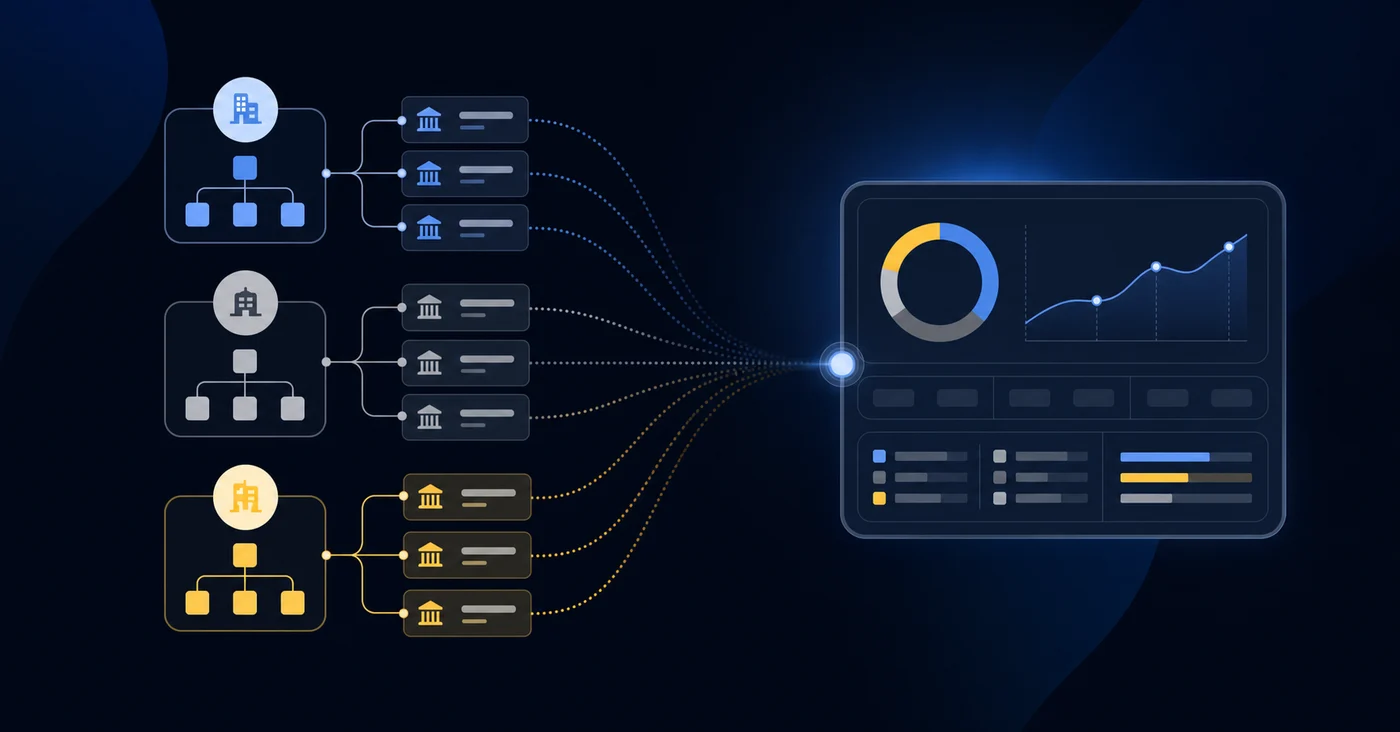
Sage Intacct's multi-entity architecture handles the GL side well. Inter-entity eliminations, consolidations, shared dimensions across entities: the ledger structure is there. What it doesn't hand you is a forward-looking cash position that pulls across all those entities into one number you can act on by end of day.
That gap is where family office finance teams lose the most time. Someone is manually pulling bank balances, cross-referencing expected inflows from investment managers, and building a weekly cash summary in a spreadsheet that's already stale by the time it reaches the CIO.
The Private Markets Liquidity Challenge
Family offices managing private equity, venture, and real assets face a liquidity problem that public-market portfolios largely avoid: capital moves on someone else's schedule.
Capital calls arrive with short notice windows. LPAs typically require LPs to fund a notice within 10 to 20 days of receipt, per AngelList's capital call guide. Distributions follow no fixed calendar. Subscription credit facilities mature in clusters. A family office running five to fifteen fund relationships at once can face six-figure cash demands in the same week it receives a distribution it wasn't expecting until next quarter.
The result is a forecasting environment where the standard rolling 13-week treasury model breaks down. That model assumes relatively predictable cash flows with known timing. Private markets cash flows are binary and event-driven, which means the forecast is only as good as the pipeline data feeding it.
Where the Forecast Typically Fails
Three gaps show up repeatedly in family office cash forecasting:
- Capital call notices land in inboxes instead of systems, so the data entry lag between receiving a notice and updating the forecast can run several days, during which the forecast is stale by a material amount.
- Unfunded commitment balances live in spreadsheets or investor portals, not in the GL, so there is no single source of truth for how much dry powder remains across the portfolio.
- Currency and entity consolidation happens manually, meaning a multi-entity family office with offshore vehicles has to stitch together cash positions across legal entities before it can see a consolidated picture.
Each gap individually is manageable. Together, they mean the CFO or CIO reviewing the weekly cash report is often looking at a number that is already several days old and missing at least one pending obligation.
What Sage Intacct Cash Management Does (and Doesn't Do)
Sage Intacct includes a Cash Management module that tracks cash positions, bank feeds, and account balances across entities. For a family office running a handful of entities with straightforward operating accounts, that coverage is adequate. The ledger stays clean, reconciliations run on schedule, and the finance team has a clear view of what cleared.
The gap appears when forecasting enters the picture.
Sage Intacct records what happened. It stores cleared transactions, posted journal entries, and verified balances. What it does not store is forward-looking cash flow data: pending capital calls, anticipated LP distributions, scheduled management fee draws, or any other uncommitted outflow that has not yet hit the GL. A family office cash forecast depends on that uncommitted data, and Sage has no native construct for it.
The result is that most family office finance teams build their cash forecasts outside of Sage entirely, typically in Excel or a standalone FP&A tool, then tie that model back to the GL manually. That tie-back step is where timing errors and missed items accumulate.
What Sage Cash Management covers well
- Bank feed ingestion and multi-entity cash position tracking across operating accounts, investment vehicles, and holding entities
- Cleared transaction history with full dimension tagging (class, location, project, department) that supports entity-level and consolidated views with automated reconciliation workflows
- Reconciliation workflows that tie posted activity to bank statements with documented sign-off
Where it stops short for forecasting
- No forward-looking cash flow module that captures uncommitted obligations like capital calls or distribution schedules
- No T-minus-one visibility into what is expected to clear tomorrow versus what has already posted
- No mechanism to model cash across multiple entities under different timing assumptions without exporting to a separate tool
| Requirement | Sage Intacct Cash Management Coverage | Gap for T-Minus-One Forecasting |
|---|---|---|
| Bank feed ingestion and cleared transaction tracking | Posts cleared transactions with full dimension tagging across entities and ties to bank statements | Historical record only; no pipeline for uncommitted obligations arriving tomorrow |
| Multi-entity cash position consolidation | Consolidates posted balances across entities with inter-entity eliminations and shared dimensions | Consolidation reflects what cleared yesterday, not what is expected to settle by close of business today |
| Capital call and LP distribution tracking | Records capital calls and distributions after they post to the GL as journal entries | No construct for unfunded commitments or pending distributions before they hit the ledger |
| Forward cash position by entity and fund | Reports historical cash by entity, class, and location through standard dimension reporting | No scenario modeling for pending wire settlements, expected inflows, or timing assumptions across entities |
The question for any family office finance team is not whether Sage handles the historical record well. It does. The question is what workflow sits between the GL and the forecast, and who owns it.
Brokerage Account Data Integration
Brokerage account data sits at the center of family office cash forecasting, and getting it into Sage Intacct reliably is where most offices run into friction.
Most custodians, whether Schwab, Fidelity, or Northern Trust, export account activity in CSV or OFX formats on a daily basis. The integration question is how that data moves into the GL in a way that preserves enough structure to support a T-minus-one view.
What the Feed Needs to Carry
For the forecast to reflect the prior day's position, each inbound data feed should carry at least:
- Settlement date and trade date, since cash doesn't move on execution alone and conflating the two produces forecast errors that compound across entities
- Account-level and sub-account-level balances, so Sage dimensions (entity, project, class) can be populated at the point of entry
- Pending transactions flagged separately from settled ones, which lets the model hold a conservative floor while still projecting expected inflows
Where Sage Intacct Fits
Sage Intacct doesn't pull custodian feeds natively. The connection typically runs through a middleware layer, whether a direct API integration, an SFTP-based file drop, or a scheduled import job. Each path works; the tradeoff is latency. An SFTP drop processed at 6 AM gives the forecasting layer data that's roughly 18 hours old by the time the New York session opens. An API pull configured to run at market close gets closer to the T-minus-one target, though custodian API availability varies.
The underlying requirement is consistent: whatever path the data takes, it needs to arrive in Sage with enough dimensional tagging that the forecast view assembles without manual intervention the next morning.
Building Multi-Entity Cash Consolidation Logic
For family offices managing capital across multiple entities, consolidating cash positions is rarely a single-query operation. Each entity carries its own operating account, reserve account, and potentially a currency exposure. Before any T-minus-one forecast can be meaningful at the family level, those positions need to roll up cleanly.
Sage Intacct's multi-entity architecture handles this through shared dimensions and inter-entity eliminations, but the consolidation logic still requires deliberate setup. A few areas where teams commonly need to invest time:
- Account mapping across entities must be consistent before any consolidated cash view is possible. If one entity books its sweep account under a different GL code than another, the rollup produces noise, not signal.
- Inter-entity transfers need elimination rules configured at the consolidation level . A cash movement from the operating entity to the investment holding entity should not inflate gross cash at the family level.
- Currency translation, where applicable, requires rate assignments in Sage before consolidated balances reflect real purchasing power instead of nominal figures.
Getting this foundation right is what separates a T-minus-one view that a CIO can act on from one that requires a phone call to the controller to explain the variance.
Automating Data Refresh Workflows
Stale data is one of the most common failure points in family office cash forecasting. When balance and transaction feeds refresh once a day, or less, your T-minus-one view is already behind before the morning standup.
Sage Intacct's native data refresh cadence works for most general ledger workflows, but cash forecasting runs on tighter tolerances. A same-day wire, an unexpected capital call drawdown, or a late-posted management fee can shift your projected ending cash by enough to matter.
There are a few ways teams handle this in practice:
- Scheduled API pulls at tighter intervals push updated transaction data into your forecasting layer without manual exports, keeping your cash position current through the trading day.
- Exception-based refresh triggers fire a data pull when a transaction posts above a defined threshold, so high-value activity updates your forecast immediately instead of waiting for the next scheduled sync.
- Custodian feed reconciliation runs alongside the GL pull, catching positions or settlements that haven't yet flowed through Intacct so your forecast reflects actual custodian balances.
The question to pressure-test in your own environment: how many hours of lag are currently sitting between when cash moves and when your forecast knows about it?
Comparing Forecast Against Actual Daily
The forecast is only as good as the feedback loop behind it. Once your T-minus-one cash position is posted in Sage Intacct, the next step is comparing it against what actually settled.
Pull your daily bank feed and tie it to the prior day's forecast line by line. Timing differences on wire settlements and investment distributions tend to surface quickly. When actuals deviate, log the variance against the originating forecast dimension in Sage so you build a clean history of where your estimates drift.
Over time, that history tells you which entity types and account categories carry the most forecast error, which is exactly where to tighten your assumptions next.
Scenario Modeling for Capital Call Exposure
Capital call exposure stress-testing starts with unfunded commitments mapped by fund and vintage, not summed into a single number. A family office carrying $40M in uncalled capital across six private equity funds faces very different timing risk depending on which funds are in their investment period versus harvesting. Family office cash flow discipline treats liquidity as an operating function, not a static reserve calculation.

Sage Intacct's dimensions let you tag each commitment by fund, vintage year, and entity. From there, scenario modeling pulls those tagged balances into a cash forecast under two or three draw-down schedules: base case, accelerated, and stress.
Three scenarios worth running:
- Base case assumes capital calls arrive on the manager's projected schedule, typically quarterly over the remaining investment period.
- Accelerated case compresses that schedule by 30 to 60 days to reflect market dislocation periods when GPs draw faster.
- Stress case layers simultaneous calls across multiple funds, testing whether liquid reserves cover obligations without forcing asset sales.
The output your treasury team needs is not a single projected cash balance. It is a date-by-date view showing which entities hold the liquid reserves and whether those reserves are accessible without triggering tax events or breaching LP agreement minimums.
Building a T-Minus-One Environment on Sage Intacct with Truewind
Truewind integrates directly with Sage Intacct through an API-level integration that reads and writes across your GL in real time. For family offices running multiple entities, that depth matters because the forecasting problem extends beyond aggregating balances: it requires knowing which cash is actually available, where it sits, and what is committed before your investment team makes a capital allocation decision.
A T-minus-one environment means your cash position is current as of yesterday's close, every day. Truewind makes that achievable on Sage Intacct by handling the execution work that otherwise lands on your accountants each morning.
What Truewind Automates in the Daily Cash Workflow
- Transaction coding runs automatically as bank feeds post to Sage, so your accountants are not manually categorizing wire transfers, management fee receipts, or capital call drawdowns before they can trust the day's opening balance.
- Dimension tagging at the entity and fund level happens at posting, so cash by entity is immediately queryable in Sage's reporting layer without a manual allocation step.
- Exception routing surfaces items that do not match your coding rules into a review queue, so a human reviewer confirms the edge cases without touching routine transactions.
- Reconciliation status across entities is tracked in one interface, so you can see which entities are clean and which are pending before you build the consolidated view through month-end close automation .
The result is a daily cash position that your team can stand behind because the underlying GL is current, coded, and verified, not a spreadsheet estimate assembled from yesterday's exports.
Final Thoughts on T-Minus-One Forecasting for Multi-Entity Family Offices
The distance between your GL and a usable T-minus-one cash forecast is the workflow that ties, codes, and consolidates yesterday's activity before your team needs to make a capital decision this morning. Sage Intacct stores the historical record, but the forward view requires uncommitted data and automated refresh cadences that don't exist natively. If your accountants are manually building that bridge each day, see how Truewind automates entity consolidation directly in Sage so your cash position is current by yesterday's close.
FAQ
Can I build a T-minus-one cash forecast on Sage Intacct without custom development?
Yes. Sage Intacct handles the general ledger and entity consolidation well, but the forward-looking cash position requires connecting custodian feeds, automating daily data refresh, and comparing forecast against actuals each morning. You can structure that workflow on top of Sage through scheduled API pulls, exception-based triggers, and dimensional tagging at the entity level; no custom code required if you use middleware or an automation layer that reads and writes to Sage in real time.
What's the difference between Sage Intacct Cash Management and a T-minus-one forecast?
Sage Intacct Cash Management tracks what already cleared: posted transactions, verified balances, and historical cash positions across entities. A T-minus-one forecast projects what will clear tomorrow based on uncommitted obligations like capital calls, expected distributions, and pending settlements. Sage stores the historical record; the forecast model pulls that data forward and layers in what hasn't hit the GL yet.
How do I handle capital call exposure across multiple private equity funds?
Map each unfunded commitment by fund, vintage year, and entity using Sage Intacct's dimension structure. Then run three draw-down scenarios: base case assumes the GP's projected quarterly schedule, accelerated compresses that by 30–60 days, and stress layers simultaneous calls across funds. The output you need is a date-by-date cash position showing which entities hold liquid reserves and whether those reserves cover obligations without forcing asset sales or breaching LP minimums.
Sage Intacct vs. spreadsheets for family office cash forecasting?
Sage Intacct eliminates the manual GL export and entity-consolidation steps that make spreadsheet-based forecasts stale by the time they're built. Your cash position, dimensions, and inter-entity eliminations stay current in Sage; the forecast pulls directly from that structure. Spreadsheets still work for scenario modeling on top, but the daily refresh and reconciliation workflow belongs in the system where the data already lives.
How often should I compare forecast against actuals in a T-minus-one environment?
Daily. Pull your bank feed or custodian statement each morning and tie it line-by-line to the prior day's forecast. Timing differences on wire settlements and investment distributions surface immediately, and logging those variances by entity and account category in Sage builds the history you need to tighten your assumptions next period.
Turn this into a close-ready workpaper
Start with sample files or upload your own statements to see how Truewind prepares review-ready workpapers and journal entries.