
Most family offices outgrow their first accounting system fast because managing 50+ entities and multiple custodians isn't a bookkeeping problem. Sage Intacct for family offices solves the structural piece with multi-entity consolidation, dimensional tagging, and configurable hierarchies that mirror how families actually hold wealth. Where it falls short is in native automation around brokerage reconciliation and transaction coding, which is where manual processes creep back in and why the question of what sits alongside Sage matters more than the software itself.
TLDR:
- Sage Intacct supports multi-entity consolidation and dimensional reporting for family offices managing 50+ legal entities
- Brokerage reconciliation won't display in Sage's module even when data is present in the backend
- 69% of family offices now use automated reporting tools, up from 46% in 2024
- Sage lacks native bank feeds and uses rigid rule engines that miss transaction variations
- Truewind automates brokerage reconciliation, transaction coding, and close workflows while keeping Sage as system of record
Why Family Offices Choose Sage Intacct
Family offices operate under a different set of pressures than most accounting environments. A single office might manage dozens of legal entities, multiple custodians, multiple generations of beneficiaries, and asset classes ranging from public equities to private real estate to direct investments. That's an infrastructure problem, not a bookkeeping one.
Sage Intacct has become the GL of choice for many family offices because it was built for exactly this kind of complexity. Multi-entity consolidation, dimensional reporting, configurable chart of accounts, and role-based access controls give family office accountants tools that general small-business software simply can't match. Sage Intacct users manage over $1.3 trillion in AUM, reflecting the level of institutional trust the software has earned in this segment.
What draws family offices is the combination of depth and flexibility. You can configure entities, ownership structures, and reporting hierarchies to mirror how a family actually holds wealth. Dimensions like class, department, location, and project can be mapped to investment vehicles, family branches, or asset categories, making reporting both granular and auditable.
That said, Sage Intacct is a GL, not an operating system. The gaps in native automation around brokerage reconciliation and transaction coding are real, which is where the conversation about what sits alongside Sage becomes worth having.
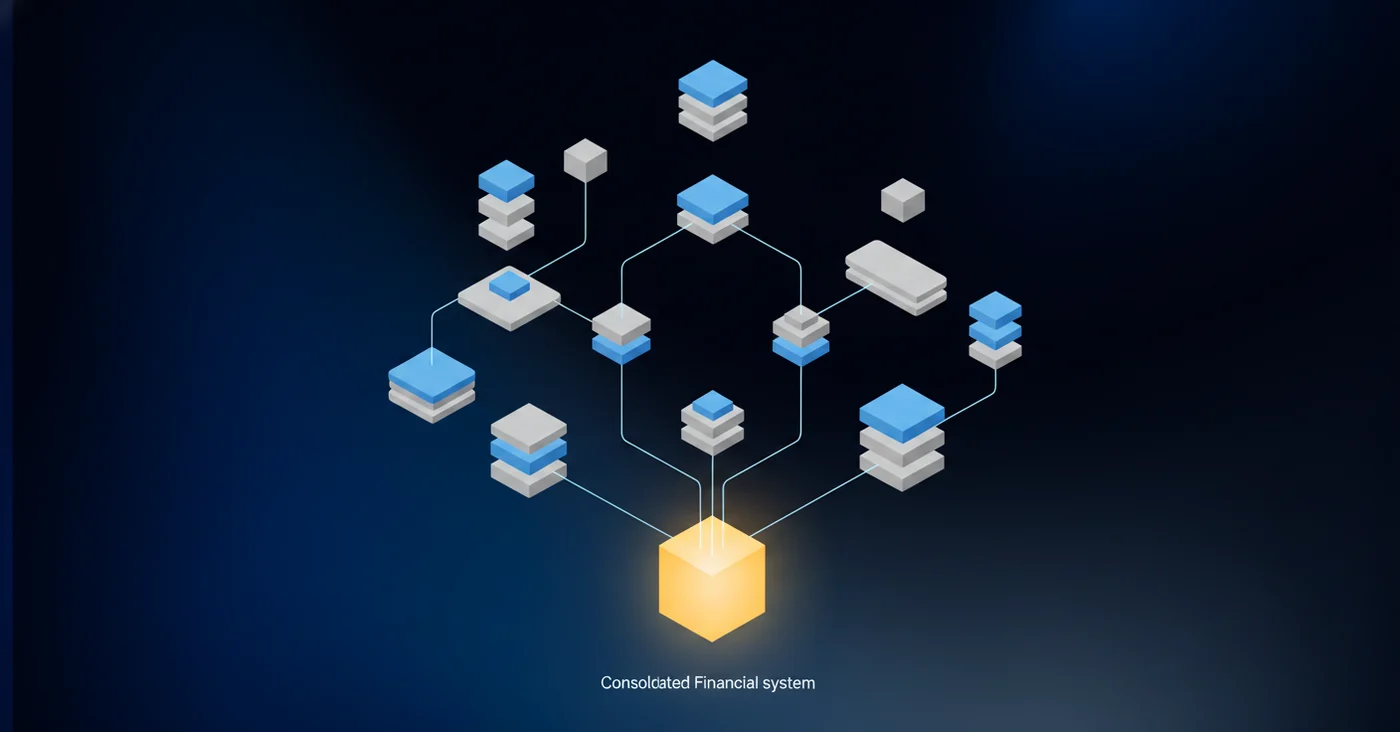
Multi-Entity Consolidation for Family Office Operations
Managing books across dozens of legal entities is where spreadsheet-based consolidations break down entirely. A family office running 50 trusts, a handful of LLCs, and several operating companies can't afford to manually match intercompany eliminations every month. The math doesn't scale, and the error rate climbs fast.
Sage Intacct handles multi-entity consolidation natively. You define each entity once, configure the intercompany relationships, and the system rolls them up automatically. Currency conversion, intercompany eliminations, and ownership-weighted consolidations happen at the GL level instead of inside a spreadsheet someone maintains on their desktop.
The gains here are concrete. Teams migrating from manual consolidation workflows to Sage Intacct's native consolidation engine commonly reclaim 40+ hours per month in report preparation time. For a lean family office accounting team, that's the difference between being reactive and having capacity for advisory work.
A few capabilities worth understanding:
- Consolidated and entity-level financials are generated from the same data set, so there's no matching between two separate reports
- Intercompany transactions are flagged and eliminated automatically at close
- Multi-currency support with configurable exchange rate sourcing
- Ownership structures can be layered so consolidation reflects actual economic interest beyond legal hierarchy
The flexibility of the entity model is what makes Sage Intacct practical for family offices. You can mirror how a family actually holds wealth, independent of how an accountant wants to file it.
| Capability | Sage Intacct | QuickBooks Online | Sage Intacct + Truewind |
|---|---|---|---|
| Multi-Entity Consolidation | Native support with automated intercompany eliminations and ownership-weighted rollups across unlimited entities | Requires separate QuickBooks files per entity with manual consolidation in spreadsheets | Same as Sage Intacct with automated dimensional mapping |
| Dimensional Reporting | Unlimited custom dimensions for class, department, location, project, and custom fields attached to every transaction | Limited to class and location tracking with no custom dimension support | Same as Sage Intacct with full dimension preservation across all automated workflows |
| Brokerage Reconciliation | Cannot display brokerage data in reconciliation module even when data exists in backend | No native support for brokerage or custodian data feeds | AI-powered bank-to-book reconciliation using Addepar or custodian data with exception-based review workflow |
| Transaction Coding | Rigid rule engine requiring exact pattern matches with no fuzzy matching capability | Basic rules with manual categorization for most transactions | LLM-based classification with context-aware matching that learns from historical GL data and handles description variations |
| Bank Feed Integration | No native bank feeds available | Native bank feeds through Intuit network | Direct Plaid and Finicity integration with automated transaction pull and coding |
| Audit Trail | Complete timestamped audit trail with user attribution for every GL posting and intercompany transaction | Basic audit log with limited intercompany tracking | Same as Sage Intacct plus evidence linking and task ownership for close management workflows |
| Schedule Automation | Manual creation of prepaid, accrual, and fixed asset schedules | Manual schedule tracking outside the system | Automated prepaid, accrual, and fixed asset schedules posted directly to Sage with dimensional tagging |
Dimensional Reporting and Investment Tracking
Raw transaction data is only useful if you can slice it the right way. For a family office, that means knowing what was spent or earned, by whom, through which entity, in which asset class, and under which investment vehicle. Sage Intacct's dimension system is what makes that granularity possible.
Dimensions are metadata tags attached to every transaction. Instead of forcing everything into a flat chart of accounts, you layer attributes like class, department, location, project, and custom fields on top of each entry. A single wire transfer can be tagged to a specific trust, a family branch, a fund category, and an investment type simultaneously.
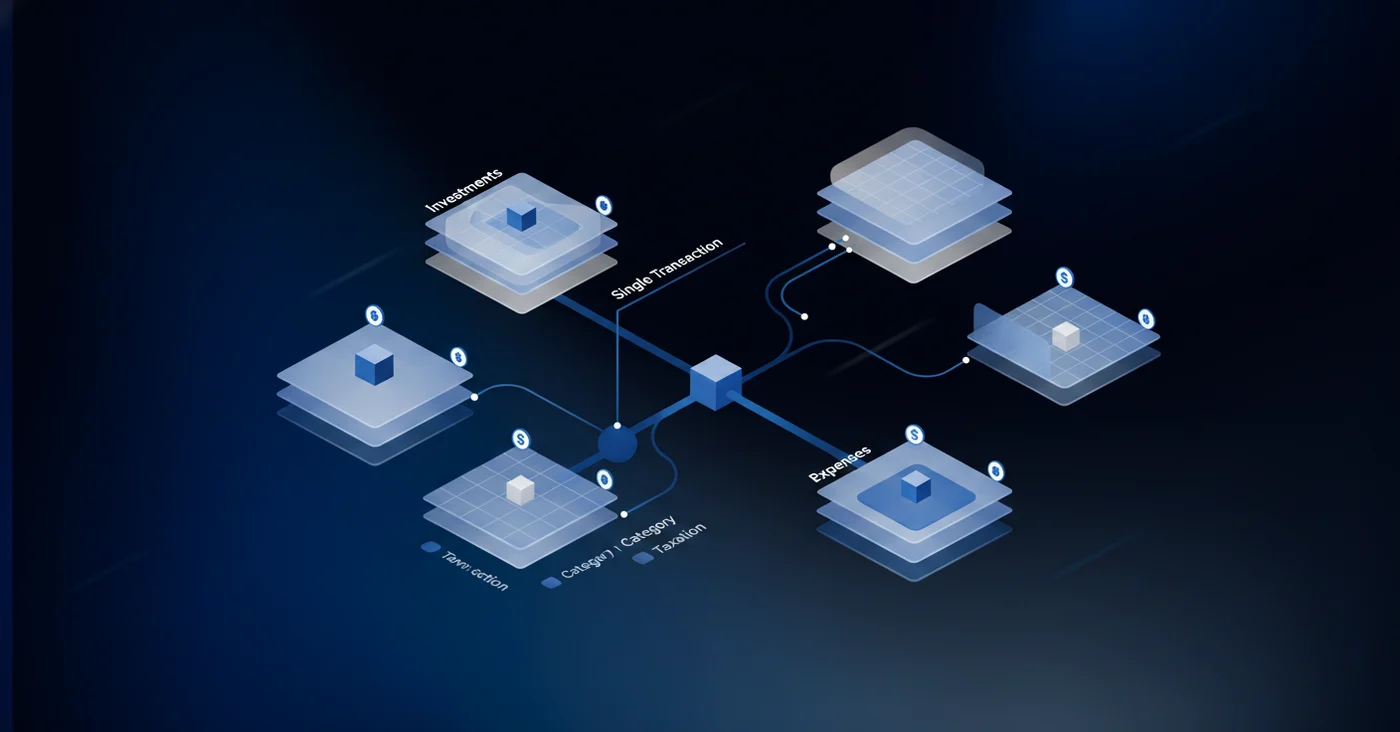
For family offices, that flexibility maps directly to how families actually think about their wealth:
- Tag by beneficiary or family branch to produce per-member financial summaries
- Tag by asset class (public equities, private credit, real estate, alternatives) for allocation reporting
- Tag by legal entity and investment vehicle for entity-level P&L
- Create custom dimensions for foundation grants, co-investment vehicles, or any structure unique to that family
The same underlying ledger can then answer different questions for different stakeholders without maintaining separate books. A family principal wants a consolidated net worth view. A trustee needs entity-level detail. An investment committee wants returns by asset class. Dimensions let Sage produce all three from the same data set.
"Any dimension that you need ported over, we can bring that. We know that's important for a lot of our customers."
Integration With Portfolio Management and Custodian Systems
Family offices working with more than five financial institutions face a data aggregation problem that accounting software alone cannot solve. Portfolio systems, custodian feeds, and bank accounts each operate on their own schedules and formats.
Sage Intacct connects to parts of this stack through native integrations covering standard banking and AP workflows. For portfolio management systems like Addepar, data may reach Sage's backend without surfacing cleanly in the reconciliation module, leaving gaps that manual processes end up filling.
Custodian complexity adds another layer. Firms working with Wells Fargo, J.P. Morgan, or multiple brokerage custodians receive data in different formats through different feeds. Getting that data into Sage in a reconciliation-ready state is where most teams lose time.
Where Sage Intacct holds up well is as a consolidation point. Once data arrives in the GL, dimensional tagging and entity-level reporting handle downstream analysis. The harder problem is the upstream pipeline from custodians and portfolio systems into Sage in a clean, structured format.
The Brokerage Reconciliation Challenge
Brokerage reconciliation is where Sage Intacct hits a hard ceiling for family offices. The limitation is specific: even when brokerage data is piped into Sage's backend through systems like Addepar, it won't display in the reconciliation module. You can't run a bank-to-book reconciliation for brokerage accounts inside Sage. The data is technically present, but the module can't surface it.
That's a product constraint, not a configuration issue.
For a family office running 350+ bank and brokerage accounts, that gap forces manual reconciliation in spreadsheets, outside the GL, with no audit trail attached to the output.
There are tools that handle this by serving as the reconciliation layer between Addepar and Sage:
- Brokerage data from Addepar or custodian statements enters as the bank-side input
- GL entries already posted in Sage serve as the book side
- Exceptions are routed to reviewers and matched entries are produced
- Those entries sync back into Sage mapped to the client's full dimensional structure
Sage stays the system of record throughout.
Real-Time Dashboards and Custom Reporting Capabilities
Family offices rarely have one audience. Principals want high-level net worth snapshots. Investment committees want returns by asset class. Trustees need entity-level detail. Advisors want variance against prior periods. Sage Intacct's reporting layer handles all of these from a single data set without requiring separate reports to be built and maintained manually.
Because reporting runs on the same dimension structure as the underlying ledger, you can filter any report by entity, asset class, family branch, or custom tag without waiting for month-end to close. Dashboards refresh as transactions post, so performance visibility is not a lagging indicator.
For family offices, that timeliness matters. Decisions about liquidity, distributions, and rebalancing do not wait for a CFO to assemble a slide deck.
Security, Compliance, and Audit Readiness
Family offices carry fiduciary responsibility for multigenerational wealth, which makes security and audit readiness non-negotiable. Nearly 1 in 3 family offices have reported experiencing a cyberattack, and 40% of those saw a major impact on family assets. The stakes for data governance are unusually high when the underlying assets belong to named individuals and their heirs.
Sage Intacct's controls hold up well against these requirements:
- Role-based access restricts staff visibility to only the entities and accounts relevant to their work
- Every posting decision carries a timestamped audit trail with user attribution
- Intercompany transaction logs are preserved at the GL level
- GAAP-compliant reporting structures are enforced by default
The audit trail point matters more than it might seem. When a family office faces a regulatory review or an estate-related legal inquiry, the ability to reconstruct every posting decision, with evidence and reviewer attribution, is the difference between a clean response and weeks of forensic accounting.
Automation and AI Adoption in Family Office Accounting
Adoption of automated reporting tools has climbed to 69 percent, up from 46 percent in 2024, with wealth aggregation and automated investment reporting cited as the most sought-after solutions by 27 percent of respondents.
The pattern is consistent: Sage Intacct handles structure, and AI handles execution. Transaction categorization, brokerage data extraction, schedule preparation, and reconciliation matching all belong in an automated layer, not in a human's queue.
For Sage users, that execution gap is real. No native bank feed. Rigid rules. Brokerage reconciliation that stops at the module boundary. AI fills those gaps without replacing the GL or the accountant reviewing the output.
How Truewind Extends Sage Intacct for Family Office Workflows
Sage Intacct gives family offices the structural foundation they need. What it doesn't give you is an automated execution layer for the daily work of coding, matching transactions, and closing.
That's where Truewind fits. We built one of only two production-grade integrations with Sage Intacct, with a dedicated engineering team and an official Sage partnership behind it. The connection is API-level read/write with full dimensional support, not an Excel upload dressed up as an integration.
For family office teams, the coverage spans the gaps covered throughout this guide:
- AI-powered transaction coding via Plaid and Finicity, replacing Sage's rigid rule engine with context-aware classification that learns from your chart of accounts
- Brokerage reconciliation using Addepar or custodian data as the bank side and Sage GL as the book side, with exception-based review instead of line-by-line matching
- Duplicate detection that flags entries already posted directly in Sage before they compound into close problems
- Prepaid, accrual, and fixed asset schedule automation tied directly to your Sage dimensions and reporting periods
- Close management with task ownership, evidence linking, and sign-off controls so nothing falls through between team members
Sage stays the system of record throughout. Truewind handles what happens before the entries get there.
Final Thoughts on Selecting Accounting Software for Complex Family Office Structures
Family offices running multi-entity consolidations and dimensional reporting need a GL that can handle structural complexity without breaking down at scale, which is why Sage Intacct for family offices has become the standard in this segment. But the brokerage reconciliation ceiling and rigid transaction coding rules create manual bottlenecks that your team has to work around every month. We built Truewind to automate those gaps while keeping Sage as your system of record, so you get both structural integrity and execution speed. If you're curious how AI-powered reconciliation works with your specific custodian setup, schedule a demo to walk through it with real data.
FAQ
Can Sage Intacct handle brokerage reconciliation for family offices?
No. Sage Intacct cannot perform bank-to-book reconciliation for brokerage accounts even when data is piped into the backend through systems like Addepar. This forces family offices to match transactions manually in spreadsheets outside the GL, with no audit trail attached to the output.
Sage Intacct vs QuickBooks Online for multi-entity family offices?
Sage Intacct is built for multi-entity consolidation with native support for intercompany eliminations, dimensional reporting, and configurable chart of accounts structures that mirror complex ownership hierarchies. QuickBooks Online lacks the depth for family offices managing dozens of legal entities and custodian relationships.
How does Truewind's Sage Intacct integration handle duplicate transactions?
Truewind monitors what is already posted in Sage and automatically flags duplicate transactions as "excluded" in the interface. The system matches on transaction IDs to prevent re-posting entries that team members coded directly in Sage while another user works in Truewind.
What dimensions does Truewind support when syncing to Sage Intacct?
Truewind pulls across all Sage Intacct dimensions including account/GL code, class, department, location, payee, project, and any custom dimensions configured in your instance. This is a true API-level read/write connection that respects the full dimensional structure of your chart of accounts.
Can I build transaction coding workflows for Sage Intacct without manual rules?
Yes. Truewind uses LLM-based classification that handles fuzzy matching natively, replacing Sage's rigid rule engine. The system learns from your historical GL data and improves accuracy with each review cycle, handling transaction description variations that cause Sage's native rules to miss.
Turn this into a close-ready workpaper
Start with sample files or upload your own statements to see how Truewind prepares review-ready workpapers and journal entries.