
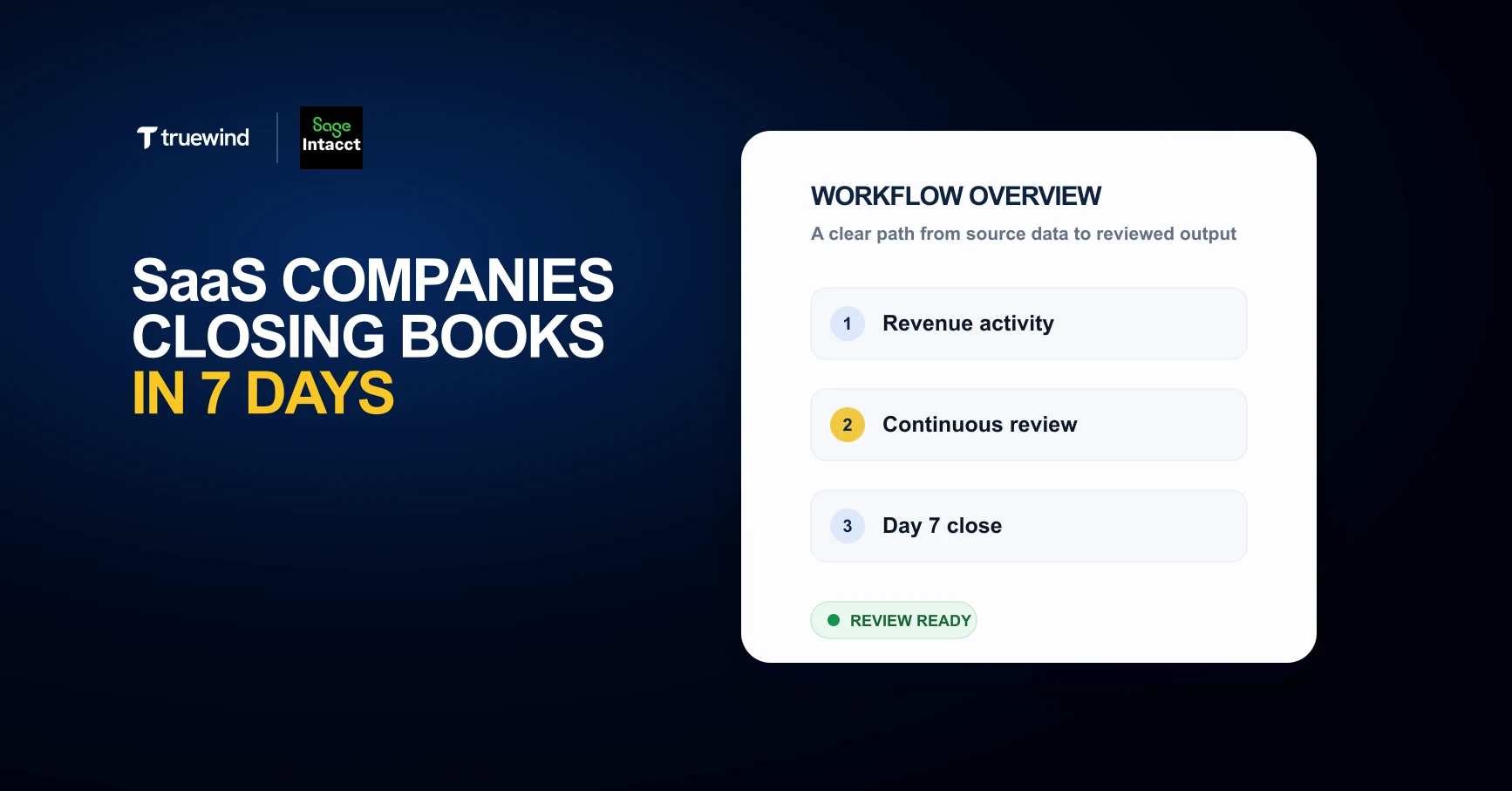
Controllers running Sage Intacct SaaS accounting workflows know the system handles the GL well. What it doesn't handle is the layer above it: transaction coding at volume, reconciliation orchestration across entities, accrual calculations, and close task tracking. That's where your SaaS month end close Sage Intacct timeline stretches past 10 days, even when Sage itself is set up correctly. The fast close SaaS companies on Sage aren't working nights to hit day 7. They've moved close work into continuous daily workflows instead of waiting for month end to process everything in a batch. We're seeing teams layer AI execution on top of Sage to automate the manual work without replacing the general ledger.
TLDR:
- SaaS close cycles run long because deferred revenue, multi-entity structures, and subscription billing create compounding verification work that manual processes can't keep up with.
- Top-performing teams on Sage Intacct close in 7 days by front-loading reconciliation, accrual prep, and variance analysis throughout the period instead of batching it all at month-end.
- The five recurring bottlenecks are transaction coding backlogs, deferred revenue recalculation, intercompany eliminations, spreadsheet-based accruals, and late-stage flux analysis.
- Automation compresses close cycles when it handles transaction coding, reconciliation tracking, and checklist orchestration in parallel workflows with documented sign-offs.
- Truewind automates transaction coding, close checklists, reconciliation tracking, and flux reporting through API-level integration with Sage Intacct in one interface.
Why SaaS Month-End Close Takes Longer Than Other Industries
Revenue recognition under ASC 606 requires matching deferred revenue balances, calculating earned versus unearned amounts across subscription cohorts, and validating that contract modifications hit the right periods. That work happens every single month, at year-end and every month in between.
Layer on equity compensation. Stock-based compensation expense requires fresh grant valuations, vesting schedule calculations, and allocation across departments before a single journal entry posts. For a SaaS company with multiple funding rounds and broad option grants, this is a multi-day task on its own.
There are a few structural reasons the close is harder here than in most industries:
- Subscription metrics tie directly to financial statements, so ARR, churn, and expansion revenue all need to tie back to recognized revenue before the books close. Any discrepancy between the CRM and the GL gets investigated before sign-off.
- Multi-element arrangements require judgment calls on standalone selling prices and allocation between performance obligations, and those calls need documentation each period.
- Investor reporting cadences are tighter. Venture-backed SaaS companies often owe board packages within two weeks of month-end, which compresses the timeline further.
- Headcount changes are frequent. Payroll accruals shift every month, and new hires mid-period create partial-month calculations that don't resolve cleanly from a payroll import alone.
Sage Intacct handles the GL side of this well. Where teams lose time is in the work that sits between raw transactions and a closed period: coding, reconciliation, accrual calculations, and variance explanations that still require manual effort even after the system is set up correctly.
The Current State of Close Speed: 2026 Benchmarks for SaaS Companies
According to APQC's financial close benchmarks, top-performing finance organizations close in roughly 6 to 7 days, while average companies take closer to 10 days. For SaaS companies, that gap matters more than it might in other industries. Investors expect monthly metrics, boards want ARR and churn figures fast, and revenue recognition under ASC 606 adds complexity that stretches close timelines further.
The 2026 picture for SaaS finance teams on Sage Intacct shows a split. Teams that have layered AI-assisted workflows on top of Sage are closing in 7 days or fewer. Teams still relying on manual reconciliation, spreadsheet-based checklists, and email-driven task coordination are landing closer to 12 to 15 days, with the final 20% of close work consuming a disproportionate share of that time.
A few factors explain why SaaS close cycles run long even on a capable GL like Sage Intacct:
- Subscription billing creates a high volume of transactions that need accurate revenue recognition treatment before the trial balance ties out, and any mismatch between the billing system and the GL surfaces late in the cycle.
- Deferred revenue rollforwards require careful period-by-period verification across customer contracts, and even minor discrepancies trigger rework that pushes the close past day 10.
- Multi-entity structures common in VC-backed SaaS mean intercompany eliminations and consolidated reporting add sequential dependencies that compress the available review window.
The teams consistently closing under 10 days share one structural trait: they front-load the close. Work that used to happen in the first week of the following month, such as coding transactions, matching accounts, and preparing flux commentary, happens continuously throughout the period.
What Makes Sage Intacct Different for Fast Close
Sage Intacct is built for multi-entity, multi-dimensional accounting in a way that generic mid-market ERPs are not. That architecture is exactly what makes it attractive to SaaS finance teams managing ARR by product line, cost center, and geography simultaneously. It is also what makes a slow close particularly painful.
The dimensions framework in Sage (class, department, location, project) lets you slice revenue and expense reporting in ways that match how SaaS boards want to see the business. But those same dimensions add tagging requirements to every journal entry, every accrual, and every reconciliation pass. More tagging means more review cycles before the books are clean.
SaaS companies on Sage also tend to carry more close complexity than their headcount suggests:
- Deferred revenue schedules that update every period as contracts start, renew, or churn require careful rollforward work before any revenue figure is reportable.
- Intercompany eliminations across subsidiaries or legal entities need to clear before consolidation, and Sage does not automate the matching step.
- Commission accruals tied to bookings data sitting outside the GL require a manual pull, calculation, and entry each period.
The result is a close that has more moving parts than a comparably sized non-SaaS business. Teams that get under 10 days do it by removing the manual handoffs between those parts, not by working faster on each one individually.
The Close Checklist Every SaaS Team on Sage Intacct Needs
The close checklist separates teams that finish in 8 days from those still clearing accounts on day 14. For SaaS companies on Sage Intacct, the sequence below reflects where time actually gets lost.
Revenue and Deferred Revenue
- Confirm ASC 606 revenue recognition entries are posted against the correct performance obligations, with deferred revenue schedules tied to contract start and end dates in Sage.
- Verify the deferred revenue rollforward: beginning balance, plus new bookings billed, less revenue recognized in the period, equals ending balance per the GL.
Intercompany and Multi-Entity
- Clear intercompany eliminations across all active entities before running consolidated financials. One unresolved intercompany payable blocks the consolidation.
- Verify that dimension tagging (department, location, class) is consistent across entities so consolidated reports group correctly.
Flux and Variance Review
- Compare period-over-period balances on every material account. Flag any variance exceeding your threshold before sign-off, not after.
- Document the explanation inline. Auditors and investors ask the same questions every quarter; having the answer in the workpaper saves a second round of research.
Final Tie-Out
- Tie the trial balance to the sub-ledgers: AR aging, AP aging, fixed asset rollforward, and prepaid schedules.
- Confirm that all journal entries posted in the period have preparer and reviewer sign-off captured in the close checklist, not in email threads.
Where Time Actually Goes: The Five Bottlenecks in Sage Intacct SaaS Close
For SaaS companies running Sage Intacct, the close rarely stalls in one place. It compounds across five recurring bottlenecks.
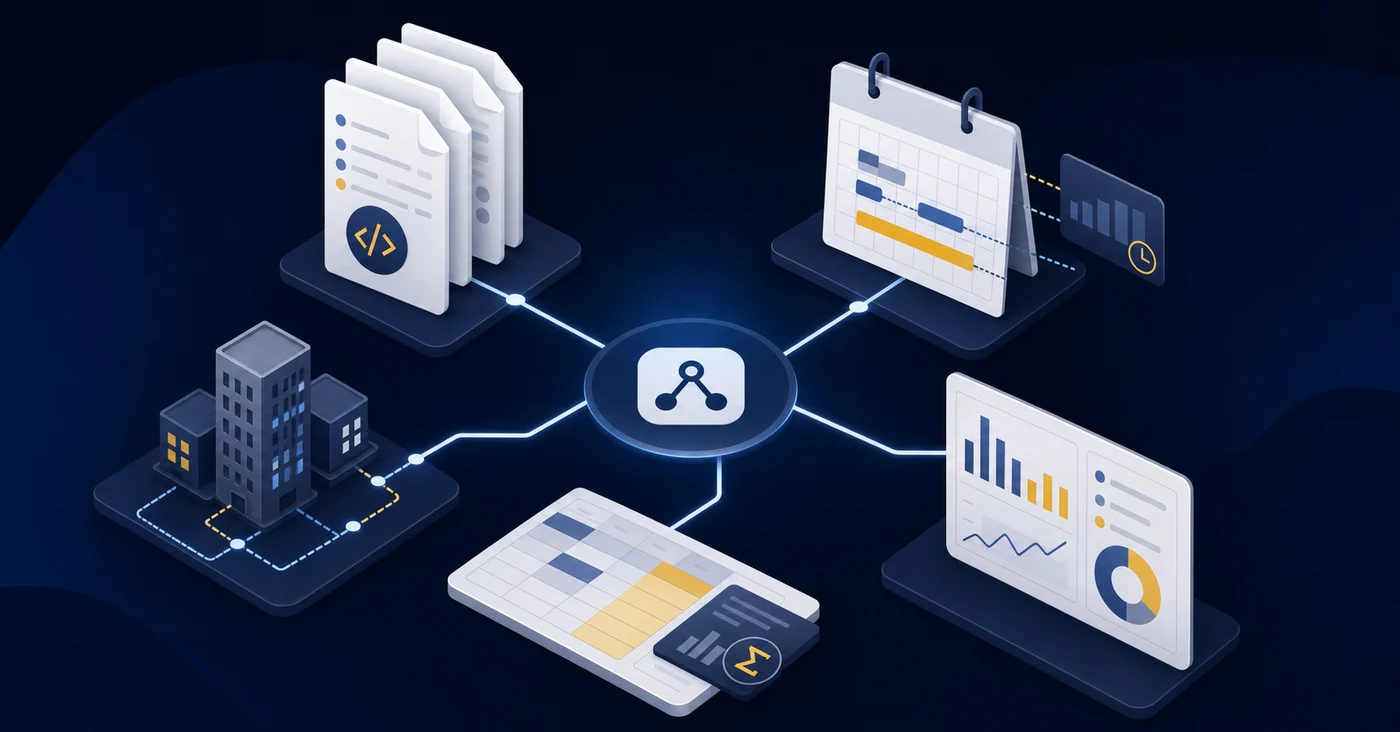
- Transaction coding backlogs pile up when rule sets in Sage fail to catch uncategorized items, leaving senior accountants sorting through exceptions during the first week of close instead of reviewing financials.
- Deferred revenue schedules require manual recalculation each period, especially when contract terms vary across customers.
- Intercompany eliminations across multiple entities demand careful coordination before consolidation can begin.
- Prepaid amortization and accrual entries often depend on spreadsheets outside Sage, creating version control risk.
- Flux and variance analysis waits until the books are nearly closed, compressing review time at exactly the wrong moment.
Continuous Accounting vs. Month-End Batch Close
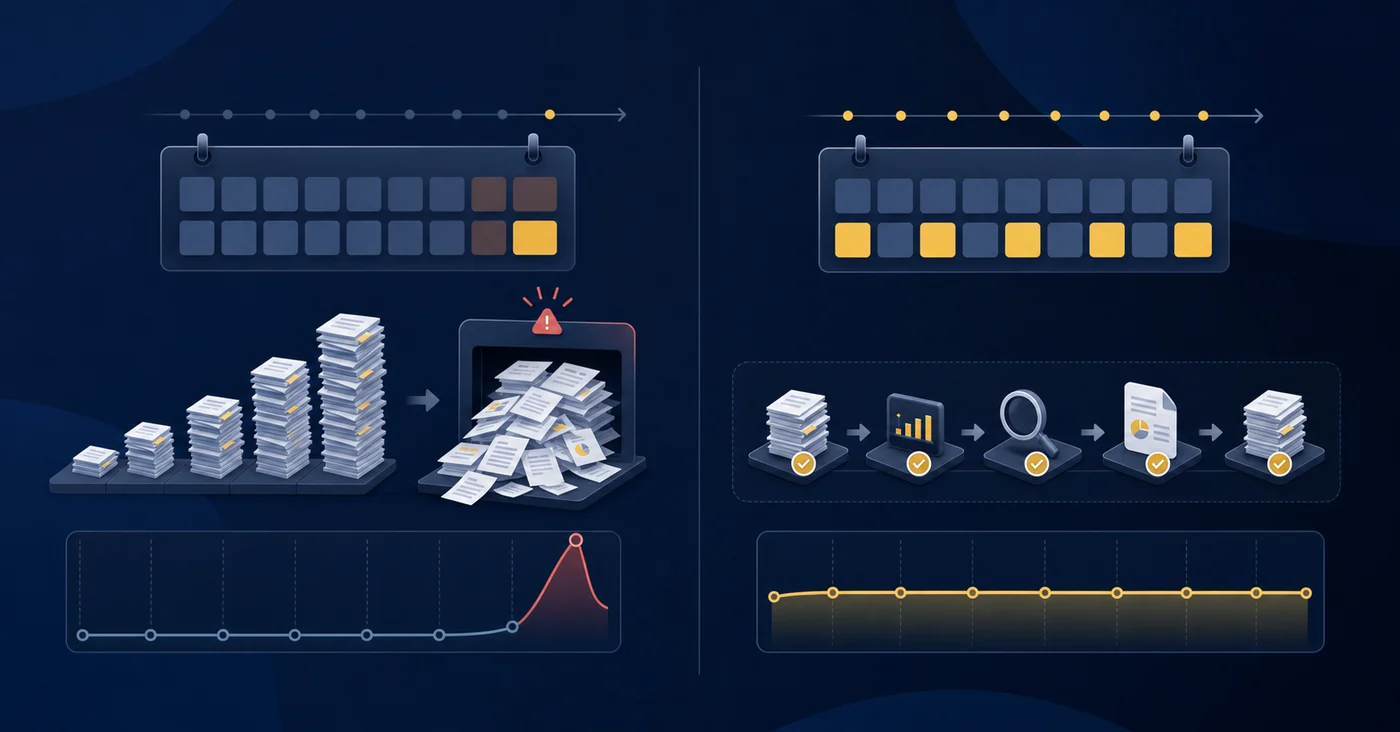
Batch close treats accounting as a once-a-month sprint. Transactions accumulate for 30 days, then every reconciliation, accrual, and journal entry gets processed in a compressed window. The pressure is predictable, and so is the result: errors, late nights, and a close that stretches past day 10.
Continuous accounting distributes that work across the full period. Reconciliations run as transactions post. Accruals get reviewed weekly. By the time the period ends, most of the close is already done.
For SaaS companies on Sage Intacct, the shift is worth a close look.
Why SaaS Close Work Is Harder Than It Looks
SaaS companies carry accounting complexity that compounds in batch close environments:
- Deferred revenue schedules update every period across every active contract, and any mid-month churn or upgrade requires a retroactive adjustment before the books can close.
- Usage-based billing means revenue recognition depends on consumption data that often arrives late, holding up the entire revenue close until the data feed ties to the GL.
- Intercompany eliminations across multiple entities require each subsidiary to close independently before the consolidated close can start, and a single delayed entity holds up the whole stack.
Continuous accounting solves each of these by moving the work earlier, so the close window itself is shorter.
How Automation Compresses Close Cycles Without Sacrificing Control
SaaS companies on Sage Intacct that close in under 10 days share a common pattern: they've stopped treating close as a sequential, manual handoff process and started running parallel workstreams with automated checkpoints at each stage.
The compression happens across three areas where manual work traditionally eats time.
Transaction Coding at Volume
Sage Intacct's native rule engine handles straightforward, high-confidence transactions, but controllers consistently find that rules cover only a fraction of the actual volume. Anything with variability in vendor name, amount, or dimension mapping falls through, landing back in someone's queue for manual review. AI trained on historical GL data codes those edge cases directly, learning that a $420 AWS charge maps to cloud infrastructure under the engineering cost center, without requiring a human to touch it each month.
Reconciliation Without the Spreadsheet Shuffle
Reconciliations in a manual close often run sequentially because each one depends on a team member finishing before the next can start. When reconciliation status is tracked centrally and exceptions are surfaced automatically, multiple reconciliations can run at once. Controllers see the outstanding items in real time and can focus review time on the accounts that actually need judgment.
Close Checklist Orchestration
The last major time sink is coordination: who owns what, what's blocking what, and whether the team is on pace to close on time. Automated close checklists with dependency logic replace the daily standup and the status-request emails. When a preparer marks a task complete, the downstream reviewer gets notified automatically. The controller sees a live view of where things stand without having to chase it down.
The result is more than speed. It's a close where the control environment is tighter because exceptions get routed to the right person, every reconciliation has a documented sign-off, and the GL reflects entries that went through a defined review workflow before posting.
Building a Repeatable 7-Day Close Process on Sage Intacct
The shift from 12 days to 7 comes from process design, not overtime. Two structural changes set the foundation before you touch the calendar: daily bank reconciliation so no coding backlog accumulates at month-end, and standardized deferred revenue templates that roll forward each period without manual rebuilding.
With those in place, the sequence below holds.
| Day | Focus |
|---|---|
| 1-2 | Lock billing; post revenue and deferred revenue entries |
| 3-4 | Complete reconciliations; clear intercompany eliminations |
| 5-6 | Review variances; post accrual and adjustment entries |
| 7 | Trial balance tie-out; controller sign-off |
The Digital Staff Accountant Model: Execution Layers on Top of Sage Intacct
Sage Intacct handles the general ledger. It stores transactions, maintains dimensions, and produces the trial balance. What it does not do is automate the work that happens between a transaction hitting the GL and a signed-off close package landing in front of your CFO.
That gap is where most SaaS finance teams lose time. Transaction coding, reconciliation status tracking, accrual entry preparation, variance analysis, close checklist management: each of these runs through a separate tool, a spreadsheet, or a senior accountant's memory.
Truewind sits on top of Sage Intacct as a digital staff accountant, handling the execution layer through the same API-level integration that reads and writes directly to your GL.
What the execution layer covers
A few specific workflows where this matters in practice:
- Transaction coding runs against your historical GL data and dimension structure. Truewind reads how your team has coded similar charges before and applies that logic going forward, routing exceptions to a review queue instead of leaving them in an uncategorized pile.
- Reconciliation status is tracked across accounts in one view, so your controller is not chasing down which reconciliations are complete and which are still open on day six of close.
- Accrual and prepaid entries are prepared with the supporting workpaper attached, ready for human review before posting. Your team owns the sign-off; Truewind prepares the entry.
- Flux reporting surfaces variance commentary at the account level, so the first draft of your close package does not start from a blank page.
The same interface that handles transaction coding also runs close checklists, tracks reconciliation status, and surfaces variance analysis. For SaaS teams managing multiple entities or revenue streams in Sage Intacct, that consolidation is what keeps close inside ten days.
How Truewind Accelerates Sage Intacct Close for SaaS Companies
Truewind sits on top of Sage Intacct as an AI execution layer, automating the transaction coding, close orchestration, reconciliation tracking, and variance analysis that slow SaaS teams down during month-end.
Where Sage stores the GL, Truewind operates on it. The same interface that codes bank transactions runs close checklists, tracks reconciliation status by owner, and surfaces flux analysis across revenue, payroll, and prepaid schedules. SaaS teams running multi-entity structures or high transaction volumes get the most direct benefit.
- Transaction coding runs against historical GL data and learned patterns, so categorization decisions stop landing on senior accountants during the first week of close.
- Close checklists with assigned owners track completion status and surface blockers before they delay the trial balance tie-out.
- Reconciliation status across accounts and entities is visible in one view, not scattered across shared drives or email threads.
- Flux reporting compares actuals to prior periods and flags variances that need commentary before the books close.
Many tools connect to Sage Intacct through the marketplace to sync data. Truewind's execution layer goes further, automating transaction coding, close orchestration, reconciliation, and dimension-aware posting through the same API-level integration, in one interface.
Final Thoughts on Building a Faster Close on Sage Intacct
The difference between a 12-day close and a 7-day close isn't overtime or more senior accountants. It's moving repetitive work out of the close window and letting automation handle the steps that don't require judgment. Sage Intacct gives you strong GL architecture, but the work between transactions and sign-off is still manual for most SaaS teams. If you want to see what a compressed close looks like on Sage, talk through your current process with us and we'll show you where the time is going.
FAQ
How do SaaS companies on Sage Intacct close books in under 10 days?
They front-load the close by running reconciliations continuously throughout the month instead of batching them at period-end, automate transaction coding to eliminate the week-one categorization backlog, and use dependency-driven close checklists that route work to the right reviewer without sequential handoffs.
Sage Intacct vs QuickBooks for fast close in SaaS?
Sage Intacct's multi-dimensional architecture (class, department, location, project) gives SaaS teams the reporting granularity boards expect for ARR by product line and geography, but those same dimension requirements add tagging overhead to every entry that QuickBooks doesn't impose. The teams closing fastest on Sage treat dimension tagging as a daily discipline, not a month-end exercise.
What's the biggest close bottleneck for SaaS companies using Sage Intacct?
Deferred revenue reconciliation consistently consumes disproportionate time because it requires validating earned versus unearned balances across every active subscription contract each period, and any mid-month churn or upgrade triggers retroactive adjustments that hold up revenue close until the data ties to the GL.
Can you run continuous accounting on Sage Intacct without changing your GL setup?
Yes. Continuous accounting distributes reconciliation and coding work across the full month instead of batching it at period-end, which requires workflow changes but no modifications to your chart of accounts, dimension structure, or how Sage stores transactions.
When should a SaaS finance team move from batch close to continuous accounting?
When reconciliation backlogs consistently push your close past day 10, when the controller spends more time chasing task status than reviewing financials, or when you're managing multiple entities where sequential close dependencies create compounding delays across the consolidation.
Turn this into a close-ready workpaper
Start with sample files or upload your own statements to see how Truewind prepares review-ready workpapers and journal entries.