
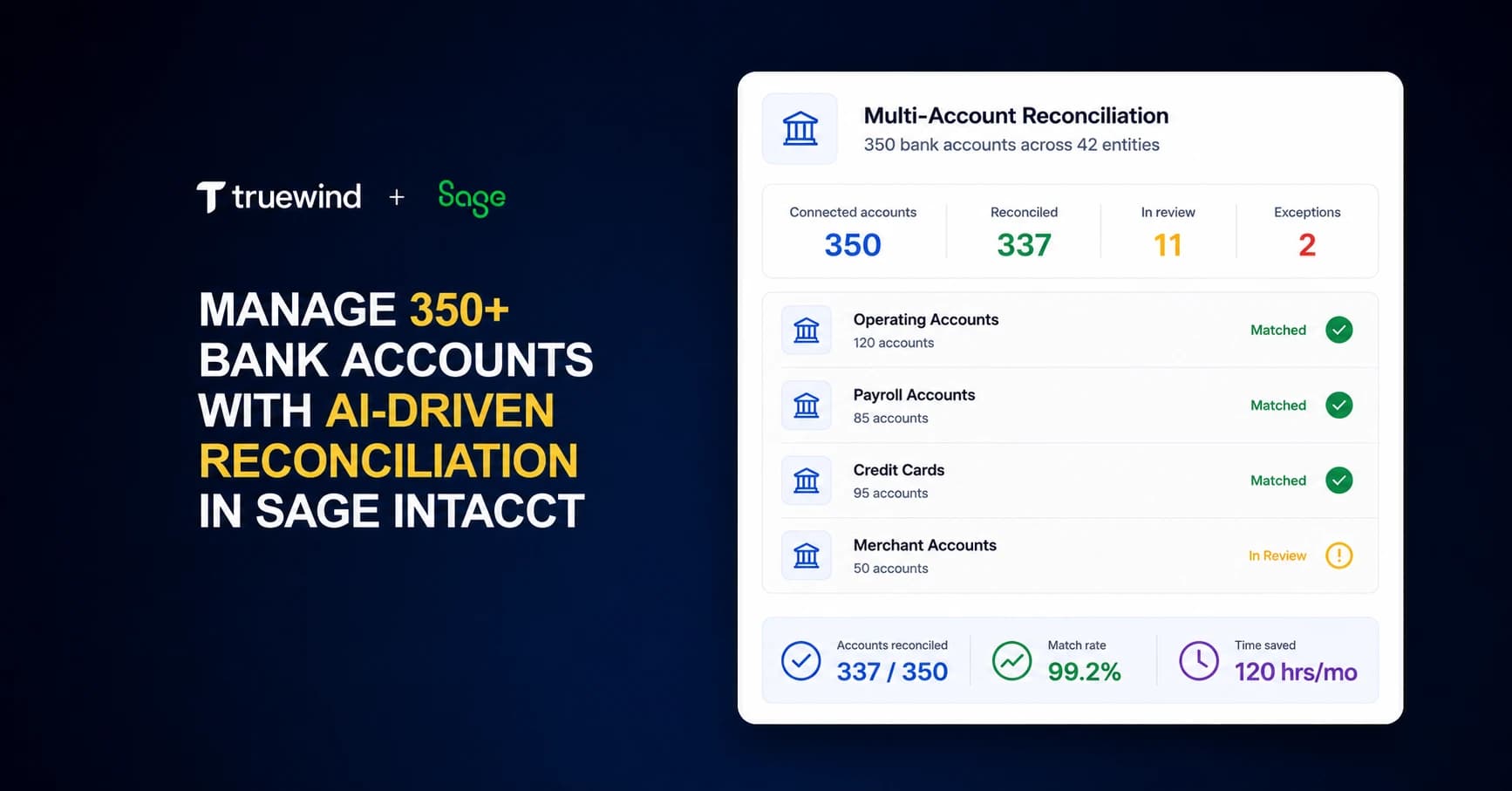
TLDR:
- Sage Intacct handles GL storage well but breaks down at 350+ accounts when coordination overhead compounds faster than teams can clear it.
- At 350 accounts across 210 entities, you face thousands of reconciliation touchpoints per close; spreadsheets stop working around 50 accounts.
- Tier accounts by velocity: high-activity accounts need daily or weekly reconciliation, low-activity accounts can run quarterly without risk.
- A 2% exception rate generates hundreds of open items per close; tiered queues by materiality and age separate noise from real control gaps.
- Truewind runs matching logic across 350+ accounts in parallel via Sage Intacct API, routing exceptions by entity and variance size so your team reviews only what needs judgment.
Teams running 350 bank accounts in Sage Intacct hit the same wall every close: the reconciliation itself isn't the bottleneck anymore. It's the routing, the exception triage, the manual status checks to figure out which accounts are done and which ones are stuck in review. Sage intacct scale reconciliation works fine at 20 accounts. At 350, you need a workflow that was designed for volume, not adapted from one. The question isn't whether Sage stores the data. It does. The question is whether your process around it can keep up with the coordination overhead it generates when account counts multiply across entities.
The Reconciliation Bottleneck at Scale: Why 350+ Accounts Break Traditional Workflows
When a fund administrator or multi-entity controller sits down to close the books across 350+ bank accounts, the math alone is punishing. Each account needs a statement, a GL tie-out, and a reviewed exception log. At modest volume, that's a checklist. At scale, it's a staffing problem.
Sage Intacct handles the GL side well. What it doesn't absorb is the coordination overhead: routing statements to the right preparer, tracking which accounts are in progress, and surfacing exceptions without manual follow-up.
The breakdown tends to happen in three places:
- Statement ingestion takes longer than the reconciliation itself when accounts span dozens of banks, each with different export formats and delivery schedules.
- Exception triage has no native queue in Sage, so teams default to spreadsheets or email threads to track open items across accounts.
- Reviewer bandwidth becomes the binding constraint when sign-off is sequential and one reviewer covers 80+ accounts in a single close cycle.
The question isn't whether Sage Intacct can store the data. It can. The question is whether your workflow can keep up with the volume it generates.
What Sage Intacct Offers for Multi-Account Reconciliation
Sage Intacct includes a built-in bank reconciliation module that covers the basics well enough for smaller portfolios. You can match transactions, flag discrepancies, and close out accounts one at a time.
The trouble appears when account counts grow. Each reconciliation runs as a separate workflow, and there is no native mechanism to process them in batch. At 350+ accounts, that means 350+ individual sessions, each requiring manual attention.
Where the Native Tools Hit Their Limits
- Reconciliations cannot be queued or bulk-processed, so volume compounds directly into staff hours instead of into a faster workflow.
- Exception handling has no built-in triage layer, meaning every discrepancy surfaces at the same priority regardless of size or account type.
- Reporting across accounts requires manual aggregation; Sage Intacct stores reconciliation status per account, not across a portfolio view.
Connection Methods for High-Volume Bank Account Setups
At high volume, the connection method you choose for each bank account determines how much manual work lands back on your team every month.
Sage Intacct supports three main approaches:
- Direct bank feeds pull transactions automatically via the financial data aggregator network, cutting daily import time to near zero for supported institutions.
- Manual CSV/OFX file imports work for any institution but require someone to pull and upload files each period, which compounds fast across 350+ accounts.
- Third-party aggregators like Plaid or Finicity can bridge gaps where native feeds are unavailable.
The connection method also affects match rate quality before any rules run.
Rule Design Strategies That Scale to Hundreds of Accounts
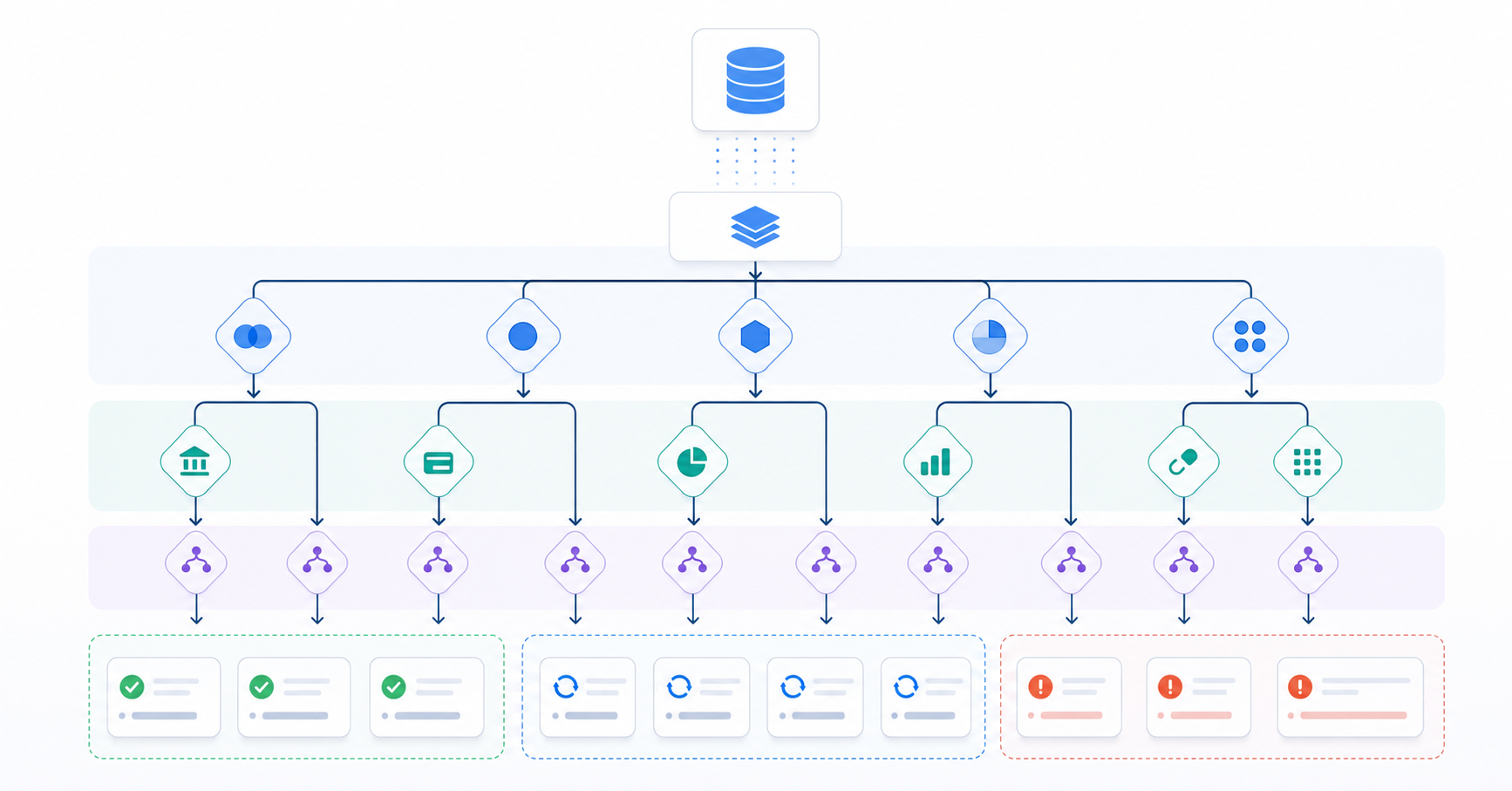
When you're managing reconciliation across hundreds of bank accounts in Sage Intacct, the rule engine becomes your biggest bottleneck. A few well-structured rules work fine at low volume. At 350+ accounts, poorly scoped rules create gaps, conflicts, and manual cleanup that compounds every close cycle.
Building Rules That Hold at Volume
Three design principles separate rule sets that scale from ones that quietly fail:
- Scope rules to entity and account type, beyond just transaction string. A rule that matches "Chase" across every entity will catch deposits, fees, and transfers indiscriminately. Narrow the match criteria so each rule fires only where it should.
- Build exception-first rather than catch-all. Define what doesn't fit a pattern before writing the affirmative rule. This forces you to think about edge cases before they appear in your exception queue at month-end.
- Version and document every rule change. When a rule stops matching correctly after a bank feed format change, you need to know what the rule looked like before. Sage doesn't maintain that history natively.
Where the Rule Engine Hits Its Ceiling
Even well-designed rules degrade over time. Bank feed formatting changes. New accounts get added mid-quarter. Entities that shared a rule set get restructured. The rule engine in Sage was built for single-entity or small multi-entity environments, and at 350+ accounts the maintenance burden often outpaces the time savings the rules were supposed to create.
The question worth asking: at what account count does managing the rule set cost more than just doing the reconciliation manually?
Duplicate Transaction Prevention Across Multiple Entities
When you run 350+ bank accounts across dozens of entities, duplicate transactions become a structural risk. The same wire confirmation, fee, or transfer can appear in multiple sub-ledgers before anyone catches it. Sage Intacct's native reconciliation tools flag discrepancies within a single entity, but cross-entity duplicate detection requires manual comparison or custom reporting. Teams running high-volume multi-entity books often catch duplicates only at month-end, after entries have already posted.
The Multi-Entity Reconciliation Challenge
When a fund administrator or multi-entity accounting firm runs 210+ legal entities, each carrying multiple bank accounts, the reconciliation math compounds fast. At 350 accounts across those entities, you are no longer looking at a workflow. You are looking at a full-time job that sits on top of every other close responsibility your team already owns.
The core problem is volume meeting variability. Each entity may bank with different institutions, carry different transaction types, and close on a slightly different schedule.
Frequency Strategies: When to Reconcile 350+ Accounts
Not every account in a 350+ account portfolio needs the same reconciliation cadence. Matching frequency to account risk is how high-volume teams stay in control without burying themselves in daily work.
Risk-Tiered Frequency Framework
A practical starting point groups accounts into three tiers:
| Account Tier | Account Types | Recommended Cadence | Why This Frequency |
|---|---|---|---|
| High-velocity | Operating accounts, merchant processors, payroll accounts | Daily or weekly reconciliation | Transaction volume is high and errors compound fast |
| Mid-activity | Credit cards, loan accounts, intercompany clearing | Monthly cycle aligned to standard close | Balances move predictably within the regular close window |
| Low-activity | Restricted reserves, escrow, dormant entities | Quarterly reconciliation when balances are stable | Movement is infrequent and risk exposure remains low between reviews |
What Breaks Down at Scale
At 350+ accounts, even a well-designed tier system creates coordination problems. Teams need a way to track which accounts are on which cadence, flag accounts that have migrated between tiers due to activity changes, and surface exceptions without manually checking each account status. A spreadsheet-based tracker stops working somewhere around 50 accounts.
The question worth asking: does your current workflow tell you which accounts are overdue, or do you find out when close prep starts?
Common Failure Modes When Scaling Reconciliation
At high account volumes, a few failure patterns show up repeatedly across teams managing Sage Intacct at scale.
Where Things Break Down
- Rule-based auto-matching collapses when transaction descriptions vary even slightly across accounts, leaving hundreds of open items that require manual review every close.
- Exception queues grow faster than teams can clear them, so older unresolved items carry forward and compound into the next period's workload.
- Without a centralized status view, close managers lose visibility into which of the 350+ accounts are blocked, in progress, or complete.
Exception Management Workflows for High-Volume Environments
At scale, the bottleneck is rarely the matching itself. It's what happens when a match fails.
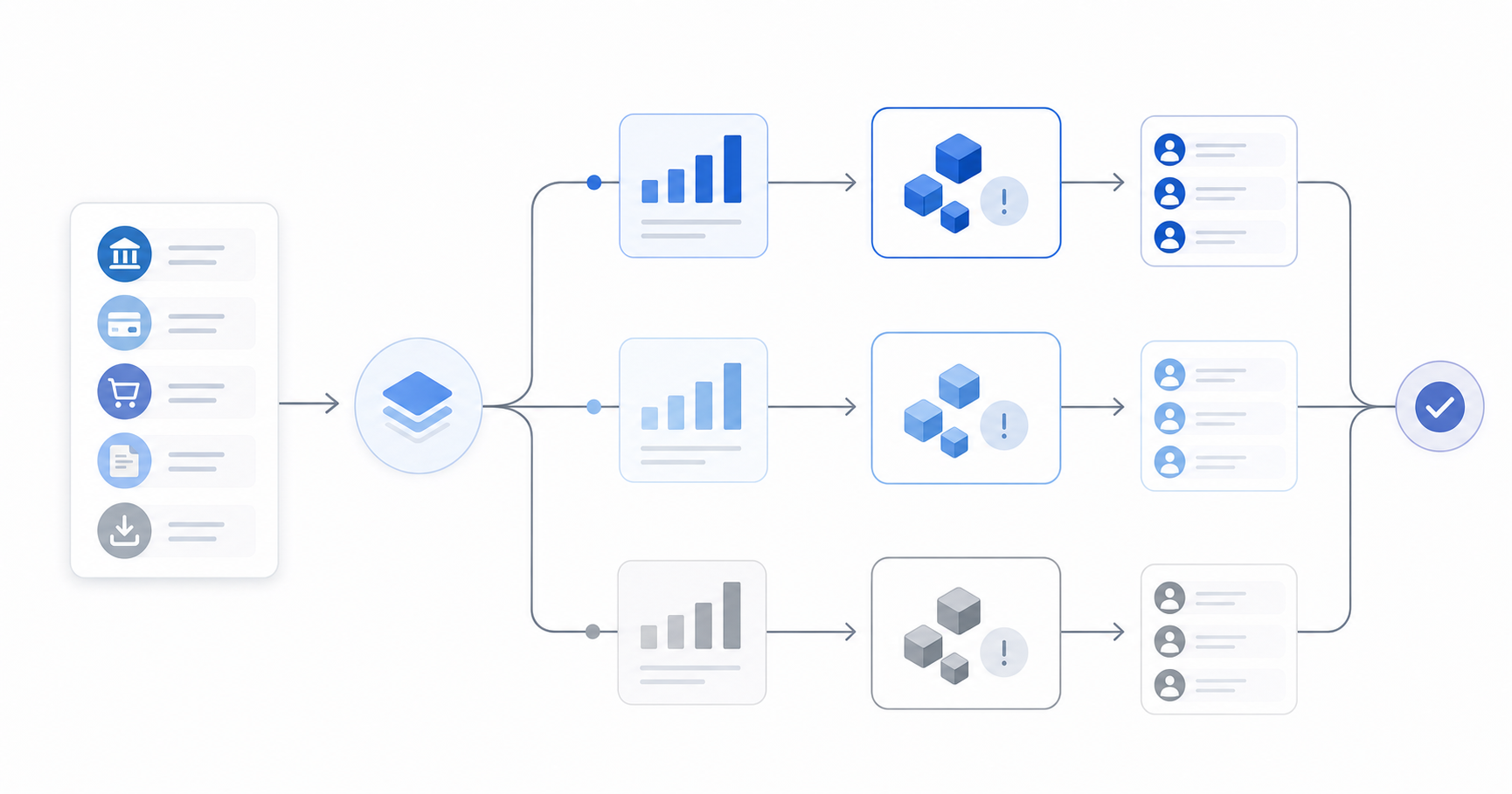
With 350+ accounts across dozens of entities, even a 2% exception rate generates hundreds of open items per close cycle. Without a structured triage process, those items pile up, get handed off informally, and stall the close.
Building a Tiered Exception Queue
Not every discrepancy carries the same risk. A tiered queue separates items by materiality and age so senior reviewers spend time where it counts.
- Low-dollar, recurring differences below a defined threshold can be auto-cleared or reviewed periodically in batch, not worked individually each month.
- Items open past a set aging threshold, typically 30 or 60 days, should escalate automatically to a named reviewer rather than sitting in a general queue.
- Entity-level exceptions should roll up into a summary view so a controller can see which accounts are stalled without opening each one individually.
Who Owns What
In high-volume environments, ownership gaps cause more delays than the exceptions themselves. Assign each account a primary and backup owner at the dimension level inside Sage Intacct, so routing is automatic instead of decided case by case during close.
The question worth asking before the next close cycle: does your current exception workflow tell you, at a glance, which items are stalled and who is accountable for clearing them?
Automation Strategies Beyond Native Sage Capabilities
When native Sage Intacct workflows hit their ceiling at volume, teams typically look in three directions: scripted workarounds inside Sage, third-party reconciliation tools, or an AI layer that sits on top of the GL.
Scripted workarounds buy time but rarely scale past a few dozen accounts before maintenance overhead compounds. Third-party reconciliation tools add coverage but often require duplicate data entry and lack write-back to Sage.
An AI layer purpose-built for Sage reads your GL directly, matches transactions, routes exceptions, and posts approved entries back without leaving the Sage environment.
How Family Offices Manage 350+ Bank and Brokerage Accounts
Family offices running 350 or more bank and brokerage accounts face a reconciliation burden that standard close workflows were never designed to handle. Each account needs a monthly tie-out, and across that many accounts, the volume compounds fast.
A few structural realities drive this:
- Many family offices with multi-custodian portfolios face statements delivered in different formats, on different schedules, and with different transaction coding conventions.
- Investment accounts generate activity that general operating accounts don't: dividends, capital gains distributions, margin activity, and securities transfers all require separate treatment at the GL layer.
- Accounts are often segmented by entity, beneficiary, or asset class, meaning a single family office may operate 50 or more legal entities, each with multiple accounts that need independent reconciliation before any consolidation can happen.
The arithmetic is unforgiving. At 350 accounts across 50 entities, you are looking at thousands of individual reconciliation touchpoints per close cycle. Manual workflows don't scale here; they just accumulate backlog.
Measuring Reconciliation Performance at Scale
At scale, gut-feel assessments of how reconciliation is going stop working. With 350+ accounts across dozens of entities, you need metrics that surface where the process is breaking down before month-end becomes a fire drill.
Key Performance Indicators Worth Tracking
A few measures consistently separate teams that have reconciliation under control from those that don't:
- Exception rate by account type: The percentage of accounts generating open exception items tells you where your matching logic is weakest, whether that's intercompany transfers, payroll clearing, or high-volume merchant accounts.
- Days to clear exceptions: How long unmatched items sit before resolution is a leading indicator of close risk. An aging exception queue at day three of close is a different problem than one at day ten.
- Preparer-to-reviewer cycle time: In high-volume environments, bottlenecks often sit at review, not preparation. Tracking how long items wait in review by reviewer and entity surfaces capacity constraints before they compress your close.
- Reopen rate: Accounts that get signed off and then reopened indicate either inadequate initial review or late-arriving transactions. Both are fixable, but only once you can see them.
What Good Looks Like at 350+ Accounts
At this volume, a clean close means exception queues cleared within two business days, reopen rates below five percent, and no single reviewer holding more than thirty accounts in their queue at once. For context, APQC Financial Management Benchmarking data shows the average financial close in 2026 takes 8.3 business days, down from 10.2 in 2022, while AI-enabled finance teams are consistently hitting a 3-day benchmark.
Teams that hit those numbers have generally moved away from tracking reconciliation status in spreadsheets and toward a system that logs timestamps, ownership, and exception counts at the account level automatically.
Building a Scalable Reconciliation Operating Model
At 350+ bank accounts, the bottleneck stops being Sage Intacct itself and starts being the operating model around it. Teams that handle this volume without burning out tend to share a few structural choices:
- They assign account ownership by entity tier, not by person, so coverage gaps surface before close rather than during it.
- They set exception thresholds per account type, letting low-risk accounts clear automatically while flagging anything outside tolerance for human review.
- They run reconciliations on a rolling basis throughout the month, avoiding the compression of everything into the final week of close.
The question worth asking is whether your current model was designed for the volume you have now or the volume you had two years ago.
How Truewind Automates Multi-Account Reconciliation for Sage Intacct Users
Truewind sits on top of Sage Intacct as an AI layer, pulling transaction data, bank feeds, and GL balances directly through the API. For firms managing 350 or more bank accounts, it runs matching logic across all of them in parallel instead of one at a time, so the volume that breaks a manual workflow becomes a background process.
Exceptions get routed into a queue by entity, account type, and variance size. Your team reviews what needs judgment; Truewind handles the rest.
Final Thoughts on Multi-Entity Reconciliation at Scale
Sage Intacct stores the data. What it doesn't do is absorb the coordination overhead when you're closing 210 entities across 350 bank accounts. The global reconciliation software market is projected to grow from $2.65 billion in 2026 to $8.10 billion by 2034, reflecting how mainstream automated reconciliation has become for firms managing volume at scale.
The question worth asking: if exception queues are piling up faster than your team can clear them, is the problem the reconciliation itself or the workflow around it?
FAQ
How do you scale Sage Intacct reconciliation beyond 50 accounts?
At 50+ accounts, spreadsheet-based tracking stops working. You need automated exception routing by entity and account type so preparers see only their accounts and reviewers can track completion status across the portfolio without manually checking each one. Direct bank feeds cut import time to near zero for supported institutions, while rule sets scoped to entity and transaction type prevent match failures from compounding across accounts.
What reconciliation frequency makes sense for high-activity accounts?
Operating accounts, merchant processors, and payroll accounts need daily or weekly reconciliation because transaction volume is high and errors compound fast. Credit cards and intercompany clearing can run monthly, while restricted reserves and dormant entity accounts can safely close out quarterly when balances stay stable. The binding constraint is whether your workflow can track which accounts are on which cadence without manual status checks.
Why do exception queues grow faster than teams can clear them?
A 2% exception rate across 350 accounts generates hundreds of open items per close cycle. Without triage by materiality and age, every discrepancy surfaces at the same priority regardless of dollar amount or account risk. Senior reviewers spend time on low-dollar recurring differences while material variances sit in the same queue. Tiered routing separates noise from real control gaps so review time goes where it counts.
Can you run reconciliations in parallel across multiple entities in Sage Intacct?
Sage Intacct processes reconciliations one account at a time, so 350 accounts means 350 individual sessions. An AI layer that pulls transaction data and bank feeds through the API can run matching logic across all accounts in parallel, routing exceptions by entity and variance size while your team reviews what needs judgment. Volume stops compounding directly into staff hours.
Turn this into a close-ready workpaper
Start with sample files or upload your own statements to see how Truewind prepares review-ready workpapers and journal entries.