
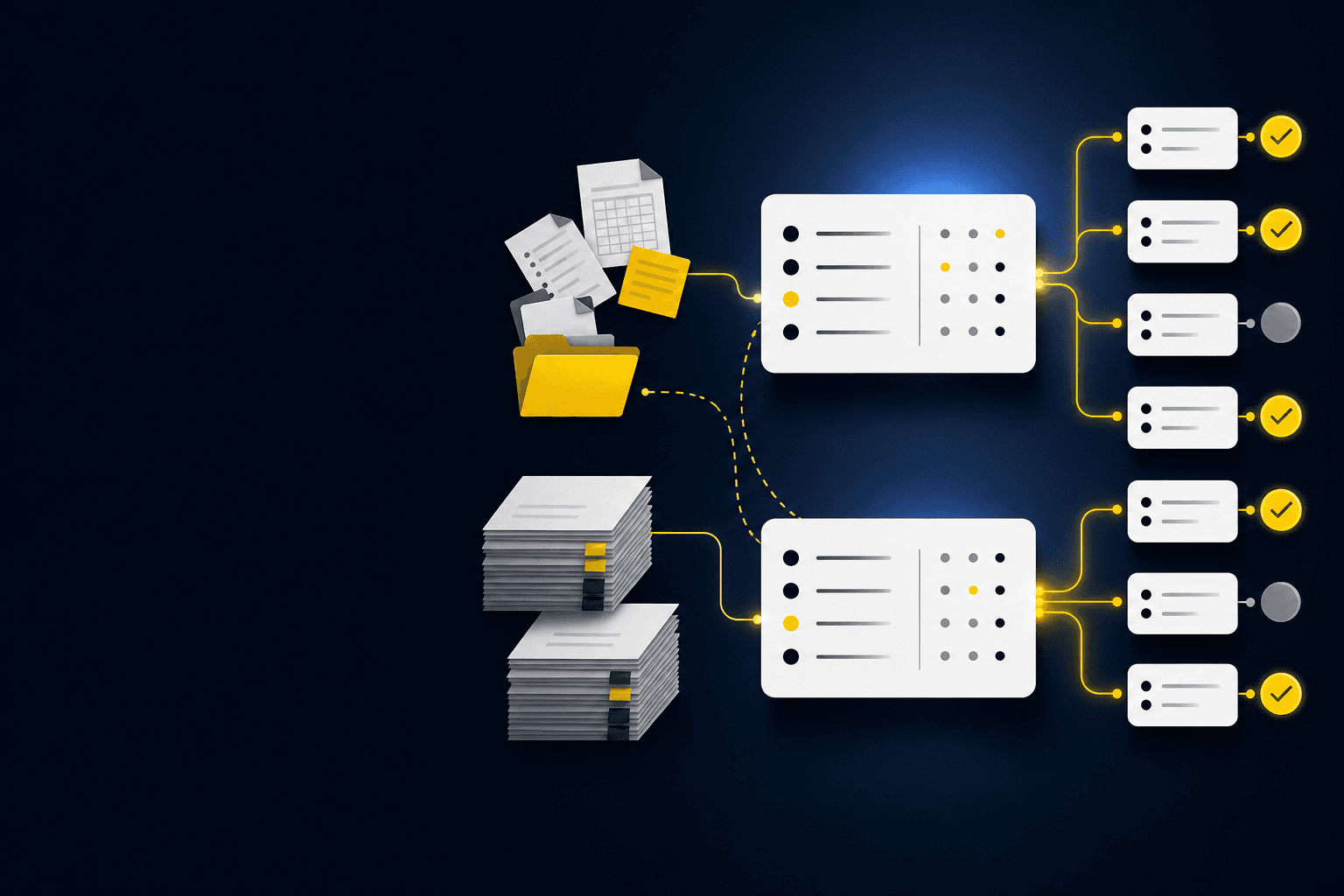
A processor report lands as a CSV, the bank feed shows a net deposit, and the GL needs the activity split between revenue, fees, refunds, and timing differences. None of those systems describes the transaction the same way. Before an accountant can review the entry, someone has to combine the files, determine what each line represents, apply the right coding, and explain why the reconciliation does not yet tie. The work starts long before posting.
When people ask what accountants waste time on, they often look at the visible end of the close: journal entries, approvals, and reporting. The larger burden sits upstream. It is the recurring preparation required to turn inconsistent source material into a workpaper a reviewer can trace and approve.
That distinction matters because the solution is not faster data entry. It is a controlled preparation workflow that can reproduce the team’s existing process, surface what does not fit, and leave accounting judgment with the reviewer. Sage Intacct or QuickBooks Online still records the approved result. The opportunity sits between the source files and that final posting.
1. Collecting and organizing source files
A close can begin with bank statements, credit card activity, payout reports, operational exports, prior workpapers, and emailed PDFs. The information may all be available, but availability is not the same as readiness. Someone still has to find the right period, confirm that every expected statement arrived, and organize each file for the workflow it supports.
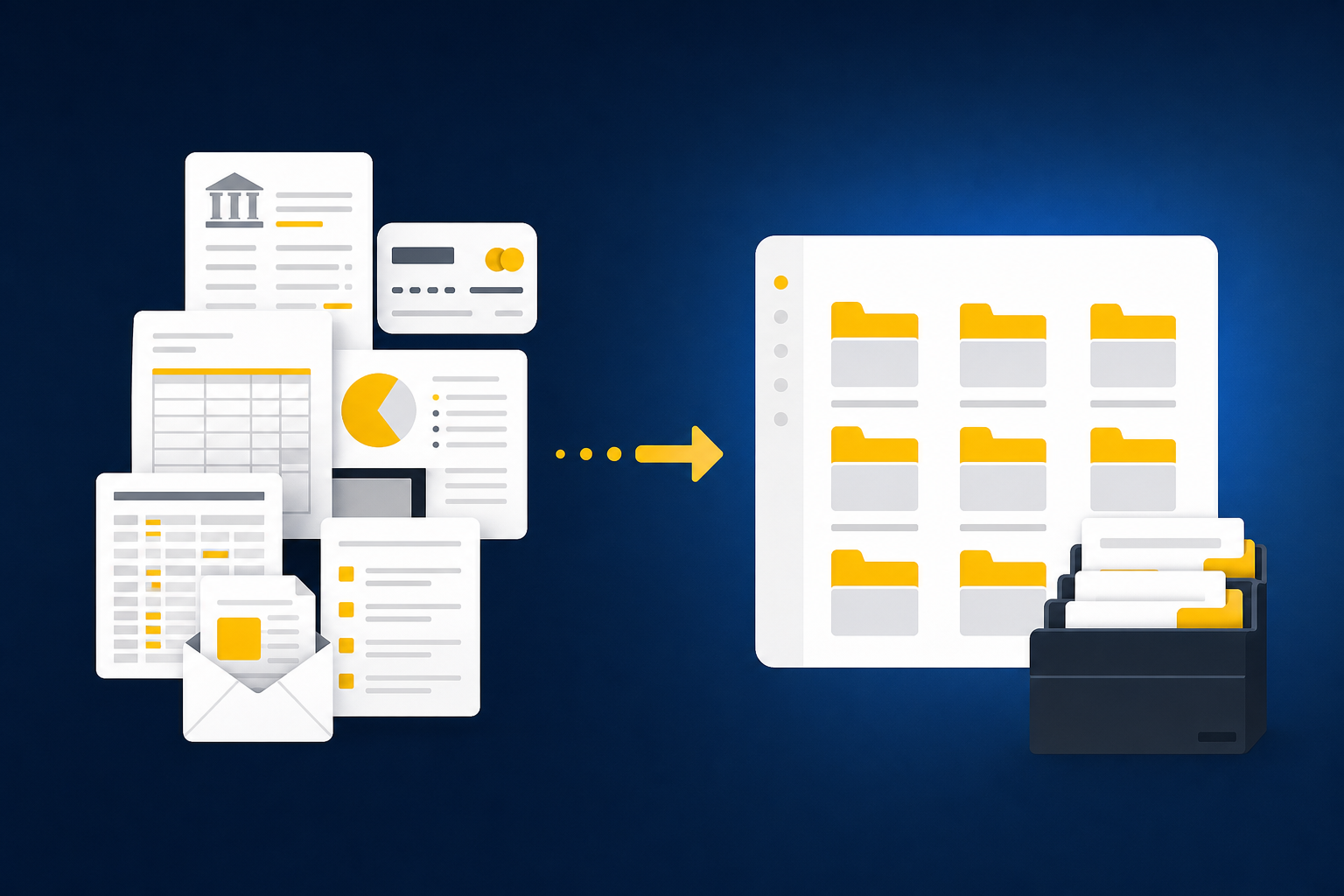
Source-file work also requires accounting context. A processor export is not useful merely because its columns were extracted. The preparer has to understand whether the file reports charges, settlements, fees, refunds, or some combination of them, then connect that activity to the bank and the ledger. A missing statement or changed format can alter the whole preparation path.
Spreadsheets handle the flexibility, but they also push the process onto the person running them. Each month starts with downloading, renaming, copying, and checking. When the usual preparer is unavailable, the next person inherits the files and the unwritten knowledge required to make sense of them.
Truewind’s multi-source ingestion accepts the recurring source materials finance teams already handle and structures them for coding, reconciliation, and workpaper preparation. The files remain tied to the workflow, so the reviewer can move from prepared output back to the underlying document. If scattered intake is where your close begins to slow, See Truewind in action to see how those source files become a review-ready workflow.
2. Rebuilding workpapers from the prior period
Recurring workpapers are supposed to make the next period easier. In practice, the prior workbook often becomes a template that someone has to copy, clear, rename, and rebuild. Balances roll forward, but the support still has to be replaced, formulas checked, and current-period activity tied to the GL.
The harder part is preserving reasoning. A prepaid schedule may carry a remaining balance, but the reviewer still needs to know which source document supports it and which amortization treatment the team approved. A brokerage rollforward may begin with the correct opening balance while losing the explanation for an entity-specific classification. Copying the workbook preserves cells. It does not necessarily preserve the decision behind them.
Truewind’s workpaper generation and rollforward starts with the prior workpaper, current-period source documents, and ERP balances. It rolls balances forward, updates supporting schedules, prepares any required journal-entry draft, and surfaces exceptions for review. The logic follows the team’s existing treatment rather than creating a new accounting policy.
That difference changes what the preparer has to do. Instead of reconstructing the artifact, the preparer reviews a current-period workpaper tied to source and investigates the items that changed. The reviewer still owns the treatment and sign-off. The preparation simply arrives in the form the reviewer already expects.
3. Repeating coding decisions the team already made
Transaction coding looks repetitive because the same vendors and descriptions return each period. The accounting treatment underneath them is rarely generic. Coding may depend on entity, department, fund, location, purpose, or the specific source that produced the transaction.
A vendor rule alone cannot carry all of that context. The same vendor may support several departments, and the correct split may change with the invoice or entity. A donor deposit may need program and restriction dimensions that never appear in the bank feed. A custodian statement may combine several activity types that belong in different accounts and schedules.
When prior decisions live in reviewer notes, email, or someone’s memory, the team pays for the same judgment twice. The preparer proposes a treatment. The reviewer corrects it. Next month, another preparer starts from the transaction description and repeats the discussion because the correction never became part of the workflow.
Historical-example learning gives recurring preparation a longer memory. Truewind records confirmed treatment and reviewer corrections against the workflow, then uses that history when preparing the next period. Coding proposals remain bounded by the team’s rules, and novel items still return to the accountant.
One accounting firm reported reducing credit card categorization time by approximately 75% after adopting Truewind. Its description was direct: “Truewind automates a huge chunk of that busywork.” The same customer also explained the practical value: “It’s not just about making bookkeeping simpler; it’s about freeing up teams, and helping them focus on higher-value projects.” Those are reported results from one customer example, not a universal benchmark, but the mechanism is clear. Prior treatment becomes operating context instead of disappearing after review.
4. Reconciling systems that describe the same activity differently
A reconciliation is not a comparison between two neat columns. One system may report gross activity, another may record net settlement, and the bank may show deposits grouped by timing. Fees, refunds, and transfers can sit in different places depending on the source.
The preparer has to establish what should agree before determining why it does not. For a payment processor, that can mean aligning processor activity to deposits and separating fees or timing differences. For a nonprofit, it can mean preserving fund or campaign detail from a donor platform while tying the total to the processor and bank. For a family office, it can mean reconciling custodian activity to investment schedules and ERP balances without losing entity context.
Generic matching addresses only part of the job. The useful output is a support schedule that shows which sources were compared, how activity was treated, what remains unreconciled, and which journal-entry draft follows from the work. If the system forces totals to agree without showing the unresolved items, it removes the exact information the reviewer needs.
Truewind’s multi-source reconciliation aligns activity across connected sources using the team’s historical treatment. It prepares the reconciliation and supporting schedule, ties the work back to source, and sends timing differences or unreconciled items to the accountant. The platform does not resolve those differences on its own or post a reconciling entry without review.
The handoff is easier to evaluate when you can inspect the reconciliation, the source links, and the exception queue together. To review that preparation pattern against one of your recurring reconciliations, Book a Truewind demo and bring the source set your team already uses.
5. Double-checking work because the exceptions are not separated
Controllers do not review every item because every item requires judgment. They review every item because the process does not reliably distinguish routine preparation from an actual exception. A clean-looking workpaper can still contain a missing statement, an unexpected balance change, mixed personal and business activity, or an inconsistent classification.
The answer is not to hide those cases behind a confidence score. Exceptions belong in front of an accountant. They are evidence that the workflow has reached the boundary of the known process and needs a judgment call.
Truewind compares current-period preparation with prior workpapers and the learned process. Items that fall outside the pattern are routed to the reviewer with source context. The reviewer can confirm the treatment, adjust it, or return it for more preparation, and that decision remains attached to the workflow.
A reliable exception queue changes the purpose of review. Accountants can inspect the items that require interpretation without pretending the rest of the work no longer needs ownership. Nothing leaves review without sign-off, and Truewind does not auto-correct an exception or change policy on its own.
6. Reconstructing how a number reached the GL
A reviewer question often begins with one number and expands into several files. Which statement produced it? Which calculation changed the source amount? Who selected the account and dimensions? Did the reviewer approve the original treatment or a later revision?
When those answers live across spreadsheets and email, the team has to reconstruct the history. The ending balance may be right, but the path to it is difficult to inspect. That creates more work during internal review, board preparation, or an external audit because the support has to be assembled again.
A reviewable workpaper keeps the evidence with the accounting result. Truewind’s audit trail retains ingested sources, coding decisions, preparation steps, reviewer corrections, and confirmations against the workflow. A reviewer can inspect the trail by item and period rather than searching through disconnected folders.
The audit trail documents what happened inside the workflow. It does not certify compliance or replace formal audit procedures. Its value is narrower and more practical: the team can show which source produced the prepared line and which reviewer confirmed the treatment without rebuilding that account from memory.
The better target is controlled preparation
The recurring work accountants spend time on is not unnecessary. Files must be interpreted. Reconciliations must explain differences. Workpapers must support the entry, and exceptions must reach someone qualified to make the call. Removing those requirements would weaken the close.
The opportunity is to stop rebuilding the preparation layer by hand every period. A controlled workflow can ingest the source material, apply established mappings and dimensions, prepare the reconciliation or schedule, and present the result with its exceptions. The accountant remains responsible for policy, treatment, materiality, and approval.
Truewind sits in that preparation layer. Its human-in-the-loop review workflow presents prepared workpapers, reconciliations, schedules, and journal-entry drafts beside their source links and exceptions. Accountants confirm, adjust, or send items back before anything moves downstream.
After reviewer confirmation, approved output can move to Sage Intacct or QuickBooks Online with coding and dimensions preserved. Those systems remain the source of truth. Truewind does not replace the GL, and it does not post without accountant approval.
Start with a workflow you already understand
AI adoption in accounting should begin with a recurring workflow that has known inputs and a prior approved result. A prepaid schedule, processor reconciliation, credit card coding workflow, or brokerage rollforward gives the team something concrete to compare. The first test is not whether the system can produce an answer. It is whether the reviewer can understand the output, trace it to source, and identify every difference from the known result.
An anonymized mid-market buyer followed that logic during evaluation. The team broke its close down by entity, account, source availability, preparer, reviewer, and implementation dependency before choosing where to begin. The first workflow had to be bounded and easy to inspect, not merely impressive in a demo.
Controlled iteration continues after the first result. Reviewer corrections become part of the workflow, the next period reflects confirmed treatment, and expansion happens only after the team can see that the process is repeatable. Turnkey autonomy skips the part that creates confidence: comparison, correction, and visible reviewer ownership.
A marketplace customer reported saving more than 10 hours per month and reducing its month-end close by four days after adopting Truewind. Its reaction was emphatic: “If I had to describe Truewind in one word: Lifechanging.” That outcome belongs to that customer’s circumstances, but the implementation lesson travels well. Begin with a real workflow, prove the preparation against a known answer, and expand from evidence.
If you have a recurring workpaper with prior-period support and a reviewer who owns the result, Get a Truewind demo to evaluate that workflow with your existing source files.
The goal is not an autonomous close. It is a close where accountants no longer spend each period collecting the same files, recreating the same workpapers, and rediscovering the same treatment. Preparation becomes repeatable, exceptions become visible, and the accountant keeps control of every result that reaches the GL.
Frequently Asked Questions
How do I collect and organize source files for reconciliation?
Start by gathering all relevant documents like bank statements, credit card activity, and payout reports. Ensure you have the right period covered and confirm that all expected statements have arrived. Organize these files in a way that aligns with your workflow, so they are ready for the next steps in your reconciliation process.
What if my prior workpapers are incomplete?
If your prior workpapers are incomplete, review the last approved version and identify missing elements. You may need to gather additional source documents and ensure that all balances are updated. Use the prior workpaper as a template, but be prepared to adjust it based on the current period's activity and any new information.
Can I automate transaction coding decisions?
While you can't fully automate transaction coding, you can streamline the process by documenting past coding decisions and using them as a reference. This way, when similar transactions arise, you can apply the same logic and reduce the time spent on repetitive coding. Ensure that all team members are aware of these coding rules for consistency.
When should I surface exceptions during the reconciliation process?
You should surface exceptions as soon as they are identified during the reconciliation process. This includes discrepancies like missing statements or unexpected balance changes. By routing these exceptions to the accountant with full context, you ensure that they can make informed decisions and maintain control over the reconciliation.
Why does my reconciliation not tie to the GL?
If your reconciliation does not tie to the GL, it may be due to differences in how transactions are recorded across systems. Review each source to identify where discrepancies arise, such as fees or timing differences. Ensure that you have a clear understanding of how each system reports activity and align them before finalizing your reconciliation.
Turn this into a close-ready workpaper
Start with sample files or upload your own statements to see how Truewind prepares review-ready workpapers and journal entries.