
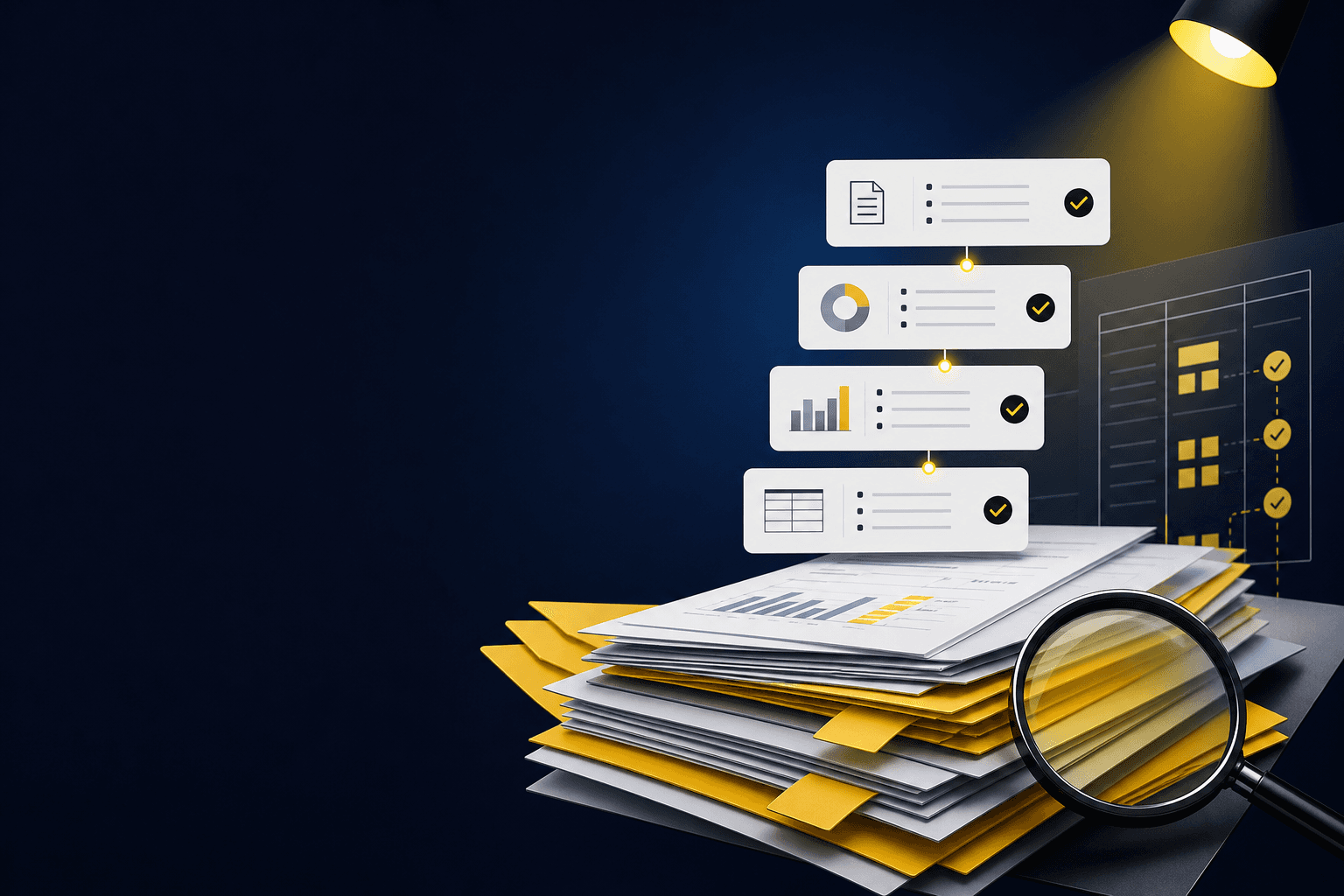
The workpaper ties to the GL. The source file is in another folder, the allocation logic sits in a preparer’s notes, and the approval happened over email. Nothing is necessarily wrong with the number. The problem appears when a reviewer has to reconstruct how it got there.
Audit readiness is often treated as a year-end exercise: gather support, answer questions, and rebuild the path from source to ledger. By then, the accounting treatment has already been applied and the close has moved on. The team is left searching old inboxes and spreadsheets for evidence that should have stayed with the work.
What audit-ready accounting really requires is a different operating standard during the close. Every prepared balance, schedule, reconciliation, and journal-entry draft needs to carry its source, logic, exceptions, and approval with it. Audit readiness is not a cleanup project. It is a property of the recurring workflow.
Audit readiness starts with visible exceptions
A clean workpaper can create more concern than an obvious error when it does not show what happened underneath. The reviewer sees a tied balance, but cannot tell whether a statement was missing, a classification changed, or an unreconciled item was forced into agreement. A polished total is not enough. The reviewer needs to know which items followed the established process and which items require judgment.
That distinction matters because exceptions are part of accounting work. Missing statements, unexpected balance changes, mixed personal and business activity, and inconsistent classifications do not belong inside an automated assumption. They belong in front of the accountant, attached to the relevant source and presented with enough context to make a decision.
An audit-ready workflow therefore does not hide uncertainty. It separates repeatable preparation from judgment items, then records what the reviewer decided. The accountant can confirm the proposed treatment, correct it, or send the work back for preparation. Nothing should reach the GL merely because the output looks complete.
Truewind follows that pattern by comparing current-period preparation with prior workpapers and the team’s established process. Items that fall outside the pattern are routed to the accountant with source links. To see how that exception queue connects preparation to reviewer approval, See Truewind in action using a recurring workflow from your own close.
A tied balance is not the same as a reviewable balance
Close-complete and audit-ready describe different conditions. A balance may tie to the GL while the supporting logic remains spread across formulas, email threads, and undocumented preparer knowledge. The entry can be correct and still be difficult to review because the evidence is disconnected from the result.
A reviewable balance answers five practical questions:
- What source produced the number? The reviewer can open the statement, export, invoice, or operational report that supports the line.
- How was it calculated? The workpaper shows the formulas, matches, allocations, and reconciling items used to reach the prepared balance.
- What accounting treatment was applied? Account mappings, dimensions, cutoffs, and classification decisions remain visible.
- What did not fit the expected process? Missing support, timing differences, unusual changes, and inconsistent treatment appear as review items.
- Who approved the result? The workflow records the reviewer’s confirmation or correction before anything moves downstream.
Keeping those elements together changes the nature of review. Instead of asking the preparer to explain the entire workpaper from memory, the reviewer can trace the prepared result back to its source and focus on the parts that required a decision. The workpaper becomes the record of how the accounting was performed, not merely a spreadsheet that contains the final balance.
That does not make the workpaper a substitute for an audit. Source links and reviewer history do not certify compliance, and they do not replace formal audit procedures. They make the underlying accounting work inspectable, which gives auditors and internal reviewers a clearer path through the evidence.
Source files are part of the accounting logic
A processor report and a bank feed can describe the same activity without presenting it the same way. The processor may show gross activity, refunds, fees, and settlement timing. The bank shows the net deposit. The GL needs the accounting treatment that connects them.
Extraction alone does not solve that problem. The preparer still has to determine what each file represents, whether the period is complete, how the activity maps to the chart of accounts, and which dimensions need to survive the entry. A donor export may carry fund and campaign detail that disappears in the bank deposit. A custodian statement may combine trades, dividends, interest, and fees that need different treatment across entities.
Audit-ready preparation preserves those relationships. The reconciliation should show how activity from each source was aligned, where timing differences remain, and how fees or refunds were treated. If the totals do not agree, the workflow should surface the unreconciled item rather than force a result.
Prior workpapers matter here because recurring accounting is specific to the team. Two companies can prepare the same type of reconciliation and still use different cutoffs, account mappings, allocation rules, and reviewer conventions. Historical workpapers and reviewer corrections provide the operating context for the next period. They show not only what the team did, but where the reviewer changed the proposed treatment.
A current-period workpaper becomes more useful when those decisions remain visible. The reviewer can inspect what carried forward, what changed, and why the new treatment differs from the last approved result. Audit readiness depends on that continuity because a source-linked number without its accounting context still leaves part of the explanation missing.
The real capacity gain happens after preparation
The case for AI in accounting is often framed around replacing accounting labor. That framing misses where experienced staff spend their time. The constraint is usually not the final approval or the accounting judgment. It is the preparation required before judgment can begin: gathering support, applying recurring mappings, rolling schedules forward, checking totals, and finding the items that changed.
When preparation is repeatable, the accountant does not leave the process. The accountant moves further downstream. More of the team’s time can go toward investigating changes, improving controls, supporting audit requests, and explaining results to the business because less of it is consumed assembling the first draft of the work.
One accounting firm customer described the effect on recurring transaction categorization plainly: “Truewind automates a huge chunk of that busywork.” The same customer added, “It’s not just about making bookkeeping simpler; it’s about freeing up teams, and helping them focus on higher-value projects.” The phrase refers to repetitive preparation, not the judgment, policy decisions, and review that accountants continue to own.
A marketplace finance customer put the experience in more personal terms: “If I had to describe Truewind in one word: Lifechanging”. That is one customer’s description, not a promised result for every team. The useful point is the mechanism behind the reaction: recurring accounting work was prepared inside a structured process instead of being rebuilt across disconnected files each month.
To examine that source-to-review chain against one of your existing workpapers, Book a Truewind demo around a recurring reconciliation your team already knows how to prepare and approve.
Audit-ready preparation needs a controlled workflow
A controlled workflow begins with known inputs and ends with accountant sign-off. Between those points, the system can structure source files, apply established accounting rules, prepare the workpaper, and identify exceptions. The boundary is clear: the system prepares, and the accountant decides.
The first implementation should be bounded enough for the team to inspect. A recurring prepaid schedule, processor reconciliation, brokerage rollforward, or credit-card coding workflow provides prior-period evidence and a known result. The team can compare the prepared output with the approved workpaper, examine differences, and correct the treatment where needed.
That process creates a stronger test than asking whether an AI answer looks plausible. Reviewers can ask concrete questions. Did every expected source arrive? Did the mapping follow the team’s rules? Were dimensions preserved? Did an unusual balance change become an exception? Can the reviewer trace the journal-entry draft to the supporting schedule and underlying statement?
Corrections also need to remain part of the workflow. If a reviewer changes an allocation or classification, the decision should not disappear into a final spreadsheet. Capturing it against the recurring process gives the next period a better starting point while leaving policy changes under the accountant’s control.
Controlled iteration is slower than a promise of instant autonomy, but it matches the responsibility structure of accounting. The team begins with a process it understands, confirms that the output is reviewable, and expands only after the workflow reproduces the known treatment. Audit readiness grows from that repeatability.
How Truewind prepares review-ready work
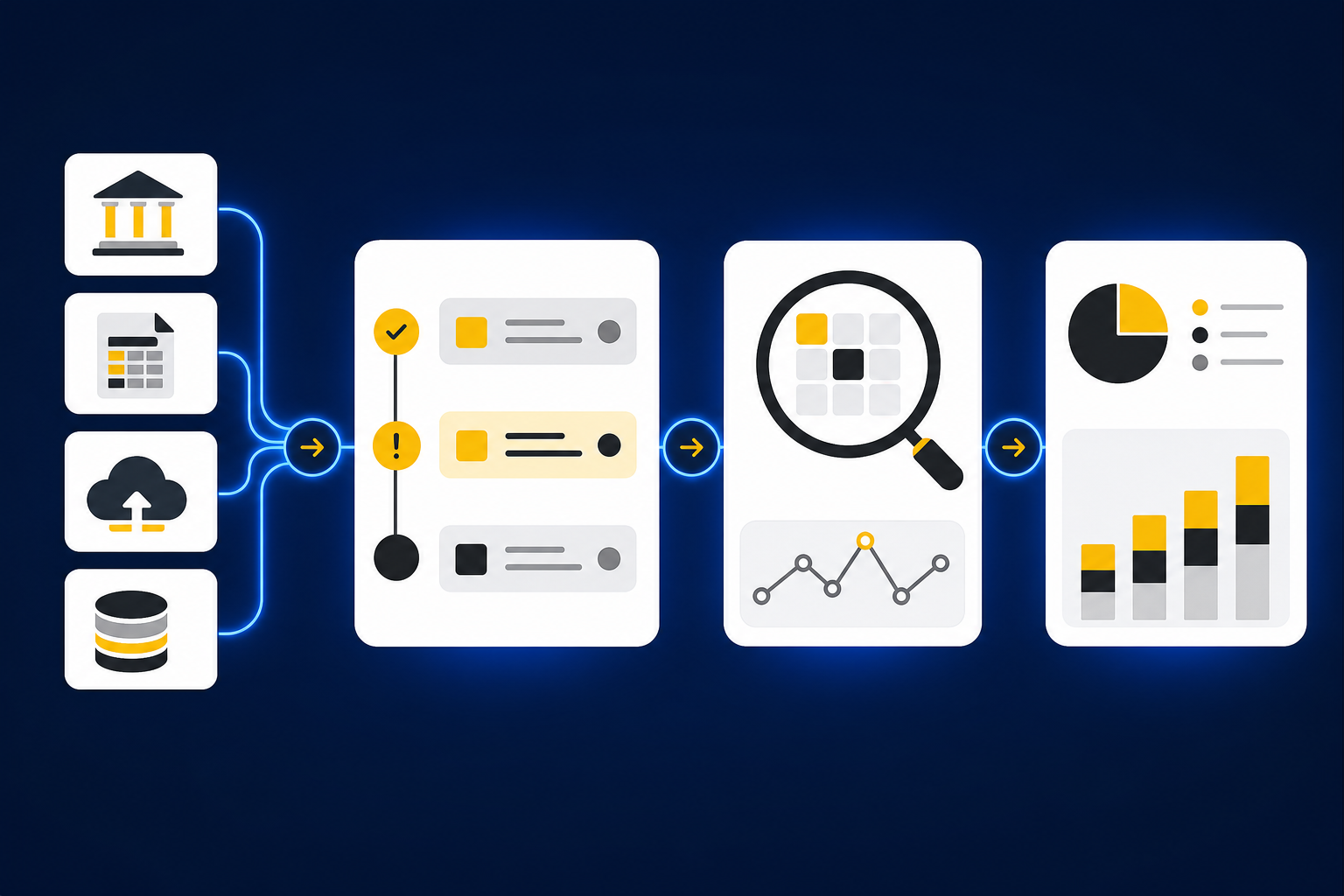
Truewind sits between the source files and the general ledger. Sage Intacct and QuickBooks Online remain the systems of record. Truewind prepares the work that feeds them, while the accountant retains ownership of accounting treatment, reviewer approval, and posting.
The workflow starts with recurring inputs such as bank statements, credit-card activity, payout reports, spreadsheets, donor-platform exports, custodian statements, prior workpapers, and operational-system exports. Truewind structures those files for coding, reconciliation, schedule preparation, and workpaper generation. The source files remain attached to the workflow so the reviewer can trace prepared work back to the underlying evidence.
Multi-source reconciliation then connects systems that describe the same activity differently. Truewind can align processor activity with bank deposits, or custodian activity with an investment schedule and ERP balance. Fees, refunds, and timing differences are prepared for review. Unreconciled items are surfaced to the accountant rather than forced into agreement.
For recurring accounts, workpaper generation and rollforward use the prior workpaper, current-period sources, and ERP balances to prepare the current period. Supporting schedules update, balances roll forward, and any required journal-entry draft carries source-linked support. The workflow follows the team’s existing treatment; it does not create accounting policy.
Reviewer corrections and confirmed treatments become historical context for later periods. Account mappings, classification splits, allocation choices, and prior review decisions can inform the next preparation cycle. Novel items still return to the accountant, and rule changes remain explicit.
The review surface keeps prepared work and exceptions together. Accountants can inspect source links, confirm or adjust treatment, and send items back for further preparation. Nothing leaves review without sign-off. After approval, structured output can be pushed to Sage Intacct or QuickBooks Online with coding, dimensions, and source references preserved.
Truewind’s audit trail retains the sources, preparation steps, coding decisions, reviewer corrections, and confirmations associated with each workflow. It documents what happened and who approved the treatment. It does not certify regulatory compliance or replace the auditor’s procedures.
For a close with prior workpapers and an accountable reviewer, Get a Truewind demo and use one bounded workflow to test how source-linked preparation, exception handling, and sign-off fit together.
Start with the work an auditor would ask you to explain
The right first workflow is not necessarily the largest or the one with the most transactions. Start with work that recurs, has stable inputs, and already has an approved prior-period result. The reviewer should understand the existing process well enough to identify whether the prepared output followed it.
A good candidate also contains enough friction to matter. The source may arrive as multiple files, the reconciliation may require timing adjustments, or the schedule may depend on dimensions that have to remain intact through posting. Those conditions give the team a meaningful test of whether preparation can become repeatable without weakening review.
Truewind is not the fit for a team seeking autonomous posting or a replacement for its GL. It also assumes an established close, recurring workflows, and an accountant who owns sign-off. Without those conditions, there is no reliable review process for the preparation layer to support.
Audit-ready accounting is built during ordinary close work, one source-linked decision at a time. When the workpaper preserves the calculation, treatment, exceptions, and approval alongside the source, the team no longer has to reconstruct the close when a question arrives. The accountant still owns the result. The difference is that the evidence is already there.
Frequently Asked Questions
How do I ensure my workpapers are audit-ready?
To make your workpapers audit-ready, start by ensuring every prepared balance, schedule, and journal entry includes its source, logic, and approval. Document any exceptions or unusual items clearly. This way, when a reviewer looks at your work, they can trace everything back to its origin and understand the decisions made along the way. Using a structured process can help maintain this clarity and continuity for future periods.
What if I find discrepancies in my reconciliations?
If you spot discrepancies during your reconciliations, first identify the source of the mismatch. Check if all expected documents were included and whether the mappings followed your established rules. Surface these discrepancies to your accountant for review rather than trying to force a resolution. This keeps the integrity of your accounting process intact and ensures that any corrections are documented.
Can I automate my accounting preparation process?
You can streamline your accounting preparation by using tools that automate data ingestion and transaction coding. Start by organizing your source documents, like bank statements and invoices, into a structured format. Then, apply your accounting rules to categorize transactions. Remember, while automation can reduce repetitive tasks, human review is essential to ensure accuracy and compliance with your accounting standards.
When should I involve my accountant in the review process?
Involve your accountant in the review process whenever there are exceptions or unusual items that require judgment. This includes discrepancies in reconciliations, changes in classification, or any items that do not fit the expected process. It's important to capture their decisions and corrections in the workflow to maintain a clear audit trail for future reference.
Turn this into a close-ready workpaper
Start with sample files or upload your own statements to see how Truewind prepares review-ready workpapers and journal entries.