
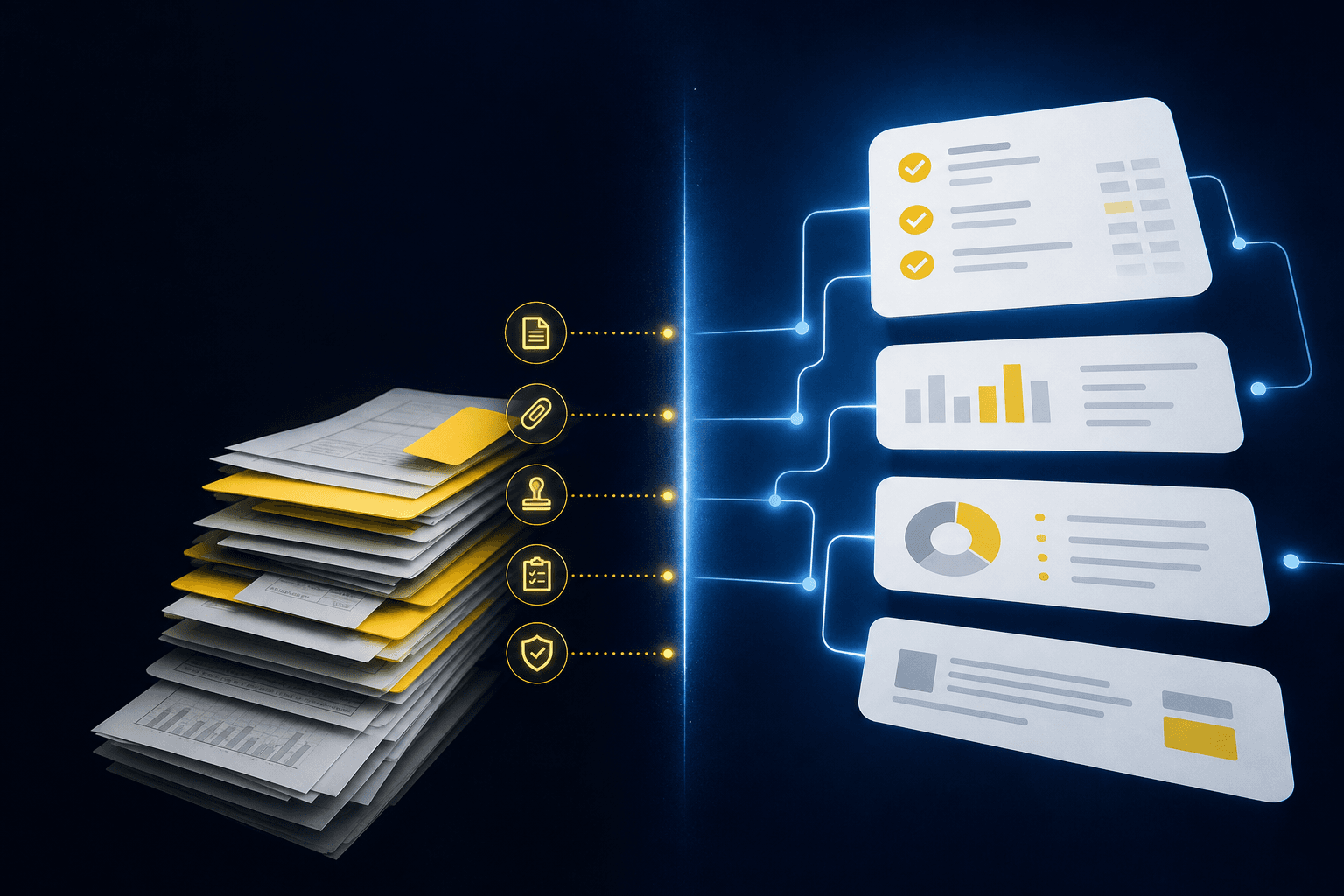
A finance team can buy accounting automation and still end up changing far more than expected. Some platforms become the new general ledger, which means migrating accounting data, policies, integrations, and reporting. Others automate the preparation work between source files and the existing GL.
The comparison examines Rillet’s system-of-record model against an ERP-augmentation model. Rillet positions itself as an AI-native general ledger for high-growth companies (Rillet). The alternative keeps the current ERP in place while automating workpapers, reconciliations, schedules, journal-entry preparation, and review.
Quick Reference: Two AI Accounting Architecture Models
| Evaluation Area | Ledger-Replacement Model | ERP-Augmentation Model |
|---|---|---|
| Core architecture | Accounting automation inside a new general ledger | Preparation and review automation upstream of the existing GL |
| System-of-record impact | Replaces the current accounting system | Retains the current accounting system |
| Typical implementation scope | Data migration, policy setup, integrations, reporting, and training | Workflow setup, source connections, accounting rules, and reviewer approval |
| Primary workflow emphasis | Ledger operations, reporting, and embedded accounting workflows | Source-file preparation, reconciliations, workpapers, and proposed entries |
| Suitable accounting environment | Teams prepared to adopt a new finance system | Teams committed to their current ERP |
| Key diligence question | Can the new ledger support the full accounting model? | Can prepared work remain traceable and controlled before posting? |
Key Takeaways:
- Ledger strategy comes first: Decide whether you want to replace the GL or automate recurring work around the current system.
- SaaS fit: Rillet targets high-growth companies seeking an AI-native ledger with embedded finance workflows (Rillet).
- Existing ERP fit: An augmentation model suits teams that need source-heavy automation without changing their system of record.
- Pricing diligence: Rillet does not publish standard pricing, so buyers need a quote tied to scope and migration requirements (Rillet Pricing).
Two Different Approaches to AI Accounting Automation
The two approaches differ at the system-of-record boundary. A ledger-replacement platform becomes the place where entries, policies, reporting, and operational accounting live, while an augmentation platform prepares work for an ERP the team already uses. For a controller, that distinction changes migration scope, review design, and ownership.
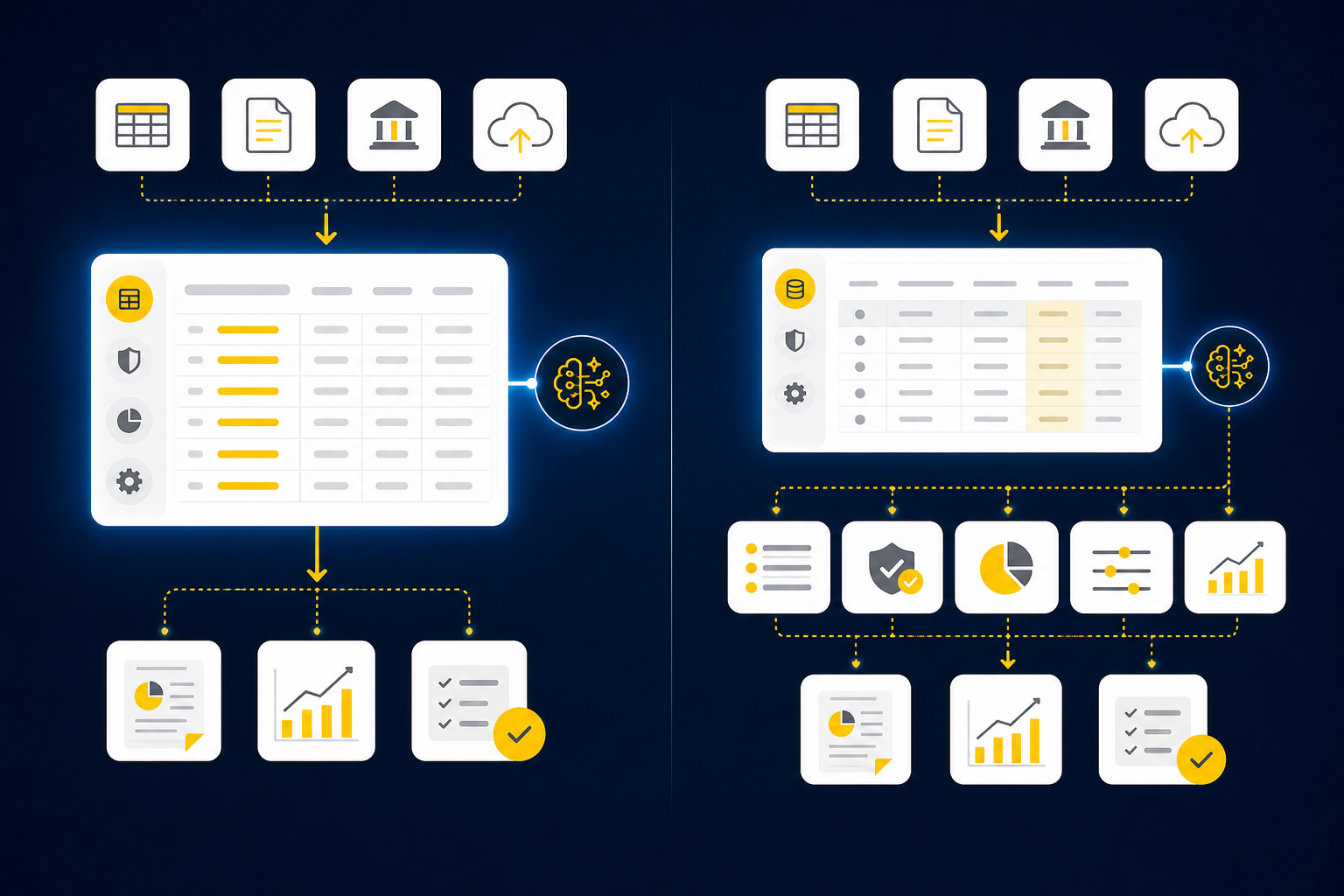
The Core Choice: Replace the Ledger or Automate the Work Upstream
A ledger replacement brings automation into the accounting system itself. The company migrates its chart of accounts, opening balances, historical data, dimensions, accounting policies, users, approvals, and integrations. That can be the right move when the existing GL no longer supports the company’s operating model.
An upstream preparation layer has a different job. It reads the statements, spreadsheets, processor reports, and other source files the team already receives. It applies the team’s mappings, dimensions, classifications, and prior-period logic, then prepares workpapers, reconciliations, schedules, and proposed journal entries for review.
The distinction matters because posting is only the final step. Before an entry reaches the GL, an accountant may need to combine files, check completeness, apply entity and department mappings, reconcile totals, investigate exceptions, and assemble reviewer support. A bank feed or generic prompt does not complete that work.
Neither architecture is universally preferable. If your team wants a new general ledger with revenue recognition and operational workflows in one system, replacement can be coherent. If the ERP is working but close preparation remains manual, replacing the ledger may expand the project beyond the actual bottleneck.
What Finance Teams Should Evaluate Before Choosing a Platform
Finance teams should evaluate architecture, controls, and workflow fit before comparing isolated features. The choice affects data migration, source lineage, approval design, integration testing, policy configuration, and the work accountants perform each period. Preserving an existing ERP requires different diligence from adopting a new general ledger.
System-of-Record Strategy and Migration Scope
Start with a direct question: Is the current GL part of the problem?
If the answer is yes, evaluate the replacement as a full accounting-system project. Inventory historical data, custom dimensions, recurring entries, reporting dependencies, consolidation rules, access roles, approval policies, and every upstream or downstream integration. The migration must reproduce the accounting model, not merely transfer balances.
If the GL is serving its purpose, identify what remains manual around it. Look for source files being reformatted, schedules being rolled forward, mappings being reapplied, reconciliations being assembled, and reviewer notes being carried through email. Those are preparation-layer problems. A ledger migration does not automatically remove them.
Reviewability, Source Traceability, and Human Approval
A clean journal entry is not enough. The reviewer needs to know which statement, report, spreadsheet, or transaction supports it, how the calculation was performed, what accounting treatment was applied, and which exceptions still need judgment.
Ask each vendor to demonstrate the review surface using a closed period. Pick a completed reconciliation or support schedule, provide the original files and approved result, and see whether the system can produce work the reviewer can trace and re-perform. That test is more useful than evaluating a polished dashboard with sample data.
Approval should also be explicit. Confirm what the preparer can change, what the reviewer sees, how corrections are recorded, and what prevents an unapproved journal entry from reaching the GL. The accountant should remain responsible for the result.
Workflow Fit, Integrations, and Total Implementation Effort
Feature availability does not prove workflow fit. A platform can offer an integration while still requiring manual work to preserve dimensions, validate totals, resolve unmatched items, or produce the reviewer’s expected workpaper.
Map one workflow from source to posting. Document where files originate, how the team checks completeness, which mappings and cutoffs apply, how exceptions are handled, what the workpaper must contain, and who approves the entry. Then ask the vendor to show every handoff.
Implementation effort should include accounting configuration, technical integration, user training, control design, historical-data validation, and security review. For a ledger replacement, add migration testing and reporting validation. For an augmentation layer, focus on source access, workflow instructions, ERP handoff, and reviewer acceptance.
Rillet: An AI-Native General Ledger for High-Growth Companies
Rillet is an AI-native finance system of record built around a general ledger for high-growth companies (Rillet). It combines ledger functions with close automation and operational accounting capabilities rather than sitting only above an existing ERP. For a SaaS buyer, this makes the evaluation both a software comparison and a ledger migration decision.
Rillet's Core Strengths
Rillet describes its architecture as an AI-native ERP, not simply an automation overlay (Rillet, What Is an AI-Native ERP?). That gives buyers a unified model for recording transactions, running accounting workflows, and producing financial reporting.
The platform’s published scope includes revenue recognition, accounts receivable, accounts payable, invoicing, multi-entity accounting, consolidation, and reporting (Rillet). These capabilities align with venture-funded SaaS and subscription companies that want revenue and operational accounting inside the same system as the GL.
Rillet also offers connectivity for finance workflows, including an integration listed in the HubSpot marketplace (HubSpot App Marketplace). Buyers should validate every required connector, data direction, field mapping, and error-handling process rather than treating an integration logo as proof of workflow coverage.
Rillet's Limitations and Implementation Tradeoffs
The main tradeoff is structural. Rillet markets itself against existing accounting systems, which means a buyer should treat adoption as a system-of-record decision rather than a lightweight addition to the stack (Rillet Comparison Overview).
That decision brings work. The accounting team needs to validate historical balances, policy configuration, dimensions, recurring entries, reporting, consolidation, user access, approvals, and integrations. Preparers and reviewers also need to understand how edge cases move through the new system.
Product scope continues to change, as shown by Rillet’s official updates in January 2026, March 2026, and June 2026. Buyers should therefore test current behavior directly, especially fixed assets, unusual revenue arrangements, exports, drill-downs, inventory requirements, and connector depth.
Rillet Pricing and Best-Fit Buyers
Rillet uses custom pricing rather than publishing a standard starting price (Rillet Pricing). The final business case should include implementation services, migration work, integration changes, internal accounting time, validation, training, and any parallel systems needed during the transition.
Its natural fit is a venture-funded, high-growth SaaS or subscription company prepared to adopt a new finance system of record. Built-in revenue recognition and broader operational accounting are especially relevant when the existing ledger no longer matches the company’s business model (Rillet).
A team committed to its current ERP faces a different question. The relevant comparison is not simply which platform has more features. It is whether replacing the ledger solves enough additional problems to justify migration and change management.
How Truewind Is Different
The platform is designed for teams that want to automate recurring accounting preparation while retaining Sage Intacct or QuickBooks Online as the system of record. It turns source files into review-ready workpapers, reconciliations, schedules, and proposed journal entries, then routes exceptions to accountants. The difference is where automation sits.
Truewind vs Rillet: Comprehensive Decision Grid
| Evaluation Criterion | Truewind | Rillet | Buyer Consideration |
|---|---|---|---|
| Product category | Accounting preparation layer | AI-native finance system of record (Rillet) | Decide whether automation should sit above or inside the GL |
| System-of-record strategy | Retains Sage Intacct or QuickBooks Online | Replaces the current ledger (Rillet Comparison Overview) | Define migration appetite first |
| Target customer profile | Nonprofit, family-office, CAS, and mid-market teams with source-heavy work | High-growth SaaS and subscription companies (Rillet) | Match the product to the accounting model |
| Raw source-document ingestion | Supports statements, reports, PDFs, and spreadsheets | Validate against the exact source files in scope | Test with closed-period files |
| Workpaper generation and rollforward | Prepares review-ready workpapers using team context | Confirm the required workpaper workflow | Judge the artifact reviewers receive |
| Multi-source reconciliation | Compares external source data with the ledger and surfaces exceptions | Confirm each required reconciliation pattern | Test completeness and unmatched items |
| Transaction coding | Applies team-defined rules and prior corrections | Ledger-centered accounting automation (Rillet) | Verify dimensions, splits, and exceptions |
| Prepaid and fixed-asset schedules | Included in the verified preparation scope | Verify required schedule functionality | Demonstrate the full lifecycle |
| Revenue recognition | Not included in the verified scope of this comparison | Built into the broader platform (Rillet) | Important for subscription revenue models |
| Accounts receivable and payable | Not included in the verified scope of this comparison | Included in the broader platform (Rillet) | Decide whether these workflows belong in the new GL |
| Multi-entity and multi-currency | Preserves entity and dimensional context; confirm currency requirements | Multi-entity and multi-currency capabilities (Rillet) | Test consolidation and entity-specific treatment |
| Human review and approval | Proposed outputs require accountant review before handoff | Confirm exact approval controls | Require a live control walkthrough |
| Source traceability and audit trail | Connects prepared work to source, calculations, changes, and approval | Confirm lineage for each material workflow | Ask reviewers to re-perform a sample |
| Supported ERP connections | Sage Intacct and QuickBooks Online | Native and API-oriented connectivity (HubSpot App Marketplace) | Validate fields, direction, and failures |
| Pricing and migration scope | Contact sales; existing ERP remains in place | Custom pricing with ledger migration scope (Rillet Pricing) | Compare total implementation effort |
How Truewind Is Different: The platform prepares the accounting work that happens before posting rather than asking the buyer to replace the general ledger. Raw source files, team-defined rules, review-ready workpapers, exceptions, and explicit accountant approval remain part of one controlled path to the existing system of record.
If that architecture matches your close, See Truewind in action with one recurring workflow and the files your team already reviews.
Automating Preparation Without Replacing the General Ledger
The workflow begins with the source material accountants already receive, including bank statements, credit card files, payout reports, PDFs, spreadsheets, payroll data, and brokerage statements. The system structures those inputs, applies team-defined coding rules, and prepares the resulting accounting work.
Sage Intacct or QuickBooks Online remains the system of record. That boundary reduces category confusion: the preparation layer assembles and checks the work, the accountant reviews it, and the approved output moves to the ledger.
The model fits teams whose ERP is working but whose recurring preparation still depends on disconnected files and manual rollforwards. It also lets the evaluation begin with a bounded workflow instead of a full accounting-system migration.
Source-Linked Workpapers, Exceptions, and Human Review
The workpaper is the review surface. It should show the source, calculation, accounting treatment, exceptions, changes, and reviewer sign-off. That gives the accountant enough context to understand the proposed result and re-perform the important steps.
Exceptions remain visible rather than being forced through. Missing statements, unexpected balance changes, duplicate activity, unusual classifications, and unmatched records return to the accountant for judgment. Human review is not a temporary compromise. It is part of the control design.
A credible evaluation uses known data. Select a completed period, provide the original sources and approved workpaper, and compare the prepared output with the known result. To examine that process with your own workflow, Book a Truewind demo.
Choosing the Right Platform for Your Accounting Model
Choose this preparation-layer model if you run Sage Intacct or QuickBooks Online and need help with source-heavy reconciliations, workpapers, schedules, dimensional coding, and reviewer-led approval. Nonprofit, family-office, CAS, and mid-market teams often encounter that combination of inconsistent source files and team-specific accounting treatment.
Choose Rillet if your high-growth SaaS or subscription company wants a new AI-native general ledger with embedded revenue recognition and operational accounting workflows (Rillet). That choice makes sense when replacing the current system of record is already part of the finance roadmap.
Which Platform Fits Your Accounting Model?
Choose based on whether your accounting model needs a new ledger or a preparation layer above the ledger you already trust. High-growth subscription companies may value built-in revenue workflows, while source-heavy teams may prioritize workpapers, reconciliations, and explicit review. That is the practical dividing line.
Before making the decision, run one closed-period test. Use real source files, known accounting treatment, the approved workpaper, required dimensions, and an actual reviewer. Ask each vendor to show what was prepared, what remained exceptional, what the reviewer changed, and what reached the GL.
If retaining your current ERP is a firm requirement, Get a Truewind demo and evaluate a recurring workflow against its approved result. If replacing the ledger is the objective, assess Rillet as a full finance-system implementation, including migration, policy configuration, integrations, controls, and training.
Frequently Asked Questions
How do I choose between Truewind and Rillet?
To decide between Truewind and Rillet, first assess your current accounting system. If you want to retain your existing GL, like Sage Intacct or QuickBooks Online, Truewind is the better option as it automates preparation work while keeping your system of record intact. On the other hand, if you're looking to replace your GL entirely and want a system that integrates operational accounting and revenue recognition, Rillet might be the right fit. Evaluate your team's needs for automation versus system replacement to make the best choice.
What if my team struggles with manual reconciliations?
If manual reconciliations are a challenge, consider implementing Truewind. It helps automate the preparation of workpapers and reconciliations using the source files your team already receives. You can upload bank statements, credit card activity, and other documents, and Truewind will structure them for review. This reduces the time spent on manual tasks and allows your accountants to focus on exceptions and judgment calls, improving overall efficiency.
When should I consider a ledger replacement?
Consider a ledger replacement if your current GL no longer supports your business model or if you're facing significant limitations in reporting and operational workflows. If your finance team is prepared to adopt a new system and migrate historical data, a replacement can streamline your accounting processes. However, if your existing GL is functioning well but you need to automate preparation work, an augmentation model like Truewind may be more suitable.
Can I automate workpapers with Truewind?
Yes, you can automate workpapers using Truewind. The platform takes raw source documents, like bank statements and spreadsheets, and transforms them into structured, review-ready workpapers. This process includes applying your team's existing accounting rules and historical treatment, which helps maintain consistency across periods. However, remember that all outputs require human review before posting to the GL, ensuring that your team retains control over the final entries.
Turn this into a close-ready workpaper
Start with sample files or upload your own statements to see how Truewind prepares review-ready workpapers and journal entries.