
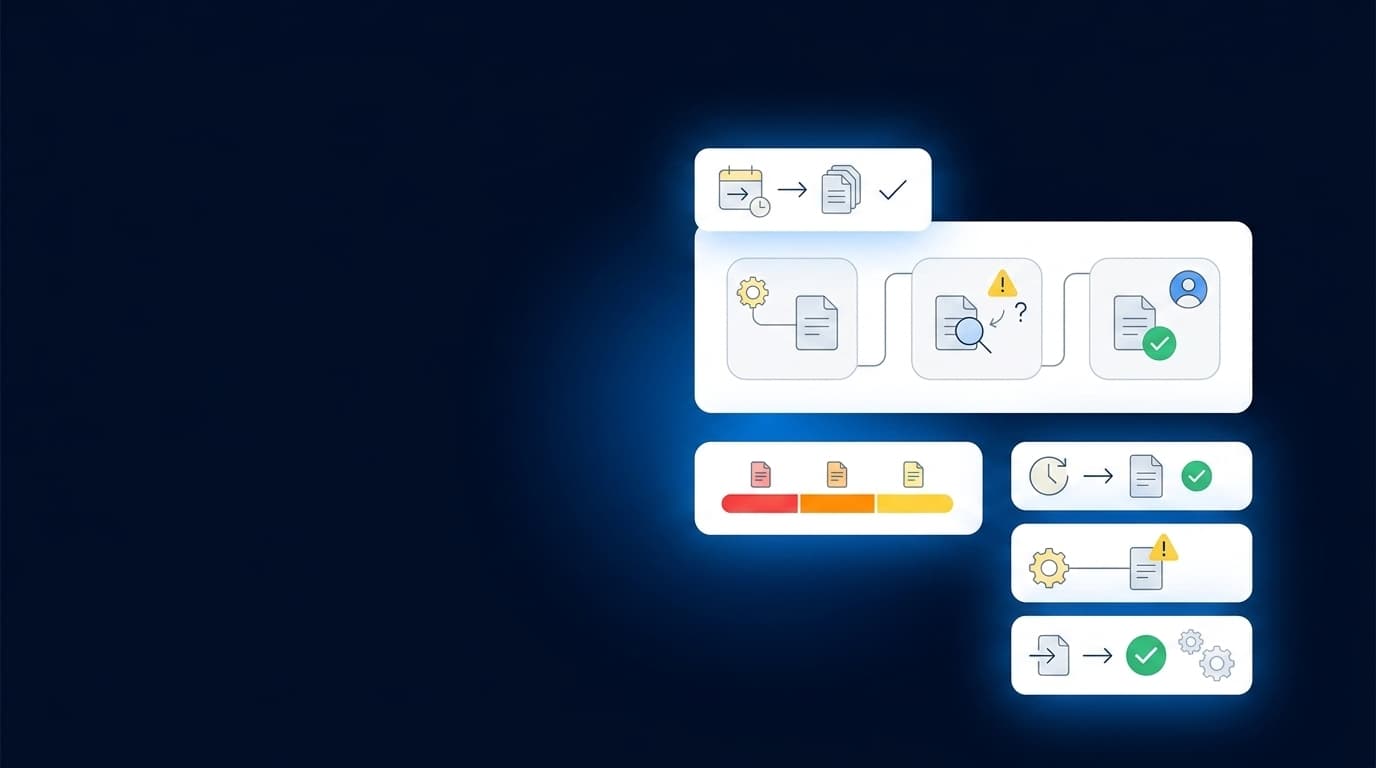
You open the prepaid rollforward and find a new software contract buried below last month’s ending balance, with no invoice attached and no clear service start date. The schedule still ties to the GL, which makes the missing support easier to miss and harder for your reviewer to approve. A prepaid expense schedule template earns its place by carrying the source and amortization logic into review. If the treatment changes, the exception should be visible before the journal entry reaches Sage Intacct or QuickBooks Online.
A prepaid expense schedule template has to carry more than beginning balance, additions, amortization, and ending balance. It has to show what the source supports, how the accounting team applied its policy, which amount reaches the GL, and where the reviewer signed off. Without that trail, a polished spreadsheet can hide more than it explains.
Key Takeaways:
- Build the schedule around reviewer questions, not just spreadsheet formulas.
- Keep invoices, service periods, calculations, GL accounts, and exceptions visible in one workpaper.
- Separate recurring preparation from items that need accounting judgment.
- Test the template against a prior approved schedule before using it in the current close.
- Preserve reviewer corrections so the next rollforward follows the team’s established treatment.
Why Clean Prepaid Schedules Still Fail Review
A prepaid schedule fails review when the arithmetic is visible but the accounting treatment isn’t. The reviewer needs to trace each balance to source, understand the release pattern, inspect exceptions, and confirm that the ending schedule agrees with the GL. A total that foots answers only one of those questions.

A Formula Can Prove Math, Not Treatment
Clean formulas create a sense of control. Beginning balance plus additions less expense equals ending balance, and the workbook displays no errors. Yet the reviewer may still have no way to tell whether the service period is right, whether the expense account follows policy, or whether an invoice belongs on the schedule at all.
That distinction matters. A spreadsheet formula repeats the instruction someone gave it, including an instruction copied from a prior period that no longer fits. If the source, rule, and reviewer decision sit outside the workbook, the formula can’t explain why the output should be accepted. In my view, that’s the real test of a prepaid workpaper: can another accountant re-perform the important steps without reconstructing the preparer’s thinking from email?
If you want to inspect how source support and reviewer actions can sit in the same preparation flow, see the review workflow in action.
The Review Breaks at the Missing Context
Consider a controller reviewing a software renewal added during the month. The schedule shows a monthly release and an ending balance, but the invoice isn’t attached, the service start date differs from the contract date, and the department split came from a note in last quarter’s workbook. The amount may be right. The reviewer still has three separate questions to resolve before signing off.
Missing context turns review into preparation. Instead of checking the proposed treatment, the controller has to find the document, establish the service period, and recover the allocation rule. That’s frustrating because the work appears finished at first glance. The clean surface isn’t the control; the trace beneath it is.
Generic Templates Ignore the Team’s Actual Rules
A blank prepaid expense template gives you columns. A useful one carries the accounting team’s process from period to period, including its capitalization threshold, account mappings, service-date conventions, allocation rules, and review notes. Two companies can receive the same annual invoice and prepare it differently because their policies and dimensional needs differ.
There’s a fair case for simple spreadsheets. A bounded schedule with few additions, one preparer, and stable treatment may not need a larger workflow. The weakness appears when entities multiply, allocations change, support moves into separate folders, or reviewers keep correcting the same fields. At that point, the template needs to preserve decisions, not merely rows.
How to Build a Prepaid Expense Schedule Template Reviewers Can Use
A review-ready prepaid expense schedule template connects five things: source evidence, dates, accounting treatment, rollforward calculations, and reviewer action. Build those fields in that order. The schedule should let a reviewer move from an ending GL balance back to the invoice and forward through the proposed release without leaving the workpaper.
Diagnose What Your Current Schedule Can’t Explain
Before adding columns, test the schedule you already use. Pick one current prepaid and ask another accountant to review it without opening email or messaging the preparer. Any question they can’t answer from the workpaper points to missing structure, not a need for more formatting.
Run the test against five questions. Frankly, the last two expose more weakness than the foot check:
- Can the reviewer open the supporting invoice or contract from the row?
- Can they identify the service start and end dates?
- Can they see which policy or prior treatment supports the release pattern?
- Can they trace the ending schedule balance to the prepaid GL account?
- Can they identify what changed after preparation and who approved it?
A “no” doesn’t mean the accounting is wrong. It means the evidence needed to approve that accounting sits somewhere else. Fix those breaks before adding automation or rebuilding the workbook.
Put Source Identity Before Accounting Output
Source identity belongs at the left side of the template because every later field depends on it. Start with the vendor, document description, invoice date, invoice number, source amount, currency where relevant, and a direct reference to the supporting file. A row without source identity shouldn’t move into calculation.
The intake sequence should be explicit:
- Confirm that the invoice, contract, or other support is present.
- Record what the document represents, not just its filename.
- Capture the source amount and relevant dates.
- Identify the entity and GL account affected.
- Flag missing or conflicting support for the reviewer.
A prepaid schedule is a bridge between the source document and the ledger. If either end is missing, the workbook may still stand, but the reviewer has to rebuild the connection by hand.
Let Service Dates Drive the Release
What period does the payment actually cover? The answer should come from the approved source and the team’s accounting policy, then appear beside the calculated release. Invoice date, payment date, service start, and service end answer different questions, so collapsing them into one “date” column creates avoidable confusion.
Equal monthly releases are easy to calculate, and they may fit many recurring prepaids. They aren’t a rule for every arrangement. If the team’s established treatment follows a different pattern, the template should display that treatment and the support behind it rather than forcing a generic straight-line formula. The reviewer owns that decision.
For each line, keep these fields together:
- Service start and service end
- Release frequency
- Current-period expense
- Remaining periods
- Remaining prepaid balance
- Treatment note or prior approved reference
The useful product review starts with your source and prior workpaper, then follows the amount into the current schedule. You can book a prepaid schedule walkthrough to see that sequence rather than a generic spreadsheet demonstration.
Make the Rollforward Explain Every Movement
Beginning balance, additions, expense recognized, adjustments, and ending balance form the core rollforward. Each movement needs its own source and explanation. Netting additions against adjustments may shorten the schedule, but it makes later review harder because two different accounting events disappear into one number.
I prefer a rollforward that forces every ending balance through a simple check:
Beginning prepaid balance + current-period additions - current-period expense + approved adjustments = ending prepaid balance
The formula is only the frame. Additions should point to current-period support, expense should follow the approved release pattern, and adjustments should carry a reason and reviewer action. If the calculated ending balance differs from the expected GL balance, keep the difference visible.
Tie the Schedule to the GL Without Forcing Agreement
A prepaid schedule is complete only when its ending balance is compared with the corresponding GL balance. The tie-out should show the schedule total, ledger total, difference, and status of any reconciling item. Don’t bury the difference inside a formula that returns “OK” after someone enters an offset.
Visible differences are useful. A late invoice, an item posted directly to expense, a prior-period adjustment, or a schedule change after review may explain the gap. The template should surface the item with enough source context for the accountant to decide what happens next. Forcing the totals to agree removes the question without resolving it.
Use a compact reconciliation block after the detailed schedule:
| Reconciliation field | What the reviewer should see |
|---|---|
| Schedule ending balance | Sum of open prepaid items |
| GL ending balance | Balance from the prepaid account |
| Difference | Unresolved amount, shown without netting |
| Explanation | Source-linked reason for the difference |
| Reviewer action | Approve, correct, or return for follow-up |
Keep Exceptions Separate From Routine Preparation
Routine rows and judgment items shouldn’t receive the same review treatment. A supported renewal following an approved release pattern can move through the normal preparation path. Missing contracts, changed service dates, unusual allocations, unexpected balance movements, or conflicting source amounts need a visible exception.
Separating them changes how the reviewer works. Instead of reopening every invoice and rebuilding every calculation, the reviewer can inspect prepared rows while spending more attention on the items that departed from the known process. The accountant still owns the result. The template simply makes the boundary between repeatable work and judgment clear.
Set the exception rules before the period starts:
- List the conditions that always require review.
- Define which source must support each condition.
- Assign an owner for follow-up.
- Keep the item open until the reviewer records a decision.
- Carry the approved correction into the next rollforward where appropriate.
Pilot the Template Against a Known Answer
A new prepaid expense schedule template should first reproduce a schedule the team has already reviewed and approved. Load the prior source documents, apply the proposed fields and formulas, then compare the rebuilt schedule with the known result. Differences show where the template misunderstood a date, mapping, allocation, or review convention.
Controlled iteration has a real downside: it asks the team to spend time comparing two versions of work it already completed. That cost is valid. It’s still safer than placing an untested template into the live close, because the prior answer gives the reviewer a concrete baseline and exposes gaps before current-period deadlines arrive.
Run the pilot in a short sequence:
- Choose one recurring prepaid workflow with complete support.
- Reproduce the prior approved schedule.
- Compare balances, dates, mappings, and treatment line by line.
- Record reviewer corrections inside the workflow.
- Repeat with the next period before expanding the scope.
Trust grows when corrections persist and the work remains understandable. A polished first output proves less than a repeatable second one.
How Truewind Prepares the Work for Review
Truewind prepares prepaid schedules from current source documents, prior workpapers, ERP balances, and the accounting team’s established treatment. It rolls the work forward, keeps source support attached, surfaces exceptions, and presents the schedule for accountant review. Sage Intacct or QuickBooks Online remains the system of record, and nothing pushes without reviewer confirmation.
Historical Treatment Becomes Current-Period Context
Truewind’s Workpaper Generation and Rollforward capability loads the prior workpaper, current-period support, and ERP balance into a familiar preparation flow. Historical-Example Learning applies captured coding decisions, allocation choices, classification splits, and reviewer corrections to the next period. It doesn’t change accounting policy or resolve a judgment item on its own.
That mechanism matters more than a generic template library. The schedule begins with how your team already prepares and reviews the account, then carries those conventions into the next period with the source still visible. One buyer described the change plainly: “Truewind automates a huge chunk of that busywork.” The preparation moves forward, while the accountant keeps the decision.
Exceptions Stay With the Accountant
Proactive Anomaly Detection compares current-period preparation with prior workpapers and the learned process. Missing support, unexpected balance changes, and inconsistent treatment become review items with source links. The Human-in-the-Loop Review Workflow lets accountants confirm, adjust, or return the schedule before any approved output reaches Sage Intacct or QuickBooks Online.
That boundary is deliberate. A team looking for autonomous posting without reviewer sign-off is evaluating a different product. For a reviewer-led close, the useful outcome is a prepared schedule that shows where each number came from and which items still need judgment. A marketplace customer put the broader experience in direct terms: “If I had to describe Truewind in one word: Lifechanging”
To inspect that preparation and approval path against your own recurring schedule, get a review-workflow demo.
Keep the Schedule Tied to Source and Sign-Off
A prepaid expense schedule template earns its place in the close when it carries the work from source to calculation, GL tie-out, exception review, and approval. Start with one recurring schedule, test it against a known answer, and make every difference visible. The goal isn’t a workbook that looks finished. It’s a workpaper your reviewer can understand, correct, and sign off without rebuilding the preparation.
Frequently Asked Questions
How do I handle edge cases effectively?
To handle edge cases effectively, start by defining specific conditions that require additional review. Make sure to document the source that supports each condition. You can use Truewind's Proactive Anomaly Detection feature to identify unusual items and route them for review. This way, your team can focus on judgment items without getting bogged down by routine checks.
What if my prepaid schedule has missing invoices?
If your prepaid schedule has missing invoices, first flag these items for review. Make sure to document the reason for the missing support. Truewind helps you surface exceptions like this, allowing your team to address them before finalizing the schedule. Always ensure that the reviewer can trace back to the source document to confirm the treatment.
How do I test my prepaid schedule before submission?
To test your prepaid schedule, have a colleague review it without any additional context. They should be able to answer key questions about the service dates, source documents, and accounting treatment just from the workpaper. Using Truewind's Workpaper Generation and Rollforward capability can help ensure that the current-period support is clearly linked to prior approved results.
When should I separate routine preparation from exceptions?
You should separate routine preparation from exceptions when you identify items that deviate from established processes. For instance, if a renewal follows a different treatment or has missing documentation, it should be flagged for separate review. Truewind allows you to manage these exceptions effectively, ensuring that reviewers can focus on what truly needs their attention.
Can I automate my prepaid schedules with Truewind?
Yes, you can automate your prepaid schedules using Truewind. The platform prepares schedules from current source documents and prior workpapers, rolling forward balances while maintaining visibility of the source support. This automation helps streamline the preparation process while ensuring that all necessary reviewer actions are captured before anything is finalized.
Turn this into a close-ready workpaper
Start with sample files or upload your own statements to see how Truewind prepares review-ready workpapers and journal entries.