

The architecture decision comes before the feature checklist. Numeric positions itself as a close and controls layer connected to ERP transaction data, while Puzzle positions itself as AI-native accounting software for startups and accounting firms (Numeric; Puzzle). The first question is whether you are keeping the ledger or choosing a new one.
Numeric vs Puzzle at a Glance
Numeric and Puzzle solve different accounting architecture decisions. Numeric presents a data layer for close and controls connected to ERP transactions, while Puzzle presents AI-native accounting software for startups and accounting firms (Numeric; Puzzle). One keeps the current ledger in place; the other can become the ledger.
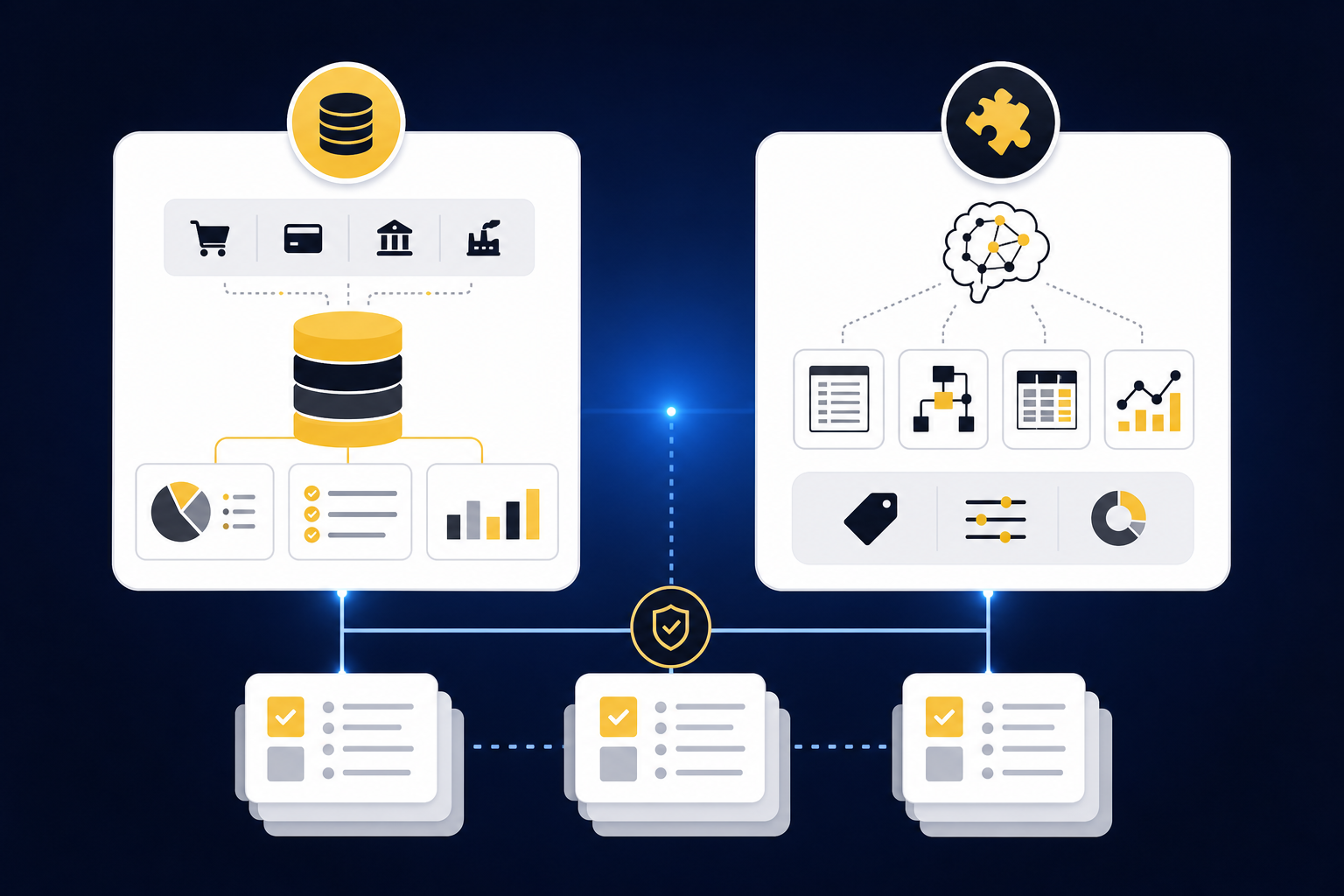
Numeric vs Puzzle Quick Reference
| Decision factor | Numeric | Puzzle |
|---|---|---|
| Core product category | Close management and accounting intelligence platform (Numeric) | AI-native accounting and bookkeeping platform (Puzzle) |
| Relationship to the general ledger | Connects to an existing ERP rather than replacing it (Numeric) | Designed to operate as the accounting system and ledger (Puzzle) |
| Primary buyer | Controllers and accounting teams preserving their current ERP | Startups and accounting firms willing to adopt a new accounting system |
| Core automation focus | Close workflows, reconciliations, reporting, and accounting analysis (Numeric) | Automated bookkeeping and continuously updated financial information (Puzzle) |
| Reporting emphasis | Ledger-connected close reporting and accounting analysis (Numeric) | Startup-oriented financial reporting inside the accounting platform (Puzzle) |
| Pricing approach | Review current packages and included capabilities on the Numeric pricing page | Confirm current plans, conditions, and trial terms on the Puzzle pricing page |
Key Takeaways:
- Numeric suits controllers who want close orchestration, reconciliations, and analysis without moving the general ledger.
- Puzzle suits startup teams prepared to combine automated bookkeeping and financial reporting inside a new accounting system.
- The main decision is architectural: add a close layer to the ERP or adopt an AI-native ledger.
- Compare current pricing only after confirming required integrations, approval controls, reporting scope, and migration work.
The Key Decision: Close Layer or General Ledger?
The central choice is whether to preserve your existing general ledger or adopt a new accounting system. Numeric connects close and control workflows to ERP transaction data, while Puzzle combines automated bookkeeping with its own accounting platform (Numeric; Puzzle). That changes migration scope, control design, and reporting ownership.
Keeping Your ERP Versus Replacing the Ledger
Numeric makes sense when the ERP remains the system of record. Its role is to organize and analyze work around that ledger, including close management, reconciliations, reporting, and AI-supported accounting analysis (Numeric). The accounting team does not need to redefine where approved financial records live.
Puzzle asks for a broader operating change. Because the product combines bookkeeping and accounting records inside its platform, buyers need to evaluate migration, historical data, integrations, chart-of-accounts design, and downstream reporting together (Puzzle). That can simplify the stack for the right startup, but it is more than adding close management software.
Why Source Data, Review Controls, and Reporting Needs Matter
Start with the work your team actually performs. If the main issue is task ownership, reconciliation status, flux analysis, or evidence connected to an established ERP, a close layer addresses that need without changing the ledger. Numeric's product scope aligns with that model (Numeric).
If the team instead wants automated bookkeeping and current financial information within one startup-oriented accounting platform, Puzzle follows that path (Puzzle). Buyers should still test how bank activity, revenue data, payroll information, reviewer adjustments, and financial statements move through the system. A clean dashboard does not replace a reviewable accounting process.
Numeric: Close Management and Accounting Intelligence on Top of the ERP
Numeric is built for finance teams that want close management and accounting intelligence without replacing their ERP. Its product materials center on close workflows, reconciliation, reporting, and AI-supported analysis connected to ledger data (Numeric). A controller can add structure around the close while keeping the current system of record.
Numeric's Main Strengths
Numeric's central strength is the connection between close work and ERP data. The platform positions transaction-level information as the foundation for close procedures and controls, giving accounting teams a common place to investigate ledger activity and support review (Numeric data foundation).
The broader product includes close management, account reconciliation, reporting, and AI-supported analysis (Numeric). For evaluation, ask the team to demonstrate task ownership, review notes, period rollforward, reconciliation support, variance investigation, and the evidence retained with each accounting conclusion. Those details determine whether the platform fits your existing control design.
How Truewind Is Different: Truewind supports workpaper generation and rollforward. Include a prior-period workpaper in the evaluation and ask to see what carries forward for accountant review.
Numeric's Limitations and Tradeoffs
Numeric does not replace the general ledger. That is useful when the ERP is staying, but it does not serve a buyer trying to consolidate accounting into a new system of record (Numeric data foundation). The accounting team will still depend on the underlying ERP and the quality of its transaction data.
Integration depth also deserves direct testing. A platform can support several accounting systems without delivering identical data access or workflow behavior for every connector. Use your own entities, dimensions, reconciliations, and review requirements during evaluation rather than assuming one integration demonstration represents every ERP configuration.
Numeric Pricing and Buyer Fit
Numeric maintains a public pricing page, but buyers should verify current package definitions, included capabilities, user limits, and quote requirements before budgeting (Numeric pricing). Entry pricing alone will not show whether the required reconciliation, reporting, control, and integration features sit in the same package.
The stronger fit is a high-growth or mid-market accounting team that already has an ERP and wants a structured close layer around it. Very small teams seeking basic bookkeeping may find that scope broader than necessary. Teams wanting an entirely new ledger should evaluate a different product category.
How Truewind Is Different: The preparation layer starts with inconsistent source files and prior workpapers, then applies the accounting team's logic to prepare reviewable outputs. The accountant reviews exceptions and approves the handoff to the existing ledger, rather than using the platform mainly to orchestrate and analyze the close.
Puzzle: AI-Native Bookkeeping and a Startup-Focused General Ledger
Puzzle is built for startups and accounting firms that want automated bookkeeping inside an AI-native accounting system. Its product positioning combines ongoing accounting automation with continuously updated financial information (Puzzle). That makes it a ledger decision, not simply another close checklist layered over an ERP.
Puzzle's Main Strengths
Puzzle brings bookkeeping and financial reporting into the same software environment. Its startup focus can appeal to founders and accounting firms that want automated accounting processes without building a close stack around a separate ERP (Puzzle). The operating model is designed around current books, not only period-end task coordination.
Connectivity is part of that model. Puzzle documents banking integrations within its automated accounting workflow and separately provides instructions for configuring automation through Make (Puzzle banking integrations; Make Integration Guide). Buyers should confirm the exact accounts, actions, and data flows supported by each connection.
How Truewind Is Different: Truewind supports multi-source ingestion and multi-source reconciliation. Evaluate those capabilities with the source files needed for your workpaper, not only a bank connection.
Puzzle's Limitations and Tradeoffs
Adopting Puzzle means evaluating a new accounting system, including migration and system-of-record responsibilities (Puzzle). That can be appropriate for a startup building its finance stack, but it is a materially different project for a controller with established ERP controls, dimensions, workpapers, and downstream reporting.
A third-party review has discussed Puzzle's setup experience, usability, and areas where buyer requirements may differ from the product's current fit (Software Connect). Treat those observations as evaluation prompts rather than universal findings. A closed-period test with familiar transactions and expected financial statements will provide more relevant evidence.
Puzzle Pricing and Buyer Fit
Puzzle publishes plan information, but current prices, usage conditions, included automation, and trial availability should be checked immediately before purchase (Puzzle pricing). The practical comparison should include migration work, integration setup, reviewer access, and the accounting functionality required after the initial plan is selected.
Puzzle is more suitable for founder-led and venture-backed startups, or accounting firms serving them, that are comfortable adopting an AI-native ledger. Its fit is less certain when the organization must preserve an established ERP, detailed nonprofit dimensions, family-office entity logic, or an existing reviewer-led workpaper process.
How Truewind Is Different: The existing ledger remains in place. The system prepares source-linked workpapers and journal-entry drafts while preserving entity, dimensional, and client-specific rules, which is a different operating model from adopting a startup-focused ledger.
Numeric vs Puzzle Compared by Workflow, Controls, and Fit
Numeric fits an ERP-centered close model, while Puzzle fits a startup-oriented ledger model. Numeric emphasizes close, controls, reconciliation, and analysis; Puzzle emphasizes automated bookkeeping and financial information inside its accounting system (Numeric; Puzzle). The grid below turns that category difference into workflow, control, and implementation questions.
Numeric vs Puzzle Comprehensive Decision Grid
| Evaluation criterion | Numeric | Puzzle | What the buyer should verify |
|---|---|---|---|
| Best-fit company profile | Controllers keeping an existing ERP | Startups or firms willing to adopt a new ledger | Whether the product's operating model matches the accounting team's ownership structure |
| System-of-record strategy | Existing ERP remains in place (Numeric) | Puzzle operates as the accounting platform (Puzzle) | Migration boundaries and where approved records will live |
| ERP and finance-stack integrations | ERP-connected data layer | Banking and automation connections are documented (Puzzle banking integrations) | Data depth, supported actions, dimensions, and refresh behavior |
| Close task management | Part of Numeric's close management scope (Numeric) | Verify current close workflow capabilities | Ownership, dependencies, notes, sign-offs, and rollforward |
| Transaction categorization | Confirm current scope during demonstration | Part of Puzzle's automated bookkeeping model (Puzzle) | Rule changes, exceptions, and reviewer corrections |
| Account reconciliation | Included in Numeric's product scope (Numeric) | Included in the automated accounting model (Puzzle) | Matching logic, unresolved items, and supporting evidence |
| Flux and variance analysis | AI-supported accounting analysis is part of the platform (Numeric) | Confirm current variance-analysis scope | Source lineage and reviewer-editable commentary |
| Startup KPI reporting | Not the central product emphasis | Startup-oriented financial information is central (Puzzle) | Metric definitions and reconciliation to the books |
| Revenue recognition | Verify current availability and package | Verify current functionality and required setup | Contract types, schedules, adjustments, and review controls |
| Preparer and reviewer controls | Confirm exact controls and segregation in the selected package | Confirm available roles and approval actions | Whether approval is recorded before ledger impact |
| Audit trail and evidence | Controls are connected to ERP transaction data (Numeric data foundation) | Confirm evidence retention and source traceability | Ability to re-perform calculations and trace changes |
| Implementation and migration burden | Adds a layer around the ERP | Requires a ledger-adoption decision | Historical conversion, parallel testing, and ownership |
| Pricing transparency | Check current packages and quotes (Numeric pricing) | Check current plans and conditions (Puzzle pricing) | Total cost for required users, features, setup, and support |
| Scalability and complexity fit | Evaluate against ERP, entity, and control requirements | Evaluate against startup workflows and reporting needs | Multi-entity, currency, dimensional, and volume requirements |
| Recommended choice by operating model | Choose for ERP-centered close orchestration | Choose for startup-focused ledger adoption | Run one closed period through the complete workflow |
How Truewind Is Different: Truewind supports dimensional and allocation preparation with a human-in-the-loop review workflow. Ask to see the prepared work and the accountant's review before evaluating the ERP handoff.
When Truewind Is the Better Fit for Accounting Preparation
Truewind is the stronger fit when unresolved work sits between fragmented source files and an existing Sage Intacct or QuickBooks Online ledger. It prepares workpapers, reconciliations, schedules, and journal-entry drafts for accountant review. A nonprofit, family office, or CAS team can preserve its own mappings, dimensions, and review conventions.
Source-Linked Workpapers and Multi-Source Reconciliation
The distinction starts before the close checklist. Bank statements, processor reports, donor files, custodian statements, PDFs, and spreadsheets arrive in different structures. The platform reads those sources, applies the team's mappings and historical logic, checks the prepared work against the GL, and produces the workpaper format the reviewer expects.
That matters when the accounting task cannot be reduced to transaction extraction. A reviewer needs to see the source, calculation, accounting treatment, exceptions, and proposed journal entry together. If you want to test that process on a recurring workpaper, See Truewind in action using the source files and reviewer expectations your team already follows.
Human Review, Exception Handling, and ERP Handoff
Exceptions remain with the accountant. Missing statements, changed classifications, unexpected balances, and mixed activity should not pass into the ledger without review. The system surfaces those items for review while the accountant decides the treatment, corrects the work, and owns approval.
After approval, the prepared output moves to Sage Intacct or QuickBooks Online, which remains the system of record. The model fits nonprofit controllers preserving fund, restriction, program, and grant dimensions. It also fits family offices and CAS teams that need repeatable preparation without erasing entity-specific or client-specific rules.
Final Decision: Choose Numeric or Puzzle Based on Your Operating Model
Choose Numeric when you want a close and accounting-intelligence layer around the ERP; choose Puzzle when you want startup-focused automated bookkeeping in a new ledger. Both choices depend on current integrations, controls, and packaging (Numeric; Puzzle). If source-to-workpaper preparation is the gap, evaluate that as a separate operating model.
Choose Numeric if your controller already trusts the ERP and needs more structure around close ownership, reconciliation, reporting, and analysis. Before committing, verify integration depth with your actual ledger data and confirm which capabilities are included in the proposed package.
Choose Puzzle if you are prepared to adopt a startup-oriented accounting system and want bookkeeping automation within that ledger. Test migration, categorization, reconciliations, financial statements, integrations, and reviewer adjustments using a completed period before moving current books.
Choose the preparation-layer model if your team is still combining source files, applying dimensions, maintaining workpapers, investigating exceptions, and preparing entries before anything is ready for the GL. To map that workflow with your accounting team, Book a Truewind demo. If your evaluation includes a specific nonprofit, family-office, or CAS workpaper, Get a Truewind demo and bring the prior approved result.
The right choice follows the work. Decide where the ledger should live, identify what remains manual upstream, and require every vendor to show how a reviewer traces, corrects, and approves the accounting result.
Frequently Asked Questions
How do I choose between Numeric and Puzzle?
To choose between Numeric and Puzzle, consider your team's needs. If you want to maintain your existing ERP and focus on close management, Numeric is the better fit. It connects to your current ledger without replacing it, allowing for structured close workflows and reconciliations. On the other hand, if your team is ready to adopt a new accounting system and desires automated bookkeeping, Puzzle might be the way to go. It operates as an AI-native ledger designed for startups and accounting firms.
What if I need to preserve my existing accounting processes?
If preserving your existing accounting processes is essential, Numeric is likely the best choice. It adds a layer for close management on top of your existing ERP, allowing your team to continue using their current ledger while enhancing workflows around reconciliations and reporting. This way, you maintain control over your financial processes without needing to overhaul your entire system.
How do I ensure my integrations work smoothly?
To ensure smooth integrations, start by verifying the specific capabilities of Numeric or Puzzle with your existing ERP. For Numeric, check how it connects to your current system and what data access it provides. For Puzzle, confirm the banking and automation connections it supports. Testing these integrations with your actual data during the evaluation phase is crucial to avoid surprises later.
When should I evaluate migration needs?
You should evaluate migration needs early in the decision-making process, especially if considering Puzzle. Since it operates as a new accounting system, understanding the scope of data migration, historical data handling, and integration setup is vital. For Numeric, while it connects to your existing ERP, you still need to assess how close management will affect your current workflows.
Why does the choice of accounting software matter?
The choice of accounting software matters because it directly impacts your team's workflow, data management, and reporting capabilities. Numeric is suited for teams wanting to enhance their existing ERP with close management features, while Puzzle is tailored for those ready to transition to an AI-driven accounting system. Choosing the right software can streamline processes, improve efficiency, and ensure compliance with your accounting standards.
Turn this into a close-ready workpaper
Start with sample files or upload your own statements to see how Truewind prepares review-ready workpapers and journal entries.