
When the usual preparer is unavailable, the manager inherits a workbook, a folder of source files, and an SOP written by someone who already knows the work. The balance may still agree to the GL. The harder question is whether the manager can reproduce the treatment without searching email, reverse-engineering formulas, or guessing why an exception was handled differently last period. A task list does not answer those questions. It assumes the answer is still sitting in someone’s memory.
Most accounting process documentation fails at the moment another qualified accountant has to take over under close pressure. “Update the rollforward” names a task, but it does not identify the approved source, the cutoff rule, the expected dimensions, or the conditions that require reviewer judgment. The same problem appears in processor reconciliations, accrual schedules, donation coding, and brokerage workpapers. A checklist can remind the usual preparer what to do. It cannot teach the next preparer how the team reaches an acceptable result.
The practical standard is to document accounting processes that another accountant can reproduce and a reviewer can inspect. That means preserving the evidence, logic, exceptions, and approval path behind the work. Prior-period workpapers belong inside that documentation system because they show how the written rules were applied. The SOP explains the process. The approved workpaper proves what the process produced.
A checklist can name the work without making it reproducible
A close checklist answers whether a task was assigned and completed. A useful accounting SOP answers a different set of questions: which source files were used, how completeness was checked, which accounting treatment was applied, what changed from the prior period, and who approved the result. Both documents matter, but they are not interchangeable. Treating the checklist as the full process record leaves the difficult parts undocumented.
Consider an instruction such as “reconcile processor activity to the bank.” The preparer still has to determine which processor export is authoritative, which settlement period belongs in the month, how fees and refunds are classified, and how deposits are matched when timing crosses month-end. A difference may represent timing, a missing payout, an incorrect classification, or an incomplete source file. The SOP has to explain how the team distinguishes among those possibilities and when the preparer stops and asks for review.
The same principle applies to a brokerage rollforward. Naming the custodian statement is not enough. The documentation should identify the relevant account and entity, the expected statement period, the prior workpaper, the GL balance, and the treatment used for trades, dividends, interest, and fees. If entity or account rules differ, those differences need to be visible where the work is prepared. Otherwise, the backup preparer may complete every listed step and still produce a workpaper the reviewer cannot accept.
A reviewable workpaper keeps the operating detail together. Source support sits beside the calculation. Accounting treatment is visible. Exceptions are separated from routine preparation, and reviewer actions remain attached to the result. If you want to inspect how that source-linked preparation moves into accountant review, See Truewind in action.
Build the SOP package around evidence, logic, and review
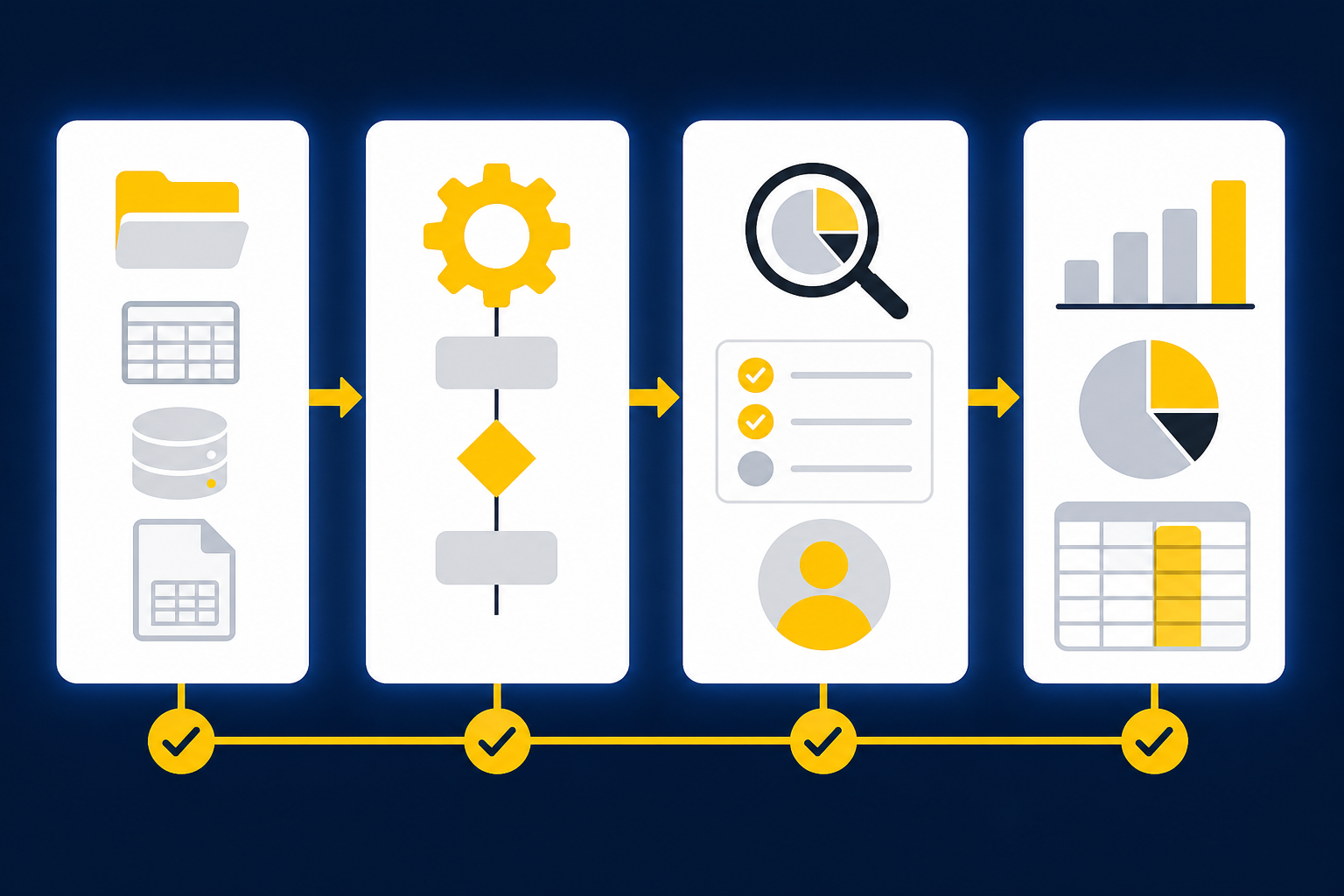
Process documentation becomes useful when it follows the actual path from source file to approved output. Start with the inputs the preparer receives, then document how those inputs are transformed into a reconciliation, schedule, workpaper, or journal-entry draft. End with the reviewer’s decision and the record of what changed. That sequence makes the SOP usable during preparation and testable during review.
Identify the workflow boundary and required evidence
Every recurring process needs a clear beginning and end. A donation reconciliation might begin when the donor-platform export, processor report, and bank activity are available. It ends when the activity is reconciled, fund and program dimensions are prepared, exceptions are resolved or carried forward, and the reviewer signs off. Without those boundaries, preparers can complete different versions of the same process while using the same checklist item.
The source register should name each required input and explain what role it plays. Include the report or statement name, covered period, expected owner, storage location, and completeness check. A bank balance may confirm the cash movement, but it does not preserve the donor, campaign, fund, or restriction context needed for coding. The documentation should show which source carries each part of the accounting evidence.
Missing evidence needs an explicit treatment too. If the custodian statement has not arrived, the SOP should say whether the workflow remains open, whether an estimate is permitted under the team’s policy, and who decides. “Follow up on missing support” is not enough because it leaves the accounting consequence undefined. The preparer needs to know what cannot proceed and what evidence the reviewer expects before approval.
Treat the prior workpaper as operating context
The prior approved workpaper is not an attachment to the documentation. It is part of the documentation. It shows the account mappings, cutoff choices, formulas, classification splits, and reviewer corrections that produced the accepted result. A written SOP may state the rule, while the workpaper shows how that rule behaves against actual source material.
Keep the prior entry and reviewer notes with the workpaper when they explain treatment. If a processor fee was reclassified, an allocation changed, or an entity-specific rule overrode the standard mapping, the next preparer needs that history. Otherwise, the correction disappears into the completed workbook and the team has to make the same decision again next period.
Historical examples also expose gaps in the written procedure. A preparer may say the process follows a standard mapping until the prior workpaper reveals several recurring exceptions. Those exceptions are not noise. They are evidence that the workflow contains judgment rules the SOP has not captured yet.
Write down the decision rules, not only the procedure
A useful SOP explains how the team makes repeatable decisions. For transaction coding, that can include the applicable account mapping, dimensional treatment, cutoff, and allocation rule. For a reconciliation, it can include the expected tie-out, accepted timing treatment, and support required for reconciling items. For a rollforward, it can include which balances carry forward and which current-period documents replace prior support.
Policy decisions still belong to the accountant. Documentation should not disguise a judgment call as a mechanical step, especially when treatment depends on materiality, contract terms, restrictions, or entity context. Mark the decision point, identify the evidence the reviewer needs, and assign the person who owns the call. The goal is not to pre-decide every future exception. It is to prevent novel items from passing through a routine procedure without review.
A simple test is to remove the original preparer from the explanation. If another accountant cannot tell why an item maps to a specific account or dimension, the logic is still personal knowledge. If the accountant can apply the rule, identify when it no longer fits, and show the reviewer the supporting source, the logic has become part of the process.
Define exceptions before delegating or automating
Exceptions should be documented before the process moves to a backup preparer, an outsourced team, or an automated workflow. Missing statements, unexpected balance changes, mixed personal and business activity, and inconsistent classifications require judgment. A system should not force those items through the standard path simply because the remaining activity matches the learned process.
An exception register does not need to predict every edge case. It should describe the conditions the team already knows require escalation, the source context the reviewer needs, and the allowed dispositions. For example, an unreconciled processor difference may remain open as a timing item only when the settlement evidence supports that treatment. A classification that conflicts with prior periods may require the reviewer to confirm whether the policy changed or the current item is different.
Exceptions are part of the control design. When they are visible, the reviewer can focus on the items where accounting judgment belongs instead of rechecking every prepared line. When they are buried inside a spreadsheet or resolved through email, the next period starts without the decision history.
Record preparation and review as separate actions
The SOP should identify what the preparer confirms and what the reviewer approves. Preparation can include gathering source files, applying established mappings, updating schedules, checking totals, and drafting the entry. Review can include inspecting exceptions, challenging treatment, confirming changes, and signing off before anything reaches the GL.
Recorded actions create continuity because the next accountant can see who changed the work and why. They also keep review from becoming a generic “approved” status with no connection to the underlying item. The record should preserve the source, the proposed treatment, the correction, and the final decision in the same workflow.
One completed workflow gives you a concrete implementation artifact: the source set, prior approved result, decision rules, exception criteria, and reviewer gate. Use that artifact as the working agenda when you Book a Truewind demo.
Build documentation by replaying an approved period
Writing the SOP from memory usually produces a cleaner process than the one the team actually runs. A better starting point is a completed period with an approved workpaper and available support. Replay the workflow from the beginning. Ask the preparer to identify each source, each transformation, each judgment point, and each handoff to the reviewer.
Start with one recurring process that has stable boundaries and a known result. A prepaid rollforward, processor reconciliation, or recurring accrual schedule is easier to inspect than a broad instruction such as “complete month-end close.” The narrow scope makes differences visible. You can compare the replayed output with the approved result and determine whether the documentation reproduces the same treatment.
During the replay, capture the following:
- Inputs: Every statement, export, ERP balance, prior workpaper, and supporting document required to begin.
- Completeness checks: How the preparer confirms that the expected periods, entities, and accounts are present.
- Preparation rules: Account mappings, cutoffs, dimensions, allocations, formulas, and rollforward treatment.
- Exception criteria: Conditions that stop routine preparation and require accountant judgment.
- Review evidence: The workpaper, support schedule, journal-entry draft, reviewer notes, and sign-off required to finish.
Next, run a takeover test. Give the SOP package to another qualified accountant who did not write it and ask that person to reproduce the work from the source set. The test is not whether the accountant can eventually reach the balance. It is whether the accountant can reach the approved treatment without relying on undocumented explanations from the usual preparer.
Pay attention to the questions that surface. A question about where to find a report points to a source-register gap. A question about why an item was coded differently points to missing decision logic. A question about whether a variance can remain open points to an incomplete exception rule. Each question tells you where the process still depends on memory.
The final revision should preserve those answers inside the workflow rather than adding another detached note. Update the SOP, annotate the prior workpaper where needed, and retain the reviewer’s decision with the affected item. Documentation improves when corrections become part of the next run, not when they remain in an inbox.
Turn the SOP into a recurring, reviewable workflow
Documentation becomes more valuable when the preparation process can apply it again each period. Truewind uses prior workpapers, prior entries, established accounting rules, and reviewer corrections as operating context for recurring work. Current-period source documents and ERP balances feed the workflow, while the team’s mappings, cutoffs, classifications, and review conventions guide preparation.
Workpaper generation and rollforward bring the prior approved artifact into the current period. Balances roll forward, supporting schedules update, and required journal-entry drafts are prepared with source-linked support. Exceptions remain visible for the accountant. The workflow follows the team’s existing treatment; it does not create accounting policy or resolve novel items on its own.
Historical-example learning carries confirmed coding decisions, allocation choices, classification splits, and reviewer corrections into later periods. The reviewer can still change the treatment, and rule changes remain explicit. That boundary matters because repeatability should come from applying approved logic, not from hiding new judgment inside automation.
Truewind’s review workflow presents prepared work beside its sources and exceptions. Accountants can confirm, adjust, or return items to preparation, and nothing leaves review without sign-off. An audit trail retains ingested sources, preparation steps, coding decisions, and reviewer actions against the workflow. Sage Intacct and QuickBooks Online remain the systems of record, and approved output moves downstream only after reviewer confirmation.
In one customer conversation, an accounting firm reported reducing the time spent categorizing credit-card transactions by approximately 75% after using Truewind for categorization. That result is one customer example, not a general benchmark. The relevant mechanism is that recurring coding followed established rules, while accountants retained review of proposed treatment and corrections informed later periods.
Truewind is not the fit for a team seeking autonomous posting or a replacement for its GL. It is designed for accounting functions that already have recurring work, prior examples, and a reviewer who owns the result. The approved workpaper becomes the starting point, and the workflow expands through controlled comparison against known outcomes. To examine how that pattern would apply to one of your recurring workpapers, Get a Truewind demo.
Design the documentation for the next accountant
The person writing an SOP is usually the person least likely to notice what it leaves out. They know which export to pull, which tab contains the adjustment, and which variance the reviewer will question. Another accountant does not. Designing for takeover forces that knowledge into the documentation before an absence, handoff, or expansion exposes the gap.
A repeatable SOP package should let the next accountant find the required evidence, follow the established logic, recognize an exception, and prepare the exact artifact the reviewer expects. It should also let the reviewer trace the result to source and see where judgment entered the process. Prior workpapers and recorded decisions make that continuity possible because they connect written rules with approved accounting treatment.
The goal is not more documentation. It is documentation that can carry the work when the usual preparer cannot. Build it around a bounded workflow, replay an approved period, test it with another accountant, and keep corrections attached to the process. That is how an SOP moves from a memory aid to a reviewable system for recurring accounting work.
Frequently Asked Questions
How do I document accounting processes for staff turnover?
To document accounting processes effectively, start by creating a Standard Operating Procedure (SOP) that outlines each step in detail. Include information on the source files used, the logic behind decisions, and any exceptions that may arise during the process. Ensure that the documentation captures the entire workflow from input to output, including who approves each step. This way, when a new accountant takes over, they can follow the documented path without needing to rely on memory or guesswork.
What if I miss a source document for reconciliation?
If you miss a source document, your SOP should clearly outline what to do next. Specify whether the workflow remains open, if an estimate is allowed, and who has the authority to make that decision. This helps maintain clarity and ensures that the preparer knows how to proceed without the missing document, preventing confusion during the reconciliation process.
Can I use previous workpapers for new accounting processes?
Yes, previous workpapers are essential for documenting new accounting processes. They provide context on how rules were applied in the past and highlight any exceptions that occurred. When creating new SOPs, refer back to these workpapers to ensure that the logic and decisions made previously are preserved, making it easier for future accountants to understand the rationale behind each step.
When should I involve a reviewer in the accounting process?
Involve a reviewer at key points in the accounting process, especially before finalizing any workpapers or reconciliations. The reviewer should inspect exceptions, confirm treatment decisions, and sign off on outputs before they reach the general ledger. This ensures that all critical decisions are validated and that the final documentation is accurate and complete.
Why does my SOP need to include decision rules?
Including decision rules in your SOP is crucial because it helps standardize how accounting decisions are made. This ensures that all accountants follow the same logic when coding transactions or handling exceptions. By clearly documenting these rules, you make it easier for others to understand the rationale behind decisions and maintain consistency in the accounting process.
Turn this into a close-ready workpaper
Start with sample files or upload your own statements to see how Truewind prepares review-ready workpapers and journal entries.