
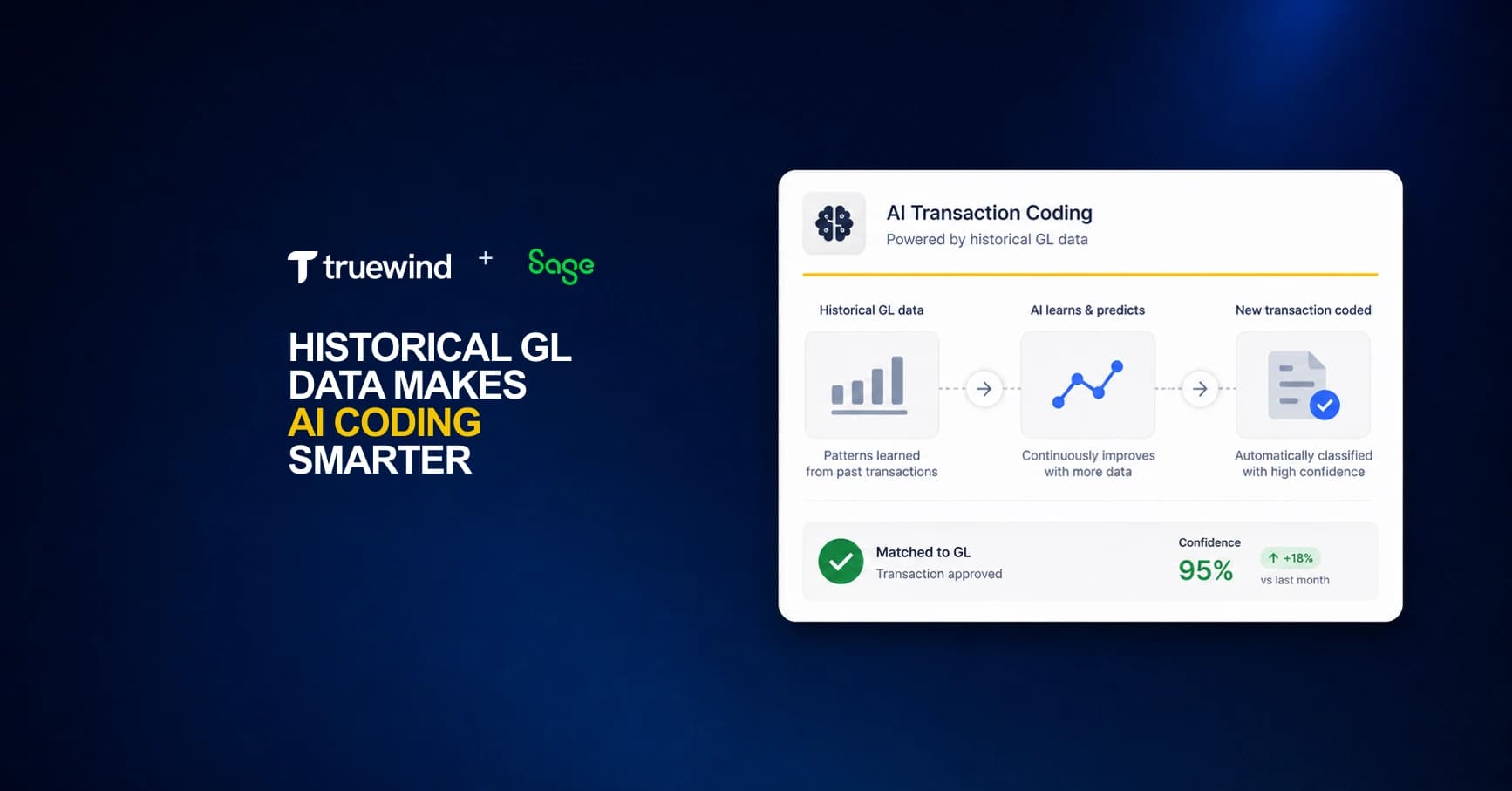
Generic classification assumes your GL works like everyone else's, which breaks down fast if you're using custom dimensions or multi-entity structures. Sage Intacct AI learning reads your historical transaction data first, so the model understands your baseline before it touches a single new entry. A $10 charge from United might belong in meals for one department and travel for another. The AI figures that out by looking at how your team has coded similar transactions in the past.
TLDR:
- AI models trained on your Sage Intacct history start at 70-80% accuracy and reach 95%+ after 50 reviewed transactions
- Historical GL data teaches dimensional assignment patterns that transaction descriptions alone cannot reveal
- LLM-based classification handles vendor name variations and context signals that break rigid rule engines
- Truewind reads your full GL history on connection to learn your specific coding conventions before classifying new transactions
How AI Classification Models Learn From Your General Ledger History
When Truewind connects to your Sage Intacct instance, it reads your historical GL data before classifying a single new transaction. The goal is understanding context, beyond structure.
Past transactions carry real information. A $300 United Airlines charge consistently coded to travel. A recurring SaaS vendor always mapped to software expenses with a specific department dimension. Repeated across months of actual activity, these patterns teach the classification model what your organization's coding decisions look like in practice.
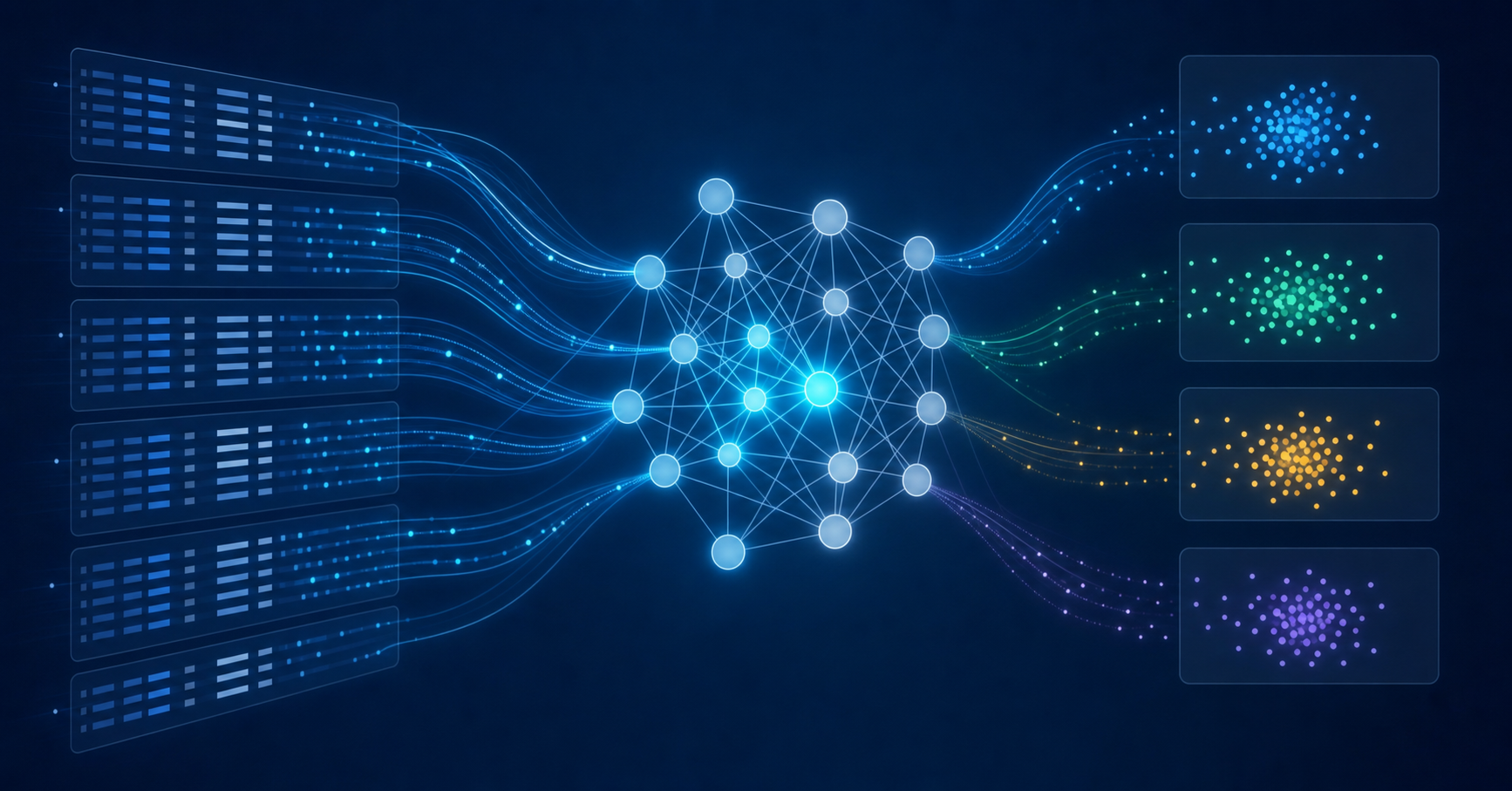
Generic classification assumptions break down when your chart of accounts has custom dimensions or entity-specific conventions. Historical data makes the baseline specific to you, not to some average company with an average GL.
Pattern Recognition Engines Replace Rigid Transaction Rules
Traditional rule-based transaction coding breaks down as your chart of accounts grows. A vendor might appear across departments, cost centers, or project codes depending on context, and static mapping tables can't account for that variation.
AI models trained on your historical GL data read those contextual signals instead. They learn which accounts your team has consistently chosen for a given vendor, transaction type, or memo pattern, then carry that logic forward to new transactions automatically.
The more historical data the model has access to, the more confidently it can classify transactions that fall outside clean, predictable patterns.
Initial Classification Accuracy vs Long-Term Performance Gains
Out of the box, Truewind's AI reaches 70-80% classification accuracy by drawing on a pre-trained base built from large volumes of accounting data. No manual rule configuration required.
The learning curve is short. After 50 reviewed transactions, accuracy climbs above 95%. Each confirmed coding decision teaches the model your specific GL conventions, your vendor relationships, and how your team assigns dimensions across accounts.
Over time, the model stops approximating your chart of accounts and starts reflecting it with precision.
| Learning Stage | Transaction Volume | Accuracy Rate | What the Model Learns |
|---|---|---|---|
| Initial Connection | 0 new transactions reviewed | 70-80% | Base patterns from pre-trained data and your complete historical GL structure, vendor relationships, and dimensional assignments from past entries |
| Early Training | 1-25 transactions reviewed | 75-85% | Your team's coding preferences for common vendors, initial department and class assignment patterns, basic dimensional logic for routine transactions |
| Active Learning | 26-50 transactions reviewed | 85-95% | Context-dependent coding rules, multi-department vendor patterns, edge case handling for unusual transaction types, cardholder-specific spending patterns |
| High Confidence | 50+ transactions reviewed | 95%+ | Full dimensional assignment logic across all custom fields, entity-specific conventions in multi-entity setups, seasonal spending patterns, vendor name variation handling |
The Feedback Loop That Makes Transaction Coding Smarter Every Month
Every correction your reviewers make feeds back into the model as a confirmed example of how your team codes that transaction type, for that vendor, in that context.
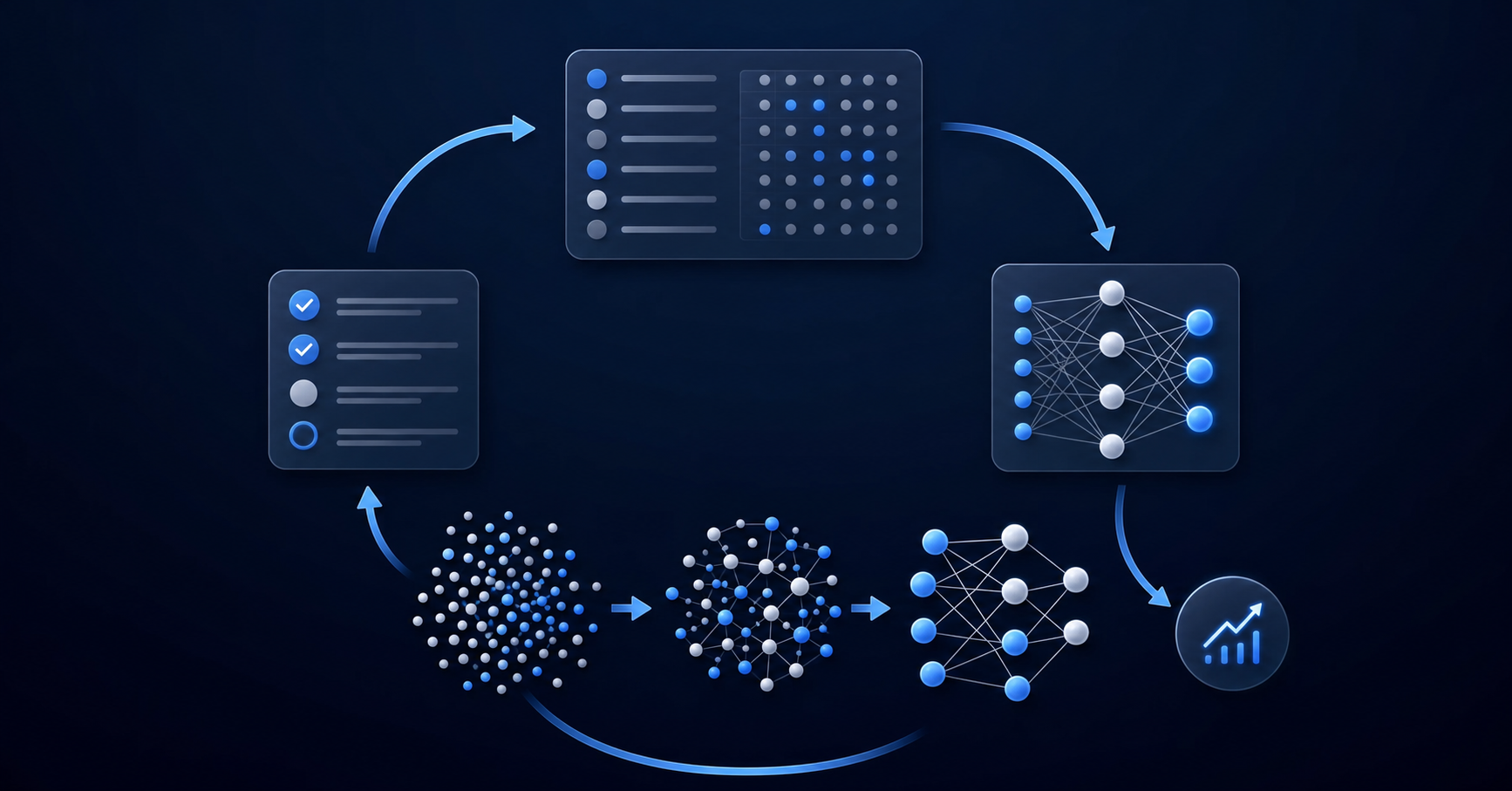
Over months, those corrections accumulate. The model learns your specific vendor preferences, how your organization splits expenses across departments, and edge cases no generic training set would ever capture. A nonprofit may code a similar transaction completely differently than a SaaS company would, and the AI picks up on those distinctions over time.
This separates continuous learning from a one-time setup. The more your team reviews, the less they need to correct.
What Historical Data Reveals About Dimensional Assignment
Sage Intacct's dimensional architecture raises the classification bar. Getting the GL code right is only part of the job. Assigning the correct class, department, location, project, and custom dimensions requires context that a transaction description alone rarely provides.
Historical postings fill that gap. Patterns in how your team has coded similar transactions reveal dimensional logic the AI cannot otherwise infer. A $300 airline charge might map to travel expense under the sales department, while a $10 charge from the same carrier belongs to meals for operations. Same vendor, different context, different dimensional outcome.
The more historical data available, the more clearly those patterns become visible across every dimension your Sage instance tracks.
How Transaction Volume Accelerates Model Training
More transactions processed means more signal for the AI to learn from. Each coded entry adds a data point that reinforces or refines the model's understanding of how your organization categorizes spend.
Training data volume directly impacts classification accuracy in machine learning systems. In practice, this means teams that have been using Sage Intacct longer tend to see higher auto-coding confidence scores over time, with fewer transactions requiring manual review and reconciliation.
The compounding effect matters most for edge cases: one-time vendors, multi-department allocations, and transactions that straddle two GL accounts.
Why Clean Historical Data Matters for AI Learning
The quality of what the AI learns depends entirely on the quality of what it reads during initial data ingestion. Historical GL data full of miscoded transactions, blank memo fields, or inconsistently applied dimensions trains the model to replicate those errors, not correct them. Poor data quality severely affects both the training process and accuracy of machine learning models.
That's the risk when migrating from a system where coding was done loosely. Catch-all accounts, skipped dimensions, and inconsistent vendor naming all become patterns the model internalizes. Garbage in, garbage out applies here as clearly as anywhere in accounting.
For teams moving to Sage Intacct from another ERP, historical transaction data can be ingested when the chart of accounts maps cleanly to the new structure with proper bank feed setup. When it does not, cleaning that data before it becomes training material is worth the effort. The model's future accuracy reflects the past decisions you hand it.
Contextual Understanding Beyond Transaction Descriptions
The classification model weighs multiple signals simultaneously: transaction amount, date, source account, cardholder identity, and timing patterns from prior transactions.
That combination matters. A $5 Starbucks charge reads differently than a $500 charge from the same merchant on a corporate card in December. One is coffee. The other is likely catering. The description alone won't tell you which is which, but the surrounding context usually does with workpaper automation.
- Amount thresholds help separate routine purchases from outliers that warrant a different GL treatment
- Cardholder history ties transactions to department-level spending patterns
- Timing signals flag recurring charges versus one-off purchases
Multi-Entity Pattern Learning at Scale
Multi-entity organizations face a specific challenge: coding conventions vary by entity, but some patterns apply everywhere. A family office managing 200+ entities on Sage Intacct cannot maintain a separate ruleset per entity, nor collapse everything into a single model that ignores structural differences.
AI learns at both levels. Shared vendor patterns transfer across entities where they hold. Entity-specific exceptions stay scoped where they belong. The model tracks which conventions are universal and which are tied to a particular entity's chart of accounts, without requiring manual configuration to draw that line through Truewind's classification engine.
How Truewind Uses Sage Intacct Historical Data for Day-One Accuracy
When Truewind connects to your Sage Intacct instance, it reads your full historical GL before classifying anything new. That read seeds the model with your actual coding decisions, not generic defaults.
LLM-based fuzzy matching then handles the description variations that break Sage's native rule engine. A truncated memo, a vendor name formatted differently, a slightly different transaction string. None of those stop a classification. Full dimensional support means every dimension your Sage instance tracks gets assigned correctly, including custom ones with AI bookkeeping.
Every reviewer correction feeds the model forward. Confirm a coding decision, and Truewind carries that context into future transactions. The gap between AI suggestion and reviewer approval narrows with each close cycle.
Final Thoughts on Historical Data and AI Classification Accuracy
When Sage Intacct AI learning starts with your historical GL, it skips the generic approximation phase and goes straight to your coding conventions. Your past transactions are training examples that teach dimensional logic no ruleset could capture. Each reviewer correction adds another data point, and the model gets sharper every month. Book a demo if you want to see how your historical data translates into auto-coding confidence.
FAQ
Sage Intacct historical data vs manual rule setup for transaction coding?
Historical GL data trains the AI on your actual coding decisions across all dimensions, not generic defaults. Manual rule setup breaks when vendor patterns vary by department or context, while historical pattern learning handles those variations automatically.
Can I use Sage Intacct historical data if I'm migrating from another ERP?
Yes, if your old chart of accounts maps cleanly to your new Sage Intacct structure. When the mapping requires major changes, cleaning the historical data before ingestion prevents the AI from learning inconsistent coding patterns from your previous system.
How does AI improve transaction coding accuracy over time in Sage Intacct?
The model starts at 70-80% accuracy using base training data, then climbs above 95% after reviewing just 50 transactions. Every correction your team makes feeds back as a confirmed example of how you code that transaction type, vendor, and dimensional combination.
What happens when historical GL data has miscoded transactions or blank fields?
The AI learns from what it reads, including errors. Inconsistent vendor names, catch-all accounts, and skipped dimensions become patterns the model replicates. Clean historical data produces accurate future classifications; poor data quality trains the model to repeat past mistakes.
Why does transaction volume matter for AI classification accuracy?
More coded transactions mean more signal for the model to learn from, particularly for edge cases like one-time vendors or multi-department allocations. Teams with longer Sage Intacct history see higher auto-coding confidence scores because the model has more dimensional assignment patterns to reference.
Turn this into a close-ready workpaper
Start with sample files or upload your own statements to see how Truewind prepares review-ready workpapers and journal entries.