

At review, a vendor-name rule can look precise and still send the same spend to the wrong account. Expense categorization rules that hold up at month-end need more than merchant text. They need entity, purpose, prior treatment, source support, and a place for the reviewer to resolve what doesn’t fit.
The common mistake is treating categorization as a lookup table. A lookup can suggest an account, but it can’t explain why a charge belongs there, whether it should be split, or which dimension should survive into the journal entry. Reviewable coding begins with a known accounting process and ends with a visible decision.
Key Takeaways:
- Build categorization rules from approved prior treatment, not vendor names alone.
- Scope each rule to the entity, account, purpose, and dimensions that make it valid.
- Separate recurring treatments from transactions that require accounting judgment.
- Treat exceptions as a control surface and route them to a named reviewer.
- Test new coding logic against a known answer before expanding it to more workflows.
Why Expense Categorization Rules Fail at Review
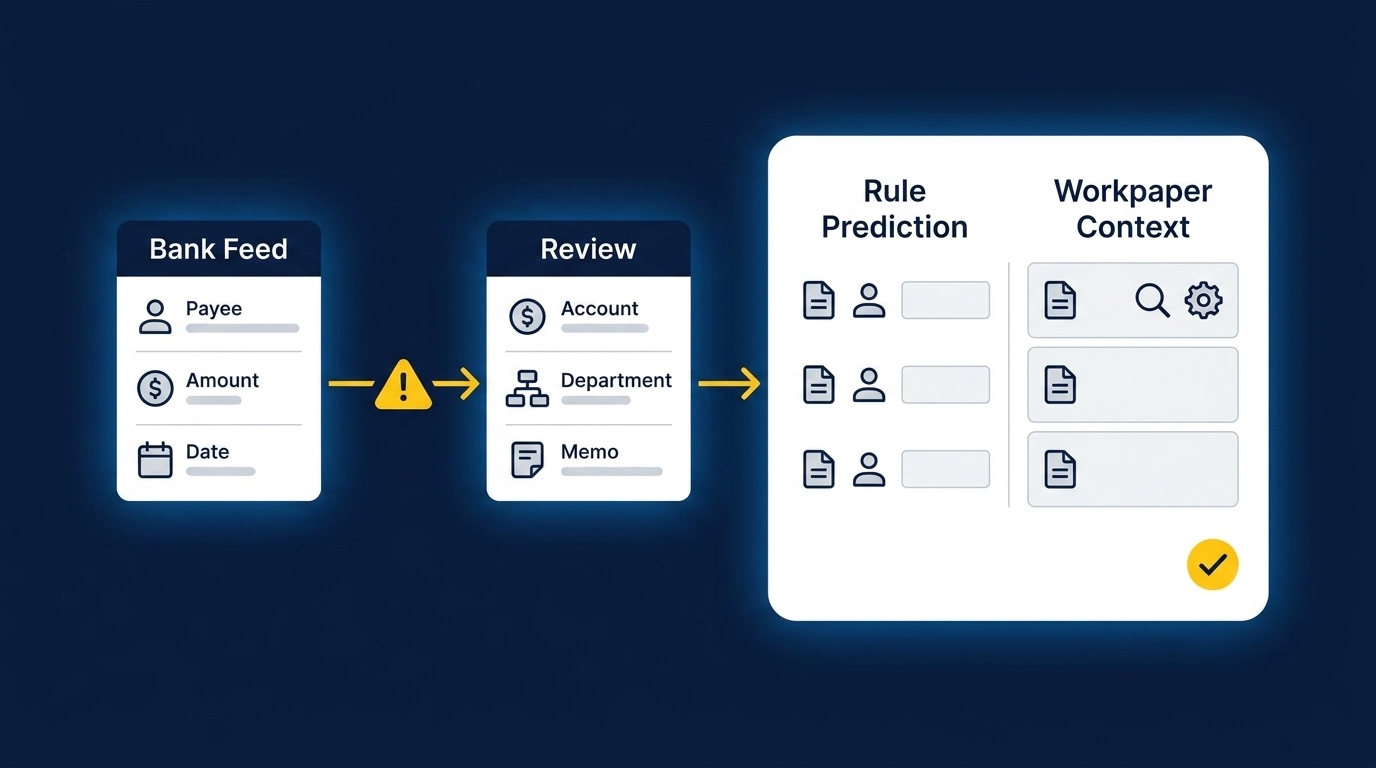
Expense coding fails at review when a rule predicts an account without preserving the context that made the treatment valid. The bank feed may show a payee and amount, while the workpaper has to carry the entity, period, allocation, and source support. A clean category is not yet a reviewable accounting decision.
Vendor Names Don’t Carry Accounting Treatment
Vendor text is a useful input. It can identify a recurring supplier, narrow the likely account, and point the preparer toward prior treatment. Yet the same vendor can bill for software, implementation work, equipment, or a prepaid service term. A rule based only on the merchant name erases those differences before the reviewer ever sees them.
Think of the vendor name as the label on an envelope. It tells you where the transaction came from, but not what accounting treatment belongs inside. The useful categorization rule reads the invoice, checks the entity and period, compares prior approved treatment, and retains the support behind its proposal. Without that context, the reviewer has to reopen the source and rebuild the decision.
Vendor matching is useful. It just can’t carry the whole treatment.
The Same Charge Can Change by Entity and Purpose
A nonprofit accounting manager sees a recurring charge from the same service provider across two entities. One entity uses the service for program delivery, while the other uses it for administration. The merchant text matches, but the fund, purpose, and dimensional coding do not. A global vendor rule would produce a consistent answer and still be wrong for one side of the entry.
Family offices run into the same problem when a custodian charge belongs to a specific entity or investment vehicle. CAS practices see it across clients whose charts of accounts use different labels for similar spend. The surface pattern is stable. The accounting context isn’t. If a categorization rule can’t preserve that context, narrow its scope rather than forcing consistency where none exists.
Exceptions Show Where the Rule Stops
A perfect match and a useful exception do different jobs. The match carries known treatment forward, while the exception marks the point where the facts no longer support the rule. Missing source documents, an unfamiliar classification, or a changed allocation should land in front of the accountant. Forcing those items through the normal path hides the very evidence a reviewer needs.
There’s a fair case for broad rules. They reduce repeated coding on stable charges, and many recurring transactions do follow an established pattern. The limit matters: once the source, entity, purpose, or treatment changes, the rule should stop and ask for review. That boundary is not failed automation. It is the control that keeps a useful rule from becoming an unreviewed policy change.
If you want to inspect how source-linked preparation and reviewer sign-off fit around the GL, See Truewind in action with one recurring expense workflow in mind. The rule has to carry the treatment, not merely guess the account.
How to Build Expense Categorization Rules Reviewers Can Use
Reviewable expense categorization starts with approved examples, separates repeatable rules from judgment, preserves dimensions, and sends exceptions to a named reviewer. The sequence matters because each stage leaves evidence for the next. Your reviewer should see the proposed account, the source support behind it, and what changed over time.
Diagnose the Rules Your Reviewer Can’t Trust
Can your reviewer explain a proposed category without reopening the entire transaction history? If the answer is no, the rule probably relies on a surface signal rather than accounting evidence. Look closely at recurring corrections, unexplained splits, missing dimensions, and transactions that bounce between accounts. Those review patterns reveal where the coding logic is too broad.
Run the test on the last approved period, not a sample built for evaluation. Select transactions that were accepted, corrected, split, and sent back for support. Then compare what the rule saw with what the reviewer needed to know. If the explanation ends at “the vendor matched,” the rule is not ready to carry the work.
Ask four questions before keeping an expense coding rule:
- What source supports the treatment? Identify the invoice, statement, contract, or approved workpaper.
- Where does the rule apply? Name the entity, account, purpose, and period conditions.
- What would stop the rule? Define the missing or changed fact that triggers review.
- Who owns the exception? Route it to the person responsible for the accounting decision.
Start With Approved Treatment, Not Merchant Text
Last period’s approved workpaper is more useful than a list of merchant names because it shows what the team actually decided. It carries the final account, dimensions, allocation, reviewer correction, and source support in one place. An SOP can add policy, but the approved work shows how that policy met the transaction. Start there.
The process should move in a clear order. First, identify the recurring source and its known treatment. Next, record the conditions that made the treatment valid, including entity and purpose. Then define what would make the current-period item different. If you can’t state those conditions, you don’t yet have a rule. You have a remembered habit.
Prior treatment has limits, and that matters. A prior workpaper can preserve an old mistake or a treatment that no longer fits current facts. The reviewer should confirm that the example remains valid before it becomes operating context. Historical consistency is useful only when accounting judgment still has the right to change it.
Keep Deterministic Rules Narrow
Good coding rules are narrow on purpose. A recurring subscription billed monthly to one entity, assigned to one department, and supported by the same contract may be a strong rule candidate. A payment to a vendor that sells both equipment and services is not. The second case needs document context before classification.
Separate the work into two paths. The first path covers transactions where the source, treatment, dimensions, and allocation conditions are all present. The second path covers missing support, changed terms, unfamiliar activity, or a conflict with prior treatment. If a transaction falls between the paths, route it to review. Don’t widen the rule just to increase the match count.
Manual review has real merit for unusual or material transactions. It gives the accountant room to inspect facts that a recurring rule was never meant to decide. The mistake is using that same depth of review for every stable item each period. Keep judgment where judgment belongs, and let narrow rules prepare the rest.
Preserve Dimensions and Allocation Logic
A card charge can carry the right natural account and still lose the coding your reporting depends on. Program, fund, department, location, purpose, and entity fields often determine how the expense appears downstream. When those dimensions live outside the categorization rule, the preparer has to add them later or the reviewer has to catch the omission.
Allocation logic needs the same treatment. The prepared split should tie back to the source and preserve the dimensions the team uses to review and report. If the allocation basis changes, the old rule should stop rather than applying an outdated split. Reviewers need to see the change because an allocation is an accounting decision, not file formatting.
A practical rule record should contain:
- Source condition: Which document or transaction type activates the rule.
- Scope condition: Which entity, account, or workflow the rule covers.
- Coding output: The proposed account and required dimensions.
- Allocation basis: The approved split and how each line is calculated.
- Stop condition: The change that moves the item into review.
To inspect how those reviewer actions stay attached to the work, Book a Truewind demo. A useful system should preserve the decision without turning it into an unchangeable default.
Make Exceptions Visible Before Posting
What should happen when the source does not fit the rule? The item should stop in preparation with the source attached and the proposed treatment left for an accountant to confirm or correct. It should not disappear into a miscellaneous account or inherit last month’s category without review. Visibility is the point.
Exception design should be specific enough to guide the reviewer. “Low confidence” says little about the accounting issue. Missing support, unclear entity or dimension, changed terms, or a conflict with prior approved treatment tells the reviewer what to inspect. The better the exception explains the break, the less time the reviewer spends reconstructing it.
Use conditional rules rather than broad warnings:
- If required source support is missing, hold the item for review.
- If the entity or dimension is unclear, do not apply the recurring treatment.
- If current facts conflict with the prior workpaper, surface the exception for reviewer judgment.
- If a reviewer changes the treatment, capture that correction in the workflow for later periods.
Test One Workflow Against a Known Answer
A broad rollout creates more activity, but it does not create more trust. Start with a recurring workflow that has stable inputs, a prior approved workpaper, clear ownership, and enough exceptions to test the boundary. Run the current source through the proposed categorization logic. Then compare the prepared output with the known answer line by line.
Differences are the useful part. Some will reveal missing rules, while others will expose a source change or a judgment call that should remain with the reviewer. Record each correction, rerun the workflow, and confirm that the next output reflects the approved treatment. If a correction can’t be explained or reproduced, expansion should wait.
The first workflow should be bounded, but not artificial. A clean demo file proves very little about how the process handles incomplete support, changed descriptions, or mixed activity. Choose work your team already knows how to review. Trust grows when the prepared result is understandable, repeatable, and tied to the same evidence the accountant would use by hand.
Once that sequence works, the remaining question is where the preparation should live relative to the ledger.
How the Platform Keeps Coding Upstream of the Ledger
Preparation should sit upstream of the GL, where source files can be read, prior treatment applied, exceptions reviewed, and approved coding handed to Sage Intacct or QuickBooks Online. The ledger remains the system of record. The accountant remains the owner of treatment and sign-off.
Historical Treatment Becomes Reviewable Operating Context
Historical-Example Learning captures confirmed coding decisions and reviewer corrections against the recurring workflow. When the next period arrives, the platform applies that history to the new source while keeping the treatment visible for review. Dimensional and allocation context stays attached to preparation rather than being reduced to a vendor lookup. Rule changes remain explicit.
That mechanism is why customer language often focuses on the review burden, not category suggestions alone. One customer put it plainly: “Categorization is accurate, and we stopped having to double-check everything.” Another said, “Truewind automates a huge chunk of that busywork.” Those are individual customer descriptions, not a promise that every transaction will follow a rule or every reviewer will accept the first proposal.
Review and ERP Posting Stay Separate
The Human-in-the-Loop Review Workflow presents prepared coding with source links, exceptions, and reviewer actions before anything moves downstream. Accountants can confirm, correct, or return an item to preparation. After sign-off, native ERP integration hands structured output to Sage Intacct or QuickBooks Online. Neither ERP stops being the system of record.
Customer descriptions can be stronger than the language an accounting team should use for evaluation. “If I had to describe Truewind in one word: Lifechanging” reflects one customer’s experience. Another said, “It’s like having an entire accounting department at our fingertips - efficient, accurate, and effortless.” A third framed the operating value more precisely: “It’s not just about making bookkeeping simpler; it’s about freeing up teams, and helping them focus on higher-value projects.”
The right evaluation still comes back to the work. Can the reviewer trace the category to source, see the rule, inspect the exception, correct the treatment, and prevent unapproved output from reaching the ledger? If your team has a recurring workflow and a known approved answer, Get a Truewind demo and bring both to the session. The preparation layer can do more work precisely because the accountant still owns the decision.
Where Reviewable Expense Categorization Rules Lead
Reviewable categorization rules move accounting effort from repeated lookup and correction toward exception review and judgment. The account suggestion is only one part of the output. Source support, scope, dimensions, allocation logic, and reviewer sign-off are what make the category usable in the close.
Start with one workflow your team already understands. Compare the prepared output with the approved result, inspect every difference, and keep the exceptions visible. Expand only after corrections carry forward and reviewers can explain how each line was produced. That is how categorization becomes repeatable without giving up control.
Frequently Asked Questions
How do I handle edge cases effectively?
To manage edge cases effectively, start by defining specific conditions that trigger a review. For example, if a transaction lacks source support or if the entity or dimension is unclear, route it to a reviewer. Truewind's Human-in-the-Loop Review Workflow can help by surfacing these exceptions with the necessary source context, allowing accountants to focus on judgment items rather than routine checks. This way, you ensure that every unusual case is visible and properly addressed before posting.
Can I automate the categorization of recurring expenses?
Yes, you can automate the categorization of recurring expenses using Truewind's AI-Powered Transaction Coding. This feature applies your team's existing accounting rules to categorize transactions accurately. It learns from past corrections, which means the more you use it, the better it gets at aligning with your team's coding preferences. Just ensure you have defined clear rules and that the system has historical data to learn from for optimal results.
What if my categorization rules aren't producing consistent results?
If your categorization rules aren't consistent, first review the rules to ensure they are narrow enough to capture the necessary context, such as entity and purpose. Truewind's Historical-Example Learning feature can help by applying past coding decisions to current transactions, which can improve consistency over time. Additionally, consider testing your rules against known answers to identify discrepancies and make adjustments as needed.
When should I involve a reviewer in the expense categorization process?
You should involve a reviewer whenever there's an exception or when the categorization rule encounters missing or changed information. Truewind's Human-in-the-Loop Review Workflow is designed to ensure that all prepared work is reviewed before it moves downstream. This means that any unusual transaction or discrepancy is flagged for a reviewer to assess, ensuring that no unapproved items reach the ledger.
Turn this into a close-ready workpaper
Start with sample files or upload your own statements to see how Truewind prepares review-ready workpapers and journal entries.