

title: "Exception-First Reconciliation Review for Accounting Teams"
The reconciliation ties, but the reviewer is still opening line after line to prove that ordinary matches are ordinary. The processor deposit agrees to the bank. The fee follows the established treatment. The coding matches the prior period. Yet the reviewer spends most of the review confirming items that do not require judgment while missing statements and unexplained differences wait in the same queue.
That is the control problem. The largest review cost is often not a rare outlier that slips through. It is the time spent rechecking the normal population because the workpaper does not separate prepared matches from actual exceptions. More review does not automatically mean more control when every item receives the same attention.
Exception-first reconciliation review changes the unit of work. Preparation covers the full population, but reviewer attention moves toward missing activity, duplicate records, timing differences, classification conflicts, and items that do not follow the established process. The accountant still owns the treatment and sign-off. What changes is where judgment begins.
Full-population review is not the same as control
A reviewer needs evidence that the reconciliation is complete, but opening every matched line is an expensive way to produce that evidence. It mixes two different tasks: proving that the preparation followed the approved process and deciding what to do when an item falls outside it. The first task should be repeatable. The second belongs with the accountant.
Spreadsheet-driven review often makes that distinction difficult. Matches, reconciling items, reviewer notes, and source support may sit in different tabs or files. A clean total at the top can obscure how the preparer got there, which sources were included, and whether an expected file never arrived. The reviewer responds by checking more of the population because the workpaper itself does not show enough.
A tie-out also proves only that the populations supplied agree under the applied logic. It does not prove that every expected source was supplied. If a monthly processor report is missing from preparation, the reviewer needs a completeness control that recognizes the absence. Generic anomaly detection cannot flag a record that never entered the population.
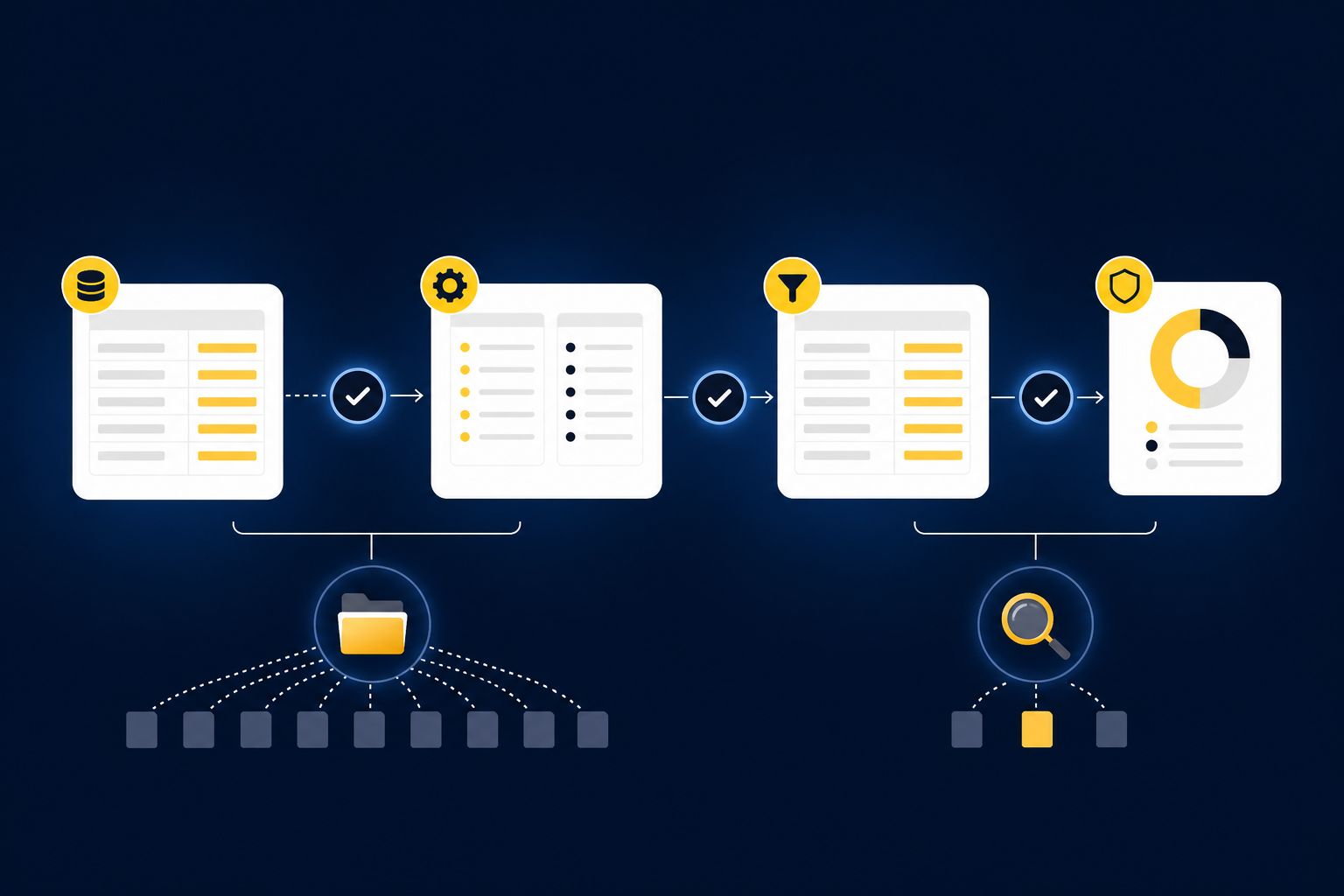
The better review pattern separates prepared matches from judgment items while preserving access to the full population. The reviewer can inspect the matching logic, totals, source coverage, and supporting records without treating every normal line as an exception. Sampling or additional checks can remain part of the team’s review policy, but they no longer need to substitute for a traceable preparation process.
In one accounting-firm customer example, automated preparation reduced credit-card transaction categorization time by approximately 75%. That result applies to the customer’s categorization workflow, not every reconciliation. It still illustrates the operating point: when recurring preparation follows known rules, experienced staff can spend less time proving routine treatment and more time on the items that need a decision.
Seeing that separation inside a real workpaper is more useful than evaluating it as a general automation claim. You can See Truewind in action through the source, exception, and reviewer path a controller actually needs to inspect.
Build the reconciliation around exceptions
Exception-first review does not mean hiding the normal population. It means preparing that population according to explicit matching and classification rules, then showing the reviewer where those rules did not resolve the work. The design starts with the expected sources and the prior approved process, not with a generic list of unusual transactions.
For a processor reconciliation, the source set may include the processor report, bank activity, and the relevant ERP balances. Preparation has to align deposits, fees, refunds, and timing differences across records that describe the same activity differently. A bank match alone is not enough when the workpaper also needs the correct account treatment or dimensions.
The workflow should answer four questions before it asks the reviewer to act:
- Was every expected source received? The source checklist should show which statements, exports, or schedules were expected for the period and which were actually included.
- Which activity matched under the approved logic? The workpaper should preserve the relationship between source records, calculations, and ledger treatment.
- What did not fit? Unmatched records, duplicates, timing differences, unexpected balance changes, and inconsistent classifications should remain visible.
- Who owns the next action? Each exception needs a reviewer path based on the accounting question it raises, not a single undifferentiated queue.
The third question gets most of the attention, but the first is often more valuable. A large transaction with an unusual description is visible and can be investigated. A missing custodian statement or absent processor export can leave no transaction to flag at all. Completeness requires the workflow to know what should have arrived before it asks whether the activity inside the files looks unusual.
Give different exceptions different reviewer paths
Not every discrepancy requires the same treatment. A timing difference may need support and a carryforward. A duplicate may need removal from preparation. An inconsistent classification may require the reviewer to confirm the correct account or dimension, while an unexpected balance change may require investigation outside the reconciliation.
Useful exception categories include:
- Missing expected activity: A statement, export, or recurring source is absent from the period.
- Unmatched or partially matched activity: Records agree only in part, or a related bank, processor, or ledger item cannot be located.
- Potential duplicates: The same activity appears more than once within or across sources.
- Timing differences: Activity belongs to the reconciliation but settles or posts in another period.
- Classification conflicts: The proposed account, fund, program, department, or entity treatment differs from established treatment.
- Source-format changes: A recurring file no longer presents the information in the structure used by the approved workflow.
Separate categories matter because they produce different evidence and decisions. A missing statement should not sit behind a long list of amount mismatches. A timing difference should not be handled like an unexplained duplicate. The workpaper should route each item to the person who can resolve it and retain the source context that person needs.
The workpaper is the control surface
An exception list by itself is not a reconciliation. The reviewer also needs to see the population that was prepared, the sources used, the calculation applied, and the accounting treatment that follows. Otherwise, exception-based review becomes another black box that asks the accountant to trust a clean result.
A defensible reconciliation workpaper should show:
- The source files and balances included in the period
- The expected sources and any missing inputs
- The matching or allocation logic applied
- The prepared population and its tie-out
- The exceptions that remain unresolved
- The treatment and support for each reconciling item
- The preparer and reviewer actions
- The final sign-off before any journal entry moves downstream
That structure lets the reviewer re-perform the important steps without rebuilding the reconciliation. If a processor fee was allocated, the workpaper should show the report that supplied it and the rule that determined its treatment. If a deposit stayed unmatched, the reviewer should see the related source records rather than search across an inbox and several spreadsheets.
Reviewability also changes how corrections should be captured. A reviewer may determine that an item belongs to a different fund, account, or entity based on the team’s policy. That decision should remain attached to the workflow so the next period can apply the confirmed treatment. Novel items still return to the accountant. Historical treatment is operating context, not permission to change policy.
The same record supports later review and audit preparation, but it does not replace formal audit procedures. Its purpose is narrower and practical: preserve what source produced the work, how the calculation was performed, which exceptions appeared, and who approved the result. A reviewer should not have to reconstruct those facts after the close.
How Truewind prepares an exception-first review
Truewind starts upstream of Sage Intacct or QuickBooks Online, where source documents become accounting work. Multi-Source Reconciliation ingests the relevant exports and statements, aligns activity using the team’s historical treatment, and prepares the reconciliation, support schedule, and any required journal-entry draft. Fees, refunds, and timing differences remain tied to their sources.
Proactive Anomaly Detection compares current-period preparation with the learned process and prior workpapers. Missing statements, unexpected balance changes, mixed activity, and inconsistent classifications are surfaced with source context. Truewind does not resolve those items autonomously or force unreconciled totals to agree.
Prepared work then moves through the Human-in-the-Loop Review Workflow. Accountants inspect workpapers, reconciliations, schedules, and journal-entry drafts alongside source links and exceptions. They can confirm the preparation, adjust it, or send it back. Nothing leaves review without accountant sign-off.
Workpaper Generation and Rollforward carries the known structure into the next period. The prior workpaper, current-period sources, and ERP balances feed a current workpaper with updated schedules and visible exceptions. Reviewer corrections are captured through Historical-Example Learning, which applies confirmed treatment later without changing accounting policy on its own.
Sage Intacct and QuickBooks Online remain the systems of record. After reviewer confirmation, Truewind can push structured output to the connected ERP with coding, dimensions, and source references preserved. It does not replace the GL, and it does not post without reviewer approval.
The review surface is where these capabilities become useful together. To inspect how source links, exception queues, and reviewer actions fit inside one recurring reconciliation, Book a Truewind demo around a workflow your team already runs.
Adopt the workflow through controlled iteration
The first reconciliation should not be selected because it sounds ambitious. It should be recurring, bounded, supported by known inputs, and backed by a prior approved result. A processor settlement reconciliation, donation reconciliation, or brokerage rollforward can be a strong starting point when the team already has the source files and an established workpaper.
Start by reproducing the known result. Load the prior workpaper, current source structure, mappings, classifications, and reviewer conventions. Compare the prepared output with the work the team already approved, then inspect every difference. Some differences will expose a configuration issue. Others will identify an exception the old process handled through an undocumented reviewer note.
Corrections matter as much as the initial result. When the reviewer confirms a classification or adjusts an allocation, that decision should become part of the workflow’s operating context. The next period can apply the confirmed treatment while continuing to surface rule changes and novel items for review.
Expansion should follow evidence from the workflow itself. Once the team can trace the sources, understand the matching logic, inspect the exceptions, and reproduce the approved result, it can add another account or entity. Turnkey autonomy skips the part controllers need most: proof that the preparation is understandable before the scope grows.
The approach also has prerequisites. A team needs a recurring close, prior examples, defined reviewer ownership, and a system of record such as Sage Intacct or QuickBooks Online. It is not a fit for buyers seeking autonomous posting or an ERP replacement. The accountant remains responsible for policy, treatment, and approval.
To test that rollout against a bounded workflow and a known prior result, Get a Truewind demo and bring the workpaper your reviewer already approves.
Move reviewer time toward judgment
Exception-first reconciliation review should not reduce control to a smaller checklist. It should make control easier to inspect by separating complete, rule-following preparation from missing, duplicate, and unexplained items. The full population remains available, but it no longer consumes the same attention as an exception that needs accounting judgment.
For a suitable recurring workflow, the operating target is a 30% to 50% reduction in low-value reconciliation review time while improving visibility into missing, duplicate, and unexplained items. The mechanism matters more than the percentage: define the expected sources, prepare normal matches under approved rules, separate exception categories, and present the result in a workpaper the reviewer can trace.
The accountant does not leave the reconciliation. The accountant moves to the part of it where experience matters.
Frequently Asked Questions
How do I implement an exception-first reconciliation review?
To implement an exception-first reconciliation review, start by preparing your full population of transactions according to explicit matching and classification rules. Next, ensure that your workpaper highlights where these rules did not resolve the work, such as missing statements or duplicates. Finally, route each exception to the appropriate reviewer based on the accounting question it raises, ensuring they have the necessary context to make informed decisions.
What if I find missing statements during reconciliation?
If you find missing statements, first check your source checklist to confirm which expected documents were not received. Document these missing items in your workpaper and evaluate their impact on the reconciliation. It's essential to maintain a record of what should have arrived before addressing the unmatched transactions, as this will help in understanding the completeness of your reconciliation.
Can I automate the reconciliation process with Truewind?
Truewind helps streamline the reconciliation process by turning raw source documents into structured workflows. However, it does not autonomously resolve exceptions or post entries without human review. You'll still need to involve accountants to inspect the prepared workpapers and confirm the accuracy of the reconciliations before any journal entries are finalized.
When should I categorize exceptions in my reconciliation?
You should categorize exceptions during the reconciliation process as soon as they are identified. Different types of exceptions—like missing activity, duplicates, or timing differences—require different handling. By categorizing them early, you can ensure that each exception is routed to the appropriate reviewer who can address the specific accounting question it raises.
Why does Truewind focus on exception-first reconciliation?
Truewind emphasizes exception-first reconciliation to improve the efficiency and effectiveness of the review process. By separating prepared matches from judgment items, accountants can focus their attention on discrepancies that truly require their expertise, reducing time spent on routine checks and allowing for more thorough investigation of exceptions.
Turn this into a close-ready workpaper
Start with sample files or upload your own statements to see how Truewind prepares review-ready workpapers and journal entries.