

Your rules work until they don't. Sage Intacct AI rules fail when bank feeds introduce abbreviations, reference numbers, or truncated descriptions that break string-match logic. A rule for "STRIPE TRANSFER 10029" won't catch "STRIPE TRANSFER 10030," and each miss becomes an exception your team handles manually. Fuzzy matching solves this by treating vendor name variations and formatting inconsistencies as inputs instead of failure conditions, so your team reviews exceptions instead of re-coding the same vendors every month.
TLDR:
- Sage Intacct's rule engine breaks when vendor names vary or descriptions truncate
- LLM-based fuzzy matching classifies transactions by context, not exact string matches
- You review only low-confidence exceptions instead of manually coding every transaction
- Truewind reads your GL history on connection and maps all Sage dimensions automatically
- Truewind connects via API to Sage Intacct for transaction coding and reconciliation
Why Sage Intacct's Rules Engine Falls Short for Transaction Matching
Sage Intacct's built-in rules engine requires exact or near-exact string matches to categorize transactions. That works fine for predictable vendor names and consistent descriptions, but real transaction data is messy. Bank feeds, credit card imports, and third-party integrations routinely produce truncated descriptions, abbreviations, and formatting inconsistencies that break rigid rule logic.
The result: your team spends time manually reviewing exceptions that a smarter system should handle automatically. According to research from PYMNTS, 45% of finance teams cite transaction categorization errors as a top source of month-end close delays.
Sage Intacct gives you conditions and filters, but no tolerance for variation. A rule built for "Amazon Web Services" won't catch "AMZN WEB SVCS" or "AWS Cloud." Each new vendor pattern requires a new rule, and rule libraries grow unwieldy fast.
What AI Fuzzy Matching Actually Does
Fuzzy matching, at its core, is the ability to recognize that two strings are substantially the same even when they don't match character for character. In accounting, that matters because your bank feed doesn't care about your rule library.
Where rule engines ask "does this description match exactly?", LLM-based classification asks "what does this transaction most likely represent?" The model considers the description, the amount, the merchant category, and historical patterns from your own GL to arrive at a classification. No pre-written rule required.
Rules are instructions. AI classification is inference. One breaks when reality doesn't cooperate; the other adapts.
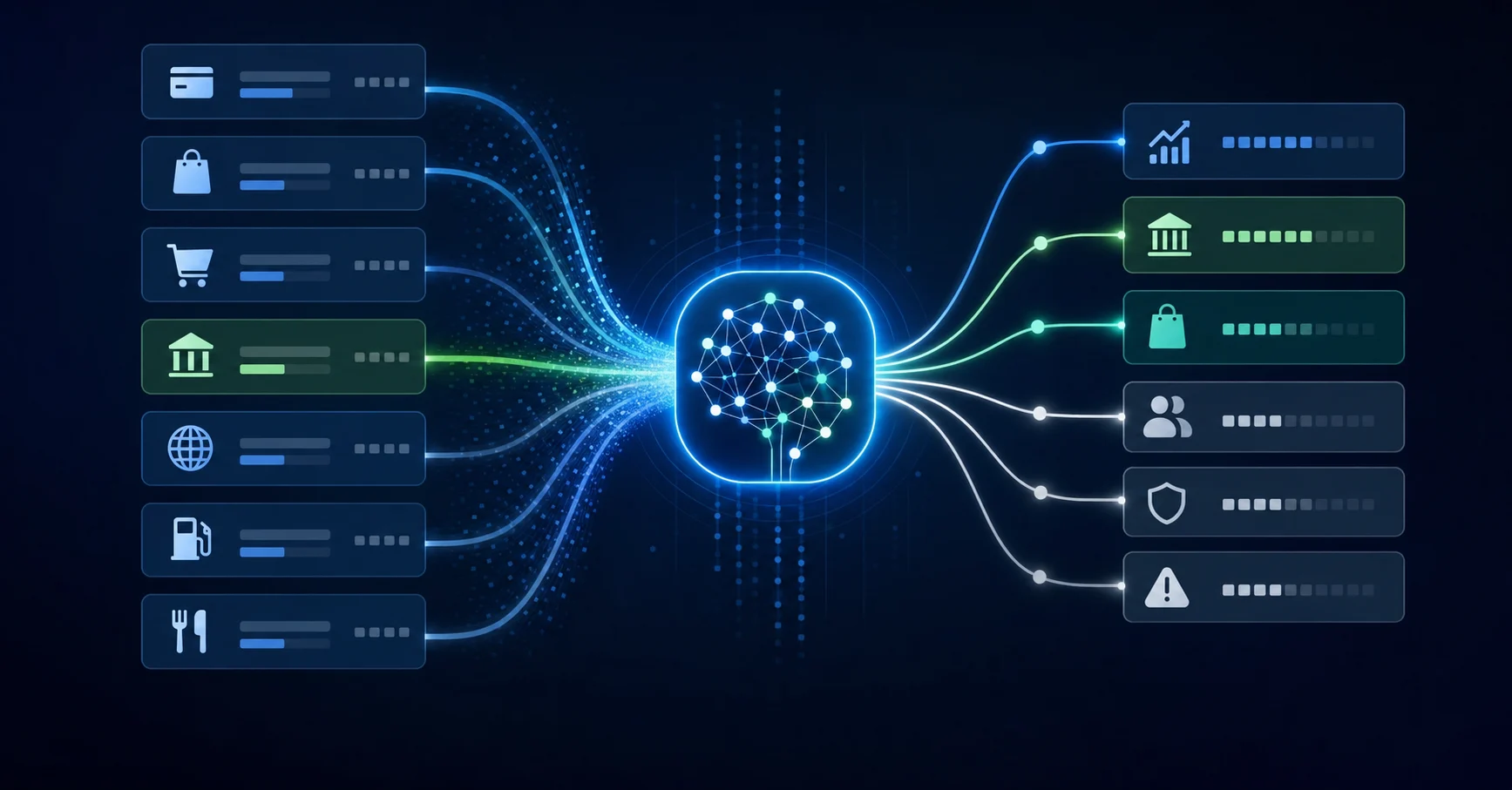
How the Inference Layer Works
A few inputs drive LLM-based transaction classification:
- The raw transaction description, including abbreviations, partial vendor names, and formatting inconsistencies that would break a string-match rule
- The transaction amount and timing, which provide context when descriptions are ambiguous or generic
- Merchant category codes, where available, as a secondary signal to confirm or disambiguate intent
- Your existing GL history, which trains the model to recognize the accounts and cost centers your team actually uses
The Real Cost of Rigid Transaction Rules
When rules miss, someone picks up the slack. Usually that's the accountant who should be reviewing, not re-coding.
Manual coding accounts for up to 60 to 70% of total time spent on transaction classification. That's the majority of the workflow consumed by exceptions a better system would have caught automatically. Categorization errors from missed rules also accumulate quietly, surfacing at close as variance that needs explaining.
At scale, the math gets worse. Multiple entities, dozens of accounts, new vendors generating new patterns every month. The rule library expands, but exceptions still slip through, and the backlog lands at close when you can least afford it.
How Sage Intacct's Bank Feed Works Today
Sage Intacct's cash management module handles bank reconciliation, but it works differently than most accountants expect coming from QBO. You can connect bank accounts through direct feeds where available, import statement files via CSV or OFX, or receive postings from Sage's AP and payment workflows. Reconciliation then matches posted GL entries against those imported bank statement lines.
What Sage does not offer is a live transaction review queue. There is no feed where uncategorized transactions surface automatically for coding and approval before they hit the GL. Sage assumes most categorization happens before reconciliation. That distinction matters because teams are left with two options: build out Sage's rule engine to auto-code before import, or handle it manually. Neither approach holds up well against the volume and variation that active accounts generate month over month.
Five Transaction Patterns That Break Traditional Rules
Five predictable patterns account for most rule failures in real Sage Intacct environments:
- Vendor name variations: "UNITED AIRLINES" posts as "UNITED AIR" or "UAL *TICKET" depending on the payment channel. Three merchants, one vendor, zero rule coverage.
- Reference number pollution: Bank descriptions include changing invoice IDs or confirmation codes that change every transaction. A rule for "STRIPE TRANSFER 10029" won't catch "STRIPE TRANSFER 10030."
- Description truncation: Card processors cut off descriptions at character limits. "SALESFORCE.COM INC" becomes "SALESFORCE.COM I" or just "SALESFORCE" depending on the processor.
- Amount rounding: Recurring charges with currency conversion or usage-based components rarely land on the exact amount a rule expects. Close enough isn't exact enough for string matching.
- Timing offsets: ACH settlements, weekend clearing, and international banking windows shift posting dates. Date-scoped rules miss transactions that fall one day outside the expected window.
Any one of these breaks a rule. In practice, a busy month surfaces all five.
Why LLM-Based Classification Outperforms Rule Engines
Rule engines are static by design. Write them once, they execute that exact logic, and stay frozen until someone manually updates them. LLM-based classification works differently: it learns from your existing GL history on connection and keeps improving with each review cycle.
The difference is contextual understanding. A rule checks whether "AWS" matches a stored string. An LLM considers the description alongside your chart of accounts and historical coding patterns, then produces a classification with a confidence score. Vendor name variations, abbreviations, and partial descriptions become inputs instead of failure conditions. The model has no need for a pre-written rule covering every pattern it has not seen before.
CapabilitySage Intacct Rules EngineAI Fuzzy Matching (Truewind)Vendor name variation handlingRequires separate rule for each variation. "UNITED AIRLINES" and "UAL" need distinct rules with manual maintenance.Recognizes all variations as the same vendor using context from GL history. Handles "UNITED AIR," "UAL," and "UNITED AIRLINES" without separate rules.Description truncation toleranceBreaks when bank feeds cut descriptions at character limits. "SALESFORCE.COM INC" rule fails on "SALESFORCE.COM I" import.Infers vendor identity from partial descriptions by analyzing transaction context, amount patterns, and historical coding.Reference number immunityString match fails when invoice IDs or confirmation codes change. "STRIPE TRANSFER 10029" rule misses "STRIPE TRANSFER 10030."Treats reference numbers as noise and classifies based on merchant pattern, amount range, and account history instead of exact string match.Dimensional mapping depthAuto-codes GL account only. Class, department, location, and custom dimensions require manual entry or additional rule configuration.Assigns full dimensional row on classification: GL account, class, department, location, payee, project, and custom dimensions based on historical patterns.Learning from correctionsStatic execution. Overrides and manual corrections do not update rule logic unless someone manually edits the rule definition.Applies every override to the classification model. Same correction does not surface twice as the system adapts to team decisions.Exception volumeHigh. Each formatting variation, abbreviation, or amount deviation generates an exception requiring manual intervention during close.Low. Only routes transactions below confidence threshold to review queue. High-confidence matches proceed to bulk approval without manual coding.
Confidence Scores and Exception Routing
Every classification Truewind produces carries a confidence score and a plain-language explanation. High-confidence matches move forward for bulk approval. Low-confidence ones route to a reviewer queue before anything posts to Sage Intacct.
Your team reviews exceptions, not every transaction. Reviewers see exactly what the AI inferred and why, so approvals take seconds and overrides are informed decisions instead of guesswork.

Integration Architecture for Third-Party AI Solutions
Connecting third-party AI tools to Sage Intacct typically goes through the REST-based Sage Intacct Web Services API. This layer exposes transaction data, chart of accounts, and vendor records so external systems can read classifications and write approved results back into the GL.
Most teams use one of three integration patterns:
- Direct API polling, where the AI layer queries new transactions on a schedule and posts categorizations back through the same endpoint.
- Middleware connectors such as Boomi or Workato, which handle authentication, retry logic, and field mapping between Sage Intacct's XML schema and the AI service's JSON payloads.
- File-based exchange via SFTP, common in environments where real-time API access is restricted by IT policy.
The choice depends on transaction volume, your team's tolerance for latency, and how tightly the AI results need to feed into approval workflows before the books close.
Truewind's Fuzzy Matching Approach for Sage Intacct
Truewind connects to Sage Intacct via API and reads your full historical GL on day one. That history seeds the classification model immediately, so accuracy starts high and keeps improving with each review cycle.
When classifying a transaction, Truewind assigns every relevant Sage dimension alongside the GL account: class, department, location, payee, project, and any custom dimensions your instance uses. Most competing tools stop at category. Truewind writes the full dimensional row back into Sage on approval, keeping your chart of accounts structure intact.
Sage Intacct stays the system of record. Truewind is the layer that processes, classifies, and routes for approval before anything posts.
What This Looks Like in Practice
- Each transaction gets a suggested GL account plus a full dimensional mapping, drawn from patterns in your own historical data instead of generic training sets.
- Reviewers see confidence scores alongside each suggestion, so your team knows where to focus attention during close.
- Any override your team makes feeds back into the model, so the same correction does not surface twice.
The goal is the bank feed experience Sage users have wanted without sacrificing the dimensional depth that makes Intacct worth using in the first place.
Final Thoughts on Automating Sage Intacct Transaction Categorization
Your rule library grows every month, but exceptions still land at close when your team has the least capacity to fix them. Flexible categorization for Sage Intacct uses your own GL history to classify transactions with full dimensional mapping, so vendor name variations and formatting inconsistencies stop breaking your workflow. You approve confident matches in bulk and review only the transactions that need attention. See it work with your own Sage data.
FAQ
Can I use AI transaction matching with Sage Intacct without changing my chart of accounts?
Yes. Truewind reads your existing chart of accounts on connection and classifies transactions against the GL structure, dimensions, and vendor patterns already in your Sage instance. No rework required.
Sage Intacct rules engine vs fuzzy matching for transaction coding?
Rule engines require exact string matches and break when vendor names vary or descriptions get truncated. Fuzzy matching uses your historical GL data to infer what a transaction represents, handling abbreviations and formatting inconsistencies without pre-written rules.
How does fuzzy matching handle vendor name variations in Sage Intacct?
The LLM considers description fragments, amounts, merchant codes, and your GL history to classify transactions even when vendor names appear as "UNITED AIR," "UAL," or "UNITED AIRLINES." No separate rule needed for each variation.
What is a confidence score in AI transaction matching?
A confidence score shows how certain the AI is about a classification. High-confidence matches move to bulk approval queues; low-confidence ones route to reviewers before posting to Sage Intacct.
How long does it take to train AI on my Sage Intacct data?
Classification starts working on day one. Truewind reads your historical GL during connection to seed the model with your existing vendor patterns and account mappings, so accuracy begins high and improves with each review cycle.
Turn this into a close-ready workpaper
Start with sample files or upload your own statements to see how Truewind prepares review-ready workpapers and journal entries.