
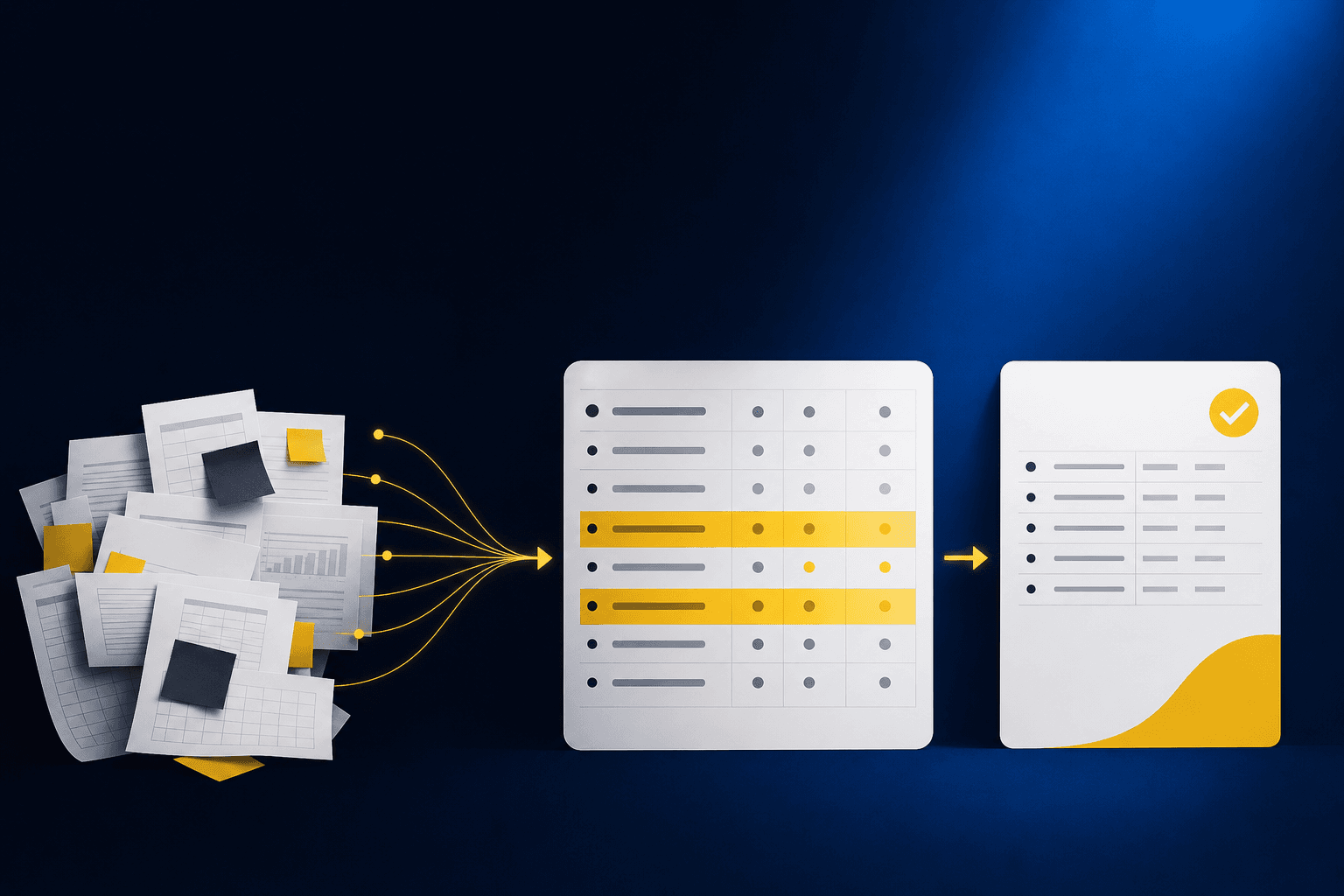
A lean accounting team can modernize AP, payroll, expenses, billing, and its close checklist, then still begin recurring preparation in Excel. In one anonymized Sage Intacct evaluation, monthly and entity-level folders held workpapers that had to be rolled forward, checked, and explained every period. The same account could appear across several entities, each with its own dimensional context. When a preparer was unavailable, a manager inherited the work.
The pressure does not come from one difficult reconciliation. It comes from rebuilding the preparation layer month after month while review deadlines remain fixed. Source files arrive in different formats. Prior treatments live across workpapers and reviewer notes. Accountants have to establish completeness before they can investigate what changed.
Accounting team burnout during the close takes shape in that gap. The GL holds the final entry, but it does not combine the processor export with the bank deposit, preserve the fund or entity coding, surface the timing difference, and prepare the support a reviewer expects. When experienced staff have to do all of that by hand, adding another checklist does not create capacity. It documents the workload.
The close starts in the source files
By the time a journal entry reaches Sage Intacct or QuickBooks Online, much of the accounting work has already happened. Someone has collected the statements, identified what each file represents, matched activity across systems, applied account mappings, checked totals, and prepared a reconciliation or support schedule. The ledger records the approved result. It does not prepare it.
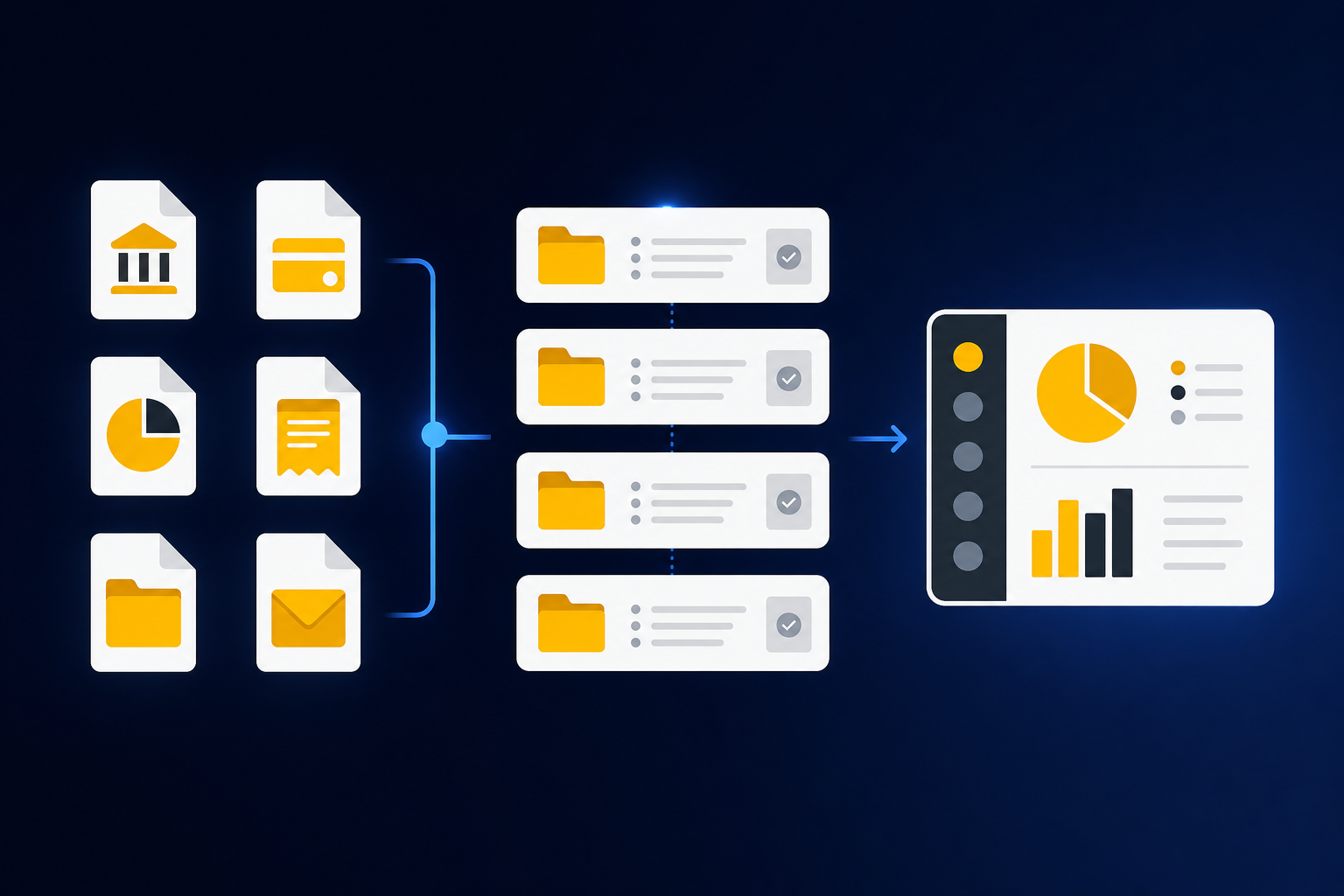
That distinction matters because source-file inconsistency is not a minor intake problem. A bank feed may show a net deposit while the processor report contains the gross activity, fees, refunds, and timing detail. A donor platform export may carry the fund and campaign dimensions the bank cannot supply. A custodian statement may combine trades, income, and fees in a layout that changed from the prior period. Extraction alone does not resolve any of those accounting questions.
When preparation remains manual, the same people who should be investigating changes spend their time organizing files and rebuilding support. Review begins late because the work was not ready earlier. Managers then have to inspect routine coding alongside genuine exceptions, which uses review capacity on items that already follow an established pattern.
Reducing that load requires a workflow that can read the recurring source materials, apply the team’s existing process, and produce something the reviewer already knows how to inspect. If that source-to-workpaper handoff is where your close keeps backing up, See Truewind in action to examine how the preparation reaches the reviewer before anything moves to the GL.
Manual touch is not the same as control
A spreadsheet-driven close can feel controlled because every workbook has an owner and every step has a person attached to it. Yet the underlying evidence is often divided among downloaded statements, email threads, copied formulas, and notes carried forward from the prior month. The team can see the files. It cannot always see the full path from source to treatment and approval without reconstructing it.
More manual review does not fix that structure. A reviewer who receives a clean journal-entry draft still needs to know which source produced each line, what calculation was applied, which accounting treatment was followed, and whether anything fell outside the expected process. If those answers are not visible in the workpaper, the reviewer has to recreate the preparation before signing off.
That is why model confidence is the wrong trust surface for accounting. A percentage does not tell the controller whether the processor fee was separated correctly or whether an entity-specific classification was preserved. Reviewability does. The prepared output has to show the source, calculation, treatment, exceptions, and reviewer action in one place.
Exceptions belong in that design. Missing statements, unexpected balance changes, mixed personal and business activity, and inconsistent classifications should not disappear inside an automated total. They need to reach the accountant with enough source context to support a decision. The goal is not to remove review. It is to stop making reviewers re-perform routine preparation just to find the items that require judgment.
Capacity is a better goal than headcount reduction
The useful question is not how many accountants AI can remove from the close. It is how much experienced accounting attention can move from assembling support to interpreting what the support says. Accountants still own treatment, policy, materiality, exceptions, and approval. Preparation technology should make those responsibilities easier to exercise, not pretend they no longer exist.
Capacity changes the operating conversation. A team with more preparation capacity can direct staff toward discrepancy investigation, audit support, and explaining results to the business. A manager can review work that is already tied to source instead of taking over a preparer’s spreadsheet when the schedule slips. The judgment stays with the team, but the repetitive assembly no longer has to reset every month.
Individual customer experiences show what that shift can feel like without establishing a universal result. A lead-generation company described its experience directly: “It's essentially perfect.” The same customer added, “Categorization is accurate, and we stopped having to double-check everything.” Those statements reflect one customer’s outcome, but the mechanism matters more broadly: proposed coding followed the company’s recurring treatment, and the review burden changed because routine items no longer needed the same repeated inspection.
An accounting firm described the preparation effect in similar terms: “Truewind automates a huge chunk of that busywork.” Its explanation was more specific about where the recovered attention went: “It's not just about making bookkeeping simpler; it's about freeing up teams, and helping them focus on higher-value projects.” A marketplace finance team expressed the personal effect even more plainly: “If I had to describe Truewind in one word: Lifechanging”
The point is not that every workflow produces the same experience. Customer outcomes depend on the work selected, the available historical examples, and the review process already in place. The point is that capacity becomes credible when a defined preparation workflow changes what accountants have to touch, while leaving approval in their hands.
For a closer look at how recurring preparation and accountant review fit together, Book a Truewind demo around a workflow your team already runs and can evaluate against a known result.
Sustainable preparation starts with a known process
The first workflow should not be the broadest or most impressive process in the close. It should be recurring, bounded, supported by known source files, and easy for a reviewer to inspect. A prepaid rollforward with a prior approved schedule is a stronger starting point than an open-ended request to automate month-end. A processor reconciliation with established mappings gives the team something concrete to compare.
Historical examples provide the operating context. Prior workpapers show how balances were rolled forward. Previous entries show which accounts and dimensions were used. Reviewer corrections show where the standard treatment stopped and judgment began. Without that context, automation falls back on a generic template that may not match the team’s close.
A known answer also makes evaluation practical. The team can compare the prepared workpaper to the approved prior process, inspect differences, correct the treatment, and determine whether the explanation is complete enough for review. Corrections then become part of the workflow rather than disappearing into an email or a local spreadsheet.
Expansion should follow evidence from that first process. Once reviewers can trace the source, understand the calculation, and see how exceptions are handled, the team can apply the same controlled approach to another recurring account. Adoption becomes a sequence of reviewed workflows, not a decision to hand the close to an unsupervised agent.
How Truewind prepares the work without taking over judgment
Truewind sits between the recurring source materials and the general ledger. It ingests bank activity, credit-card statements, payout reports, processor and donor-platform exports, custodian statements, prior workpapers, and the other documented source types connected to the workflow. Those inputs are structured for coding, reconciliation, schedule preparation, and workpaper generation. Sage Intacct or QuickBooks Online remains the system of record.
Preparation follows the accounting team’s established treatment. Truewind applies user-defined rules and historical examples to propose transaction coding, preserve dimensions, prepare split allocations where the rules are explicit, and carry prior reviewer corrections into later periods. It does not create accounting policy. When treatment changes or a novel item appears, the accountant owns the decision.
Multi-source reconciliation addresses the cases where different systems describe the same activity differently. Truewind can align a donor platform, one or more processors, and the bank, or connect a custodian statement with an investment-vehicle statement and an ERP balance. Fees, refunds, and timing differences remain visible in the reconciliation. Unreconciled items are surfaced rather than forced into agreement.
Workpaper generation carries the process through to review. The prior workpaper, current source documents, and ERP balances feed a current-period workpaper with updated schedules, source-linked support, visible exceptions, and any required journal-entry draft. Reviewers can confirm the prepared work, adjust it, or return an item for further preparation. Their decisions remain attached to the workflow and can inform the next period.
Nothing posts on its own. After the accountant signs off, Truewind can push structured output to Sage Intacct or QuickBooks Online with coding, dimensions, and source references preserved. Native ERP coverage is limited to those two systems, and the product is not intended to replace either one.
The fit also depends on the team. Truewind is built for recurring accounting work with established inputs, prior examples, and a reviewer who owns the result. It is not designed for a solo operator without a formal close, a buyer seeking autonomous posting, or a finance team looking to replace its GL. Those are different problems.
If you want to test whether a bounded reconciliation or rollforward can reach review in the format your controller expects, Get a Truewind demo using the source files and prior workpaper that already define the process.
Start with the work that keeps repeating
Burnout does not ease because the close checklist gets longer or because the team works through the same preparation faster by hand. The operating change has to happen before review, where source files are combined, mappings are applied, totals are checked, exceptions are separated, and workpapers are assembled.
Start with one process that already has a known answer. Give the workflow the prior workpaper, the current source files, and the rules the reviewer expects it to follow. Then inspect the output the same way you would inspect a staff-prepared workpaper: trace the source, re-perform the important calculation, review the exceptions, and confirm the treatment.
A successful first workflow does not prove that every part of the close should be automated. It proves something more useful: recurring preparation can be made repeatable without moving judgment away from the accountant. From there, the team can expand account by account while keeping Sage Intacct or QuickBooks Online as the source of truth and reviewer sign-off as the final control.
Frequently Asked Questions
How do I manage source file inconsistencies during the close?
To manage source file inconsistencies, start by standardizing the intake process. Ensure that all source documents, such as bank statements and processor reports, are organized before you begin the reconciliation. Use a structured workflow to keep track of each source's context, which helps in identifying discrepancies. Lastly, maintain clear communication with your team about any changes in document formats or layouts to avoid confusion during the close.
What if my team is overwhelmed during the month-end close?
If your team feels overwhelmed, consider streamlining your processes. Begin by identifying repetitive tasks that can be automated or simplified. Focus on one recurring workflow at a time, ensuring it is bounded and supported by known inputs. This approach can help reduce the workload and allow your team to concentrate on more complex tasks that require their expertise.
Can I improve the review process for workpapers?
To improve the review process for workpapers, ensure that each workpaper is traceable back to its source documents. This means including clear links to the original files and maintaining a consistent format for all workpapers. Encourage your team to document any reviewer corrections and confirmations directly in the workflow, which will help maintain clarity and consistency in future periods.
When should I consider automating my accounting processes?
Consider automating your accounting processes when you notice repetitive tasks consuming significant time and resources. Start with processes that have a known answer and are performed regularly, such as reconciliations or workpaper rollforwards. By automating these tasks, you can free up your team's time to focus on higher-value activities, such as analyzing results and addressing discrepancies.
Turn this into a close-ready workpaper
Start with sample files or upload your own statements to see how Truewind prepares review-ready workpapers and journal entries.